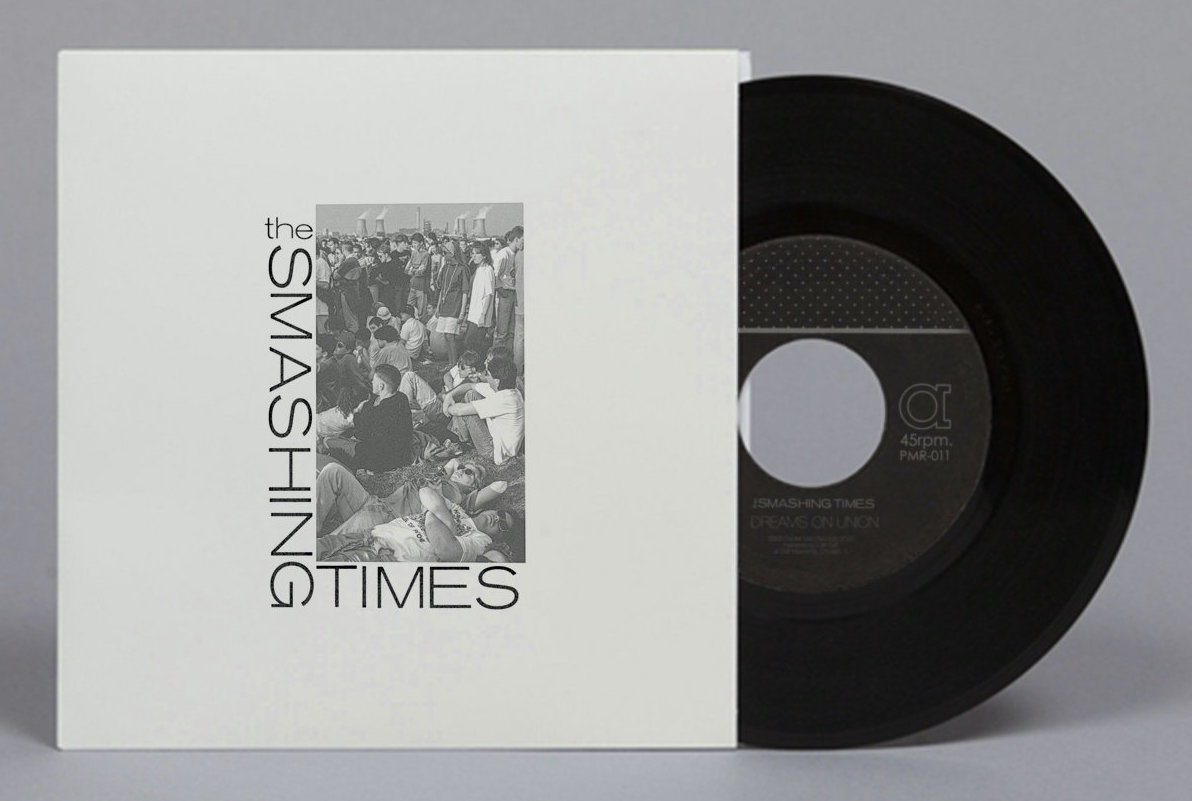
Thanks once again to Janglepop Hub for turning me on to another great band! This time around, it’s The Smashing Times. What really grabbed me about this band – even before I heard their music – was the fact that they were releasing their songs as singles on 45 RPM seven-inch vinyl. Given the price point, it’s the kind of move that takes more than a bit of chutzpah, but when I gave the music a listen, I ponied up and ordered the record, whose echoing, twangy guitars and plaintive vocals made me nostalgic for the days of my youth when the seven-inch single was the coin of the realm for indie bands. What really piqued my interest, though, was the fact that I couldn’t find any trace of the band on social media beyond their Instagram page, so I dropped them a line to find out more…
Who’s in The Smashing Times? How did you get together? What’s your working relationship like?
Myself – Jaz – Ole and Zelda/Anais. Ole and I knew each other from a now defunct punk house in Bellingham, Washington, that was called D. Street and I think may have even been on a street with a similar name to that. Anais and I go way back and similarly met at various occasions in odd places in those shabby early twenties bohemian party scene days. It’s interesting how being young and poor sort of deposits you in buildings that have gone without updates. It’s as if bohemia really does exist in some static dimension.
We sort of conceptualize what we want to do. When Ole and I first met again here in Baltimore we were sitting at Asian Taste talking about the Yardbirds and Mod Revival stuff, Squire, Purple Hearts, The Jam etc… For us the Television Personalities are really the perfect intersection between the punk DIY, irreverence, and the sick riffs of Petula Clark’s session musicians. Then Ole turned me on to The Times single “Red with Purple Flashes.” Holy moly, that single is everything. Our name is sort of a portmanteau of The Times and the single “Smashing Time,” also that film.
When we started, we wanted to be a mod revival band, but Anais had never drummed before and Ole hadn’t played bass in nine years or something. So, I wrote tunes that were carried by the vocals and guitar. We were drawing heavy from Cleaners from Venus, The Times, and TVPs on the first EP.
One thing I love about The Smashing Times is that I feel like you’re really going all-in on a kind of DIY nostalgia: seven-inch records, cassette releases, general avoidance of social media. Is that all part of a single conscious decision with respect to how the band presents itself, or is it just organic to who you are?
We are lucky to have inherited this concept from Crass. I’m so sick of perfect things and cleanliness. I want to make something with no motivation other than to make it. Like an Enso circle, the brush stroke is the art, the process is the motivation.
Ole is the largest contributor to our tactile and visual aesthetic, he is like our Gee Vaucher. Part of it is tradition, part of it is convenience and habit. I think on my last count I have been in 15 or 16 bands. And it’s like, here we go again, gotta get the tape out and then a single and try to get somebody to finance an LP. The price point on a single is about the same as a cassette but you can get a smaller batch of cassettes made and don’t have to sit on them for as long. Summer Inside happened because we were couped up for so long and couldn’t play shows so we were just like, lets make some tunes and keep putting out mixtapes.
It feels really good to me to have so much control over it. Ole and I started playing music during the Napster days, but people still bought CDs and LPs. It’s been awesome to have access to so much music but at the same time it has become really devalued. Having a tactile thing is like an offering to people who listen to the music. It’s like, hey you found us, good job, here is a thing most people can’t appreciate, but you listened, so here is a delightful bauble which, for your perseverance, you deserve to enjoy.
We have another single in the bag but we are learning that the plants are still so backlogged with the success of Mcartney III that they don’t want to do singles anymore. They don’t really make money for the plant, labels, or for the bands. So yea, we do it so that little you, the listener, can enjoy the experience. Here is the single, get ready for the LP… “Big A, Little A, bouncing be. The system might have got you but it won’t get me.”
I mean, even the sleeve for the 45 I bought (“Dreams on Union”) is, I think, a hand-folded, photocopied sheet of letter-sized paper, just like the indie records I used to buy from bands when I was in college. I’m picturing the band hunched over a dinner table, folding the sleeves by hand and sliding each record into the package. Is that accurate, or am I romanticizing things?
It literally does happen across the kitchen table. I will try to get a pic for you.
The decision to photocopy it has to do with the early TVPs singles and the O-Level stuff. It’s sort of a shibboleth. Basically Ole sat me down with his collection of old stuff and said “look what Dan Treacy did, let’s do this.”
I know you work with the independent label Painter Man Records. How did that relationship come about? Broadly speaking, what does your deal look like, if you don’t mind me asking? I’m also curious about the choice to release cassettes and seven-inch singles. Was that their idea or yours—or is it more the result of a dialog between the artist and the label?
Technically the cassettes are on Heavy Numbers Choons, Painter Man distributes those. In truth the single is self-released. We like the Painter Man logo so we were fine with it being on there.
Ah, I see. Some but not all of your music is on Spotify and other streaming services. How do you decide what to release on Spotify and what to hold back, as it were?
We do it in batches and the single didn’t make it in the first batch.
You mentioned in our correspondence a while back that you’re based in Seattle. The city is legendary among music lovers for its indie music scene in the 1990s. What’s the scene like today?
We are from various parts of Washington. Inevitably you end up in Seattle. We are mostly from the northern-most part of the state and centered around Bellingham which is near the border with BC. Because of this we had a lock on Vancouver as well as Seattle and could help distros and touring bands facilitate the crossing. I played with Jay Arner in his old group Fine Mist up there and got deported the night we opened for Hercules and Love Affair. DEPORTED. They had us in this holding vestibule and they wouldn’t let my friend Rachel go to the bathroom. Imagine having to pee in the vestibule.
Seattle has become Amazon’s town and is basically unlivable for bohemians. We all moved to Baltimore in 2018 and then Covid happened. Seattle bands that I like are Super Crush and Shine. Baltimore bands that I like are Corduroy and Posmic. It’s cool to be in a new town and meet all these local characters and hear new music.
I’ll have to check them out! In terms of your music, one thing I really love about “Dreams on Union” is your effective use of pauses. They build a tiny amount of tension that propels the music forward like a little sonic slingshot. And, of course, there’s plenty of jangle and echo, which I also love. Can you say a little bit about how you record your songs—how you approach production and arrangements?
That is good to hear. I worried they might be too progressive. It happens differently every song. I write all the parts and have a general sense of arrangement. Anais has had a bigger hand in arrangement on our newer stuff. The arrangement is big part of the value of having band members is. Everyone has suggested things at one time or another that have worked out beautifully to my mind.
I wrote and arranged “Dreams.” Anais really did not want to learn it and hates playing it. That is probably where the tension came from. The drums on it are the first take. She just got up and walked out so we had to make do. I think it turned out well, I love idiomatic art and music. I feel like on the middle 8 bass part you can picture Ole being like “oh shit, what is next?” and that to me recreates the spontaneity of fabulous improvisation like the Velvets and Miles Davis but without the burden of all that horrid skill.
We have three Shure SM57s and some kind of Shure drum mic. I’ve learned a lot about how to use them and EQ and so on and so forth. I think you can really hear the progress. It’s slow going, I’m more of a tactile and intuitive person so rather than looking up a youtube video on how to do things I just dig in and learn from the mistakes as they happen. Those recordings are gloriously imperfect but that was where we were at the time and honestly it’s what we are going for.
I feel like that Sad Eyed Beatniks person really gets the indeterminacy thing. I listened to a bit of one of their tapes on Bandcamp, I heard the drums drop the beat, I’m having that. I bought all the tapes. Similarly, but not nearly as cool, check out the guitar solo on “Heart of Stone” by the Rolling Stones, Keith Richards frets out. He fucks up the solo and they keep it and it sells millions of copies. Because the imperfection is attractive.
What about writing? What moves you? What, to your ears, makes a good song?
I think we are all sort of coming to this realization that modern life is bunk. Anais and I are in our early thirties. They say you realize there is no future. Even if you can pay your bills, what is the point? That being said, vague lyrics about your condition are bound to strike a chord with someone, I think good poetry needs to be vague enough for a sort of empathic bond to be formed between the speaker and listener. Our shared suffering is where we form solidarity and understanding. The aughts were all about shrugging and racing to be the first one to say “I am detached.” But then we got around to watching Manufacturing Consent, it matters, art matters and solidarity matters, and it seems like awareness is beginning to grow. Pay it forward, you know?
The real challenge is marrying modern day problems with a wide array of 60s-90s British pop culture references and giving you that warm feeling in bottom of your belly like the first time you heard Ride or The Creation. I’ll never be able to do that like Mick Trouble does. Have you heard that LP? Amazing.
I’ll have to look for that one! I imagine playing live is a big part of how you’ve developed a fan base. Any chance you’ll tour anytime in the near future?
We are planning some gigs on the West Coast this June hopefully with Semitrucks from LA. Paul from Expert Alterations/Corduroy will be filling in on drums. We are pretty excited to hit the road again after the last couple years.
Any other plans?
We are wrapping up an EP and will be shopping an LP this summer! Our mastering dude says there are 18 month wait times on vinyl so look for the EP in 2023.
I am working with Blake from Corduroy on a second Midden Heap EP and Anais and I recorded an album in summer of 2021 under the name Roshan Gosh.
Sounds like you’re pretty busy these days! Thanks for taking the time to chat with me!
Thanks for having me. It means a lot that there are people interested in representing underground music.
4 responses to “The Process Is the Motivation: An Interview with the Jasmine Monk (aka “Jaz”) of The Smashing Times”
I love reading your interviews Marc – finding out about other artists approaches to making music and hearing new sounds. Laini xx
Thanks, Laini! I hope I get a chance to interview you soon… I’m looking forward to hearing your new music!
A great interview, as always Marc, and your way of articulating things you hear in a song such as this – “your effective use of pauses…build a tiny amount of tension that propels the music forward like a little sonic slingshot” never cease to amaze me! I love their two songs you shared too!
Thank you! I liked that description, too… It took me a while to figure out how to describe what I was hearing!