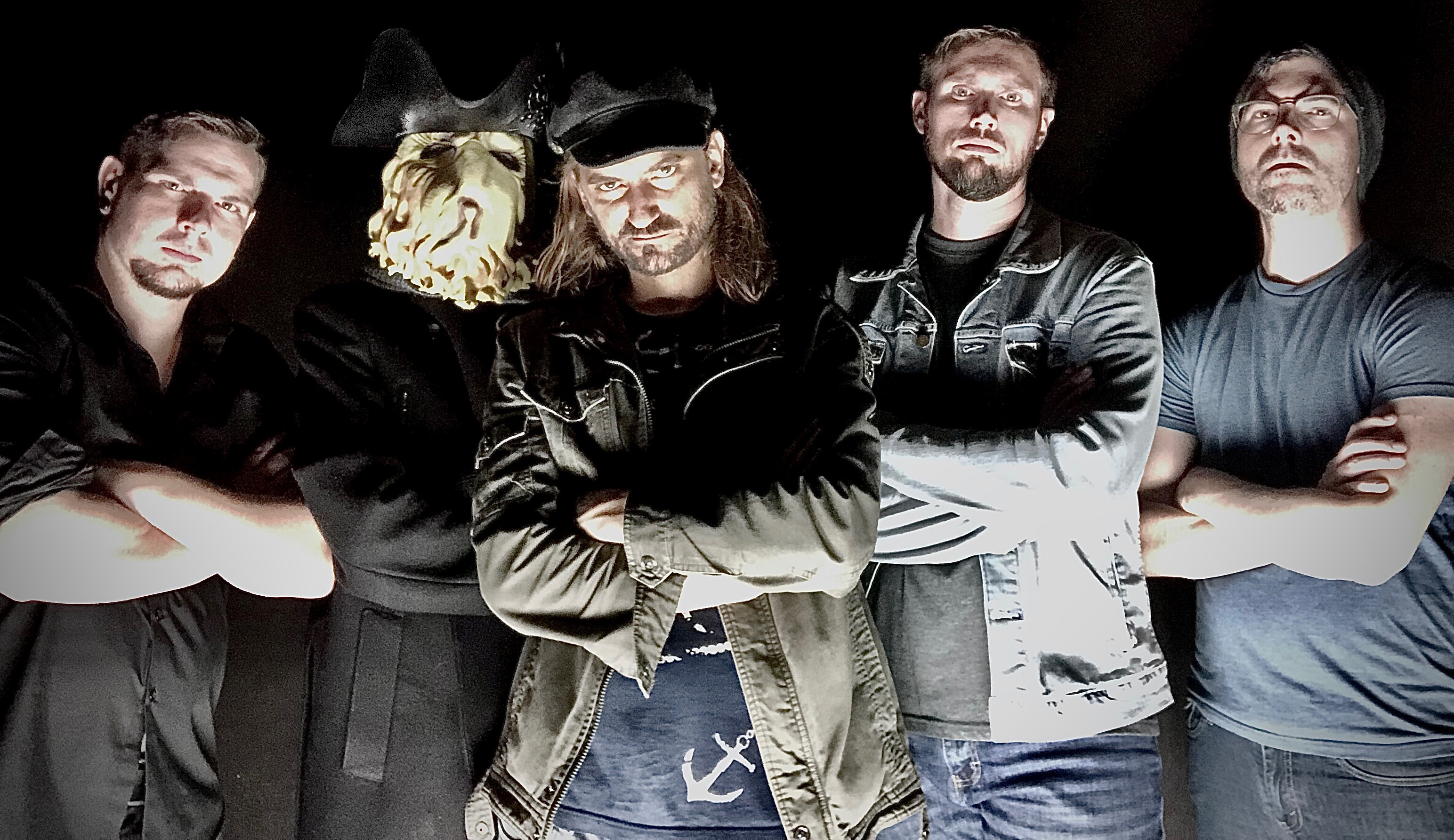
Once again, I have Jeff Archuleta’s Eclectic Music Lover blog to thank for alerting me to the subject of this week’s interview, Russell T. Shipp of the “nautical rock’n’roll band” Rusty Shipp! Jeff offered some incredibly insightful commentary on the music of Rusty Shipp back in December, praising (among other things) the act’s “dark, immersive sound, unforgettable melodies, electrifying guitar work, and Shipp’s vibrant tenor vocals.” When I checked it out, the music was as Jeff had promised, and the album art was equally impressive, so I reached out to set up an interview…
So your name is Russell T. Shipp. Did that make calling the act “Rusty Shipp” a no-brainer? Or did you try other names before settling on Rusty Shipp?
When I moved to Nashville (from D.C.) I started going by “Rusty Shipp” as a funny way to make it easier for people I met to remember me. When we were first starting this band we were throwing around different band names, but different friends of mine and even the band members themselves said, “How can you go with any other name than Rusty Shipp? It’s already the perfect band name.” So it just stuck.
While we’re on the subject, and just out of curiosity, you changed Russ T. to Rusty, but you kept to both P’s in “Shipp.” Was that a conscious decision?
Yes. We were originally thinking of calling it Rusty Ship, and it just being a funny thing that someone in the band was actually called Rusty Shipp, but then I thought that adding the extra “P” made the band name instantly more attractive and thought-provoking. Instantly you make people think about the band name: “Why the extra ‘P’? Could it possibly be someone’s name? That would be hilarious! Or maybe it’s just an artistic way of spelling “ship” for some deep reason…. I want look into this band.” At least that was the hope, and it’s actually turned out to be that way, which is really cool, and constantly validating our decision to go with the extra “p.”
I’m also curious about how your sense of identity might be tied up in the band. Is it ever difficult to separate Russ T. Shipp from Rusty Shipp?
It is sometimes. Partially because it’s my name, and my friends in Nashville do mostly call me “Rusty Shipp,” so anytime I hear the band name I’m hearing the same name that I’m known by around town. But also, because as the founder, frontman, voice, and main songwriter of the band, it really is hard to separate me from the music, because it’s such a huge part of my life. My whole life revolves around these concept albums and songs, with their lyrics, music, and message, and the mission of the band. It’s certainly not a hobby; it’s a life mission I’m planning on pursuing till the day I die, and so in many ways my life is literally Rusty Shipp.
Can you talk a little bit about the cover of your album Dark Side of the Ocean? Who did the art, and what does it depict? How does that relate to the themes of the album?
The artwork of “Dark Side” and the two previous albums “Liquid Exorcist” and “Mortal Ghost” were all done by the one-and-only Hein Zaymaan – a local Nashville artist. He’s actually my favorite artist. When a friend of mine first showed me his artwork I instantly was captivated by it and reached out to him. It’s been a great working relationship so far, and he is as much of a dreamer and world-builder as I am.
I’m thrilled you like the artwork so much; it’s my favorite of the three album covers he’s done for us. It really captures the story-based concept of our album, which is about a soul that drowned and sunk to the bottom of the ocean where it met other sunken souls and was intercepted by a sea angel and taken to an ancient, underwater angelic kingdom ruled by the King of the Deep, aka, the Archangel of the Ocean.
As Jeff mentioned in his review, you describe Rusty Shipp as a “nautical rock’n’roll band.” How do nautical themes lend themselves to discussion of larger issues relevant to a more landlocked life?
GREAT question. I love artistic, imagery-rich, story-based concept albums for all the intrigue they have that pulls in the listener to the album and keeps them there. But to some degree the artistic images and themes of nautical, ocean imagery are surface level for something fun and entertaining to the audience. But I’m very passionate and mission-minded with using our songs to somehow make the world a better place through empowering, thought-provoking lyrics. So pretty much every song we have, while rich in oceanic imagery or relating to a concept story, will have some spiritual or philosophical message buried beneath all the talk of sea angels and the kraken, etc. Our song “Man Myth Legend” is a perfect example. While talking on the surface level about the storyline of sea angels debating about whether to go to the other side of the ocean where men live, the deeper subject matter is addressing the pandemic-era issues the world faced of people suddenly becoming entrenched deeper into the comfort zones of their political and demographic camps. It confronts the fears holding people back from going to the opposing camp to learn and hear from them.

What attracts you to nautical themes?
It was a slow process, but when you have a band called Rusty Shipp, it was only a matter of time before we thought it would be good to embrace the nautical vibe that “Rusty Shipp” naturally brings to mind. Year after year we went more “all in” with the themes, imagery, and lyrics, tweaking them to be more and more overtly nautical. That, and I am a big surf rock fan, and I thought the combination of grunge and surf was a unique combination that would make us stand out from the pack of rock bands.
Your song “What’s Kraken?” really caught my attention. It manages to maintain a somewhat dry sense of humor via wordplay while still addressing the serious issue of political division. Likewise, the invocation of the Kraken calls to mind some of the—I want to say melodrama—of the political rhetoric we’ve heard over the past five years or so. Can you talk about that song a bit?
Our fans have been begging us to do a song about the Kraken for years, and we wanted to finally have a more light-hearted, funny song to change up things from our typically serious, intense songs. But as the song developed, in true Rusty Shipp fashion, the lyrics started getting deeper and more intense. What started off as a fun song about the mythological sea beast, it became a song that examines reports through history of The Kraken, and compares them to modern day news and science reports that are likewise drawing skepticism and debate over the validity of the claims. The song digs into the pandemic-era experience we all went through of being confused about which authorities were telling the truth about what, who and what we can really trust.
What do you see as the relationship between music – or art more generally – and politics?
I think politics are just the order for how humans live within a certain society, and thus humans will express themselves musically about how they think their society should function. Politics has become a dirty, triggering word, and also has come to have a certain specific label and baggage attached to it, but I think actually “politics” is a lot more far-reaching and general of a term. Sure, people have disagreements about how society should function, but as with any form of human expression, if someone is expressing any opinion about life there is going to be someone that will disagree. Politics is inescapable in human life and therefore it’s an essential part of human expression. People can make it as triggering or natural as they choose.
You’ve covered a couple of well-known songs. For example, I know you’ve covered the Beatles’ “Helter Skelter” and Pink Floyd’s “Us and Them.” What was behind the decision to cover those songs in particular?
I’m a HUGE Beatles fan and I’m in a grunge band. When I first heard “Helter Skelter” I thought it had all this pent-up raw energy that couldn’t be truly communicated with the recording technology of the time, and I brainstormed what an all-out, raw, grungy version would sound like if the Beatles had done it today. With “Us and Them,” I wanted to pick a song from “The Dark Side of the Moon” because our album was called “Dark Side of the Ocean” and I wanted to have an obvious reference to the Pink Floyd album to overtly tie it together, as well as make sure people didn’t think we were so naïve that we didn’t know there was a legendary album with a similar title. “Us and Them” was less famous than “Time” and “Money” and so it didn’t seem like a cliché cover song choice. And it actually worked out perfectly because the lyrics actually tie-in seamlessly with the themes of the album addressing the “us and them” factions the world was really falling into during the Pandemic.
And how do you approach covering a song? I’m particularly curious about walking the line between staying true to the spirit of the song but also putting your own stamp on it.
I definitely want to re-imagine a legendary song to get to the core of what made it legendary in the first place, and then take that spirit, energy, and vision and either bring out more potential I feel is still left in it, or else take it into another direction that seems a natural progression for the song, to do an innovative and artistic re-working that will only garner greater appreciation for the genius of the original. I’m confident that we did that very well with the three covers we’ve done: “Helter Skelter,” “Show Me How To Live,” and “Us and Them.”
Like most bands, Rusty Shipp has undergone some personnel changes over the years. How have those changes influenced the sound of the band or contributed to the evolution of that sound?
It’s really interesting how the different band members give each album a unique sound. At the times in our band where it’s been mostly me doing guitar solos on the album, they tend to be simpler, riff-based solos, whereas with the different lead guitar players we’ve had they can be more bluesy or metal. I’d say the lead guitar work is probably the most notable. But also Jake Adams on Mortal Ghost had a really genius-level melodic writing for his bass parts in a way I’d never really heard and wouldn’t have though of. If I do the lead guitar or bass on a song, it’s going to be very much relating to the riffs in the song.
What’s on the horizon for Rusty Shipp?
I fully expect smooth sailing, recruiting new Shippmates to come aboard and sail with us into the sunset together to find our destinies, followed by some stormy gales, followed by some rescuing of men thrown overboard, followed by some more smooth sailing, and finally reaching our port destination in a distant kingdom we can help build into a place we can call our home. And also lots of artistic, innovative, creative, philosophically-provocative, life-transforming, empowering albums that get better and more ambitious, one by one.
Thanks for taking the time to answer my questions!
10 responses to “Man Myth Legend: An Interview with Russell T. Shipp of Rusty Shipp”
A fantastic, insightful review Marc. Russ is one of the more intelligent, gracious and talented artists I’ve reviewed, which I think is pretty evident by his thoughtful responses.
Yet again I thank you for the mention, and for reaching out to another band I’ve written about. I hope you know how much I appreciate all the support you continue to give me and my blog. Love you man!
The feeling’s mutual!
😍 And I meant ‘interview’, not review lol.
No worries… It’s Monday!
I remember Jeff’s review of the album. Rusty Shipp are an intriguing band!
I agree! Great music, too!
I don’t know what it is, but I fancy “nautical” themed music as well. Your conversation with Rusty Shipp sparks me to ponder what it is that makes that a “thing,” like where did that begin and why is it so intriguing? Rhetorical question of course, but it has me speculating. Cool band.
Good question! I’m guessing it all started when people would look at the ocean and all it promised… both beyond the horizon and beneath its undulating surface!
oh yeah no doubt that the ocean is awe inspiring generally, I guess I was more in a headspace of cycling through all the “pirate” themed projects or songs that reference pirate jargon hahaha
Arrghh, yeah… That too!