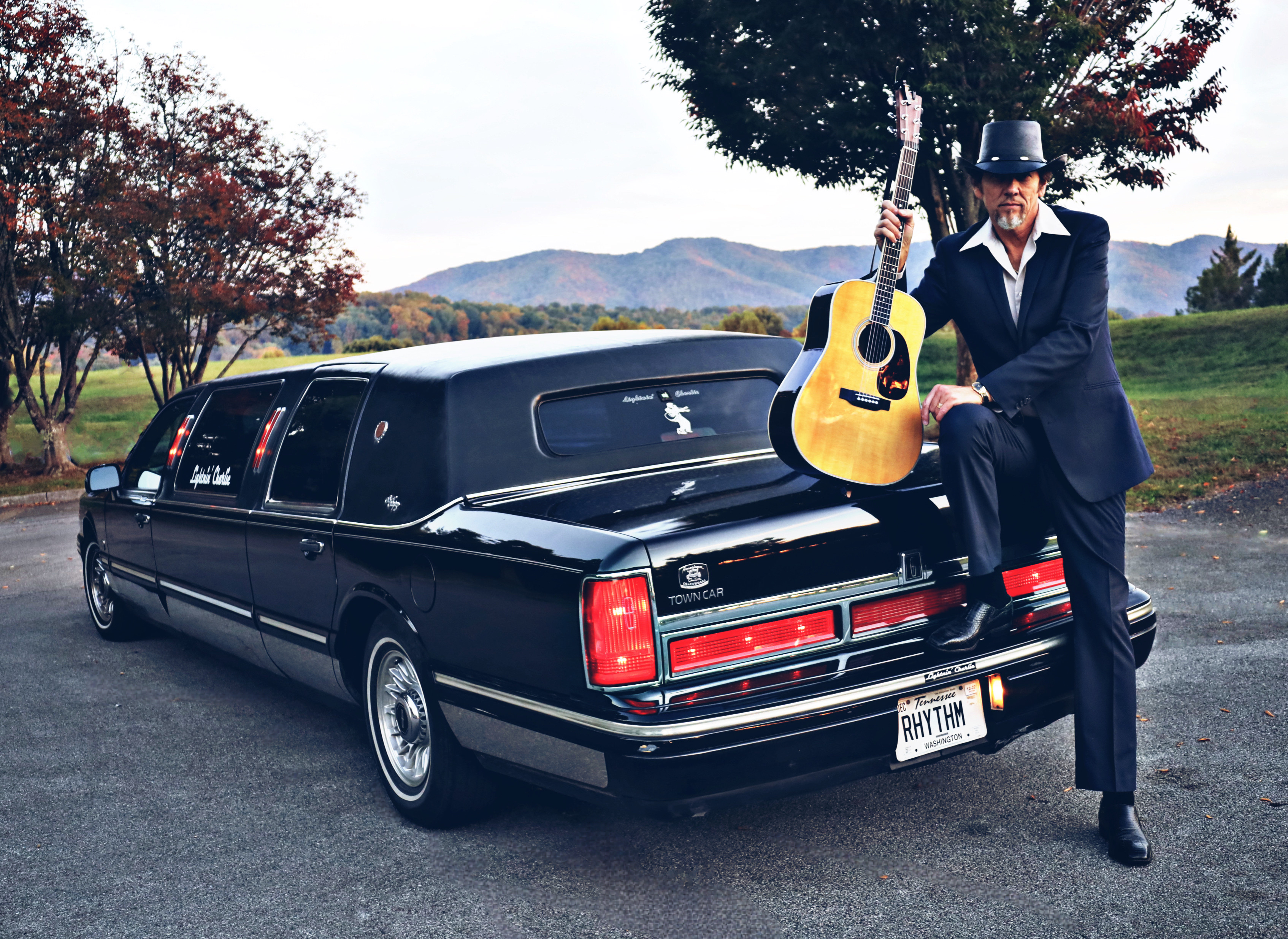
Lightnin’ Charlie has been a full-time musician, author, bandleader, and recording artist for nearly forty years. Offering a range of music from blues to soul, folk to country, and gospel to rock ‘n’ roll, his music is in constant rotation on radio stations worldwide. His autobiography, Off The Record – The Trials and Tribulations of a Travelin’ Troubadour is now in its 2nd Edition. He’s also been performing at senior communities for about 15 years. Though he plays in other venues as well, he describes his performances at nursing homes, memory care wards, senior centers, Alzheimer’s Associations, assisted and independent living centers, as a special gift that allows him to use his talents “to joyfully touch, and uplift, and engage so many people in need.”
Forty years of music! You must have some stories to tell. Obviously, I guess, since you wrote a book! Can we start with your earliest gigs? When did you start playing, and what was it like?
The first time I ever played guitar and sang in front of people was in church. The first paying gig I ever got, playing and singing in front of people, was at a strip club. #irony
And how did you get the name Lightnin’ Charlie?
Although my first name is Charles, I was never called “Charles” or “Charlie” or “Chuck”. My Dad gave me the nickname “Chip,” as in “a chip off the old block,” and that’s what I was known by for my whole life until my early twenties.
By then I was playing in a rough and tumble, hard-core, racially and culturally integrated 4-piece Chicago Blues band called the Southside Sheiks. The bandleader was a harmonica player named Brian DuBois, who was a nutjob from NYC (redundant?). Brian believed that in order to play the blues well, and with integrity and honesty, one had to have a history of violent felonies, and be a wayward, penniless, alcoholic, drug-addicted derelict (very redundant!).
So having a frontman named “Chip” was about the worst thing imaginable to him, and he raved about it to me often, saying it was an embarrassment having a hard-core blues band with a frontman named “Chip” (saying it was like having a singer named “Biff,” or “Buffy,” or “Tab”– a nightmare for him!). Then things got worse for Brian when we got a new bassist whose given name was Calvin, but who didn’t go by Calvin. No…he too had been known as “Chip” for his whole life. So now a full 50% of this hard-core blues band was named Chip!!! Although we found this to be hilarious, it did not sit well with Brian at all.
One night while loading out of a club after a show (in which I had been playing guitar behind my head, behind my back, upside-down, and with my teeth), a friend of mine came up and said “Chip…man you were like LIGHTNIN’ tonight!”, referring to the intensity of the performance. Well Brian’s head shot around when he heard that and said, “That’s it! From now on, you’re Lightnin’ Charlie!” Brian knew I was a huge fan of Lightnin’ Hopkins, the iconic Texas bluesman, and the name just stuck. Or in this case, struck!
P.S. Brian soon after changed Chip the bassist’s name to “Calvin Hakim,” thinking it made him sound more like a Black Panther!
The only problem with my name has been that, throughout my forty year career, it is misspelled 95% of the time. You misspelled it in your email to Mike! But that’s okay…it only bothers me when I’m advertised in print, on marquees, or online as “Lightening” (like I’m bleaching myself!), “Lighting” or “Lightin” (like I’m an electrician!), or with all kinds of perversions with the apostrophe, like “Lit’nin,” “Lit’n,” “Light’n,” or one misspelling that I can’t even speak or type for fear of my whole life being canceled (but at least I took that one as a compliment!). You’ll have to use your imagination!
How has music changed in the decades you’ve been playing, and what’s stayed the same?
For me the people in the audiences are basically the same…although it’s a lot harder to fill rooms now than it was in the 90s, for example. The change that has impacted touring musicians and recording artists the most i think is album sales, which are now a fraction of what they were pre-internet.
Your forthcoming album Three Chords and the Truth started when you had a chance encounter with a storied microphone. Can you talk a little bit about that?
*** We’ve changed the name of our
upcoming album to Life ***
And here’s the story of my Life…
Four score and ninety weeks ago, in July of 2019. Beth and I, along with our three kids, took off on a good, old-fashioned family vacation, Griswald-style, driving to Hamilton, Ontario, Canada to visit Beth’s big brother Joe and his family for a week.
One day, just for kicks, Joe (who happens to be the most talented musician I’ve ever known), took us to a recording studio he had done some session work in. He said his friend there would let us record a couple songs. I thought we would have fun recording a couple early Elvis songs on acoustic guitar and doghouse bass. But I had no way of knowing that this unmarked studio would be loaded to the rafters with some of the most iconic and historic recording equipment in the entire world, and that on that day, I would begin recording this angel of an album called “Life”!
At this point, allow me to introduce you to a guy named Bill Putnam. Maybe you don’t know his name, but you definitely know his work…
Bill Putnam
Bill Putnam is known as “The Father of Modern Recording.” He built the world’s first recording console. He invented reverb and multiband EQ. Putnam was an undeniable genius and a giant in the recording industry, pioneering and producing the best-sounding records in history for scores of the greatest artists in the world.
Putnam’s first studio, Universal, was located in Chicago, where he recorded everyone from Duke Ellington and Muddy Waters to Patti Page, The Platters, and Hank Williams. Then, thanks to the coaxing (and bankroll) of his friends and clients Bing Crosby and Frank Sinatra, he moved west in 1957 and opened United Western Studios on Sunset Blvd. in Hollywood. This is where Sinatra, Dean Martin, Ray Charles, Ella Fitzgerald, Sam Cooke, Elvis Presley, Richie Valens, the Mamas and the Papas, the Righteous Brothers, the Grass Roots, Simon and Garfunkel, the Beach Boys, Nat King Cole, and scores of others recorded million seller after million seller, producing some of the biggest hit records of the pop era, and some of my favorite records ever. If you’ve seen the award-winning documentary The Wrecking Crew, that’s United Western Recorders!
So as Joe, Beth, and I went inside the warehouse, passing people on horseback, and women dressed as flappers from a movie being filmed there (I’m not kidding!), Joe introduced us to the engineer and studio manager Trevor who was seated at the console. We thanked him for letting us come in and cut some stuff, as he was doing this as a personal favor to Joe, and we were there, just to do the mess-around, and have some fun. The room was huge and unadorned, with concrete floors and vintage equipment stacked up everywhere you looked. I unpacked my guitar and was pointed to a spot in front of a very beautiful 1950s RCA 44 microphone. As I was strapping on my guitar and ogling the beautiful mic I was about to sing into, I mentioned to Trevor, “Man, I’ve got a photo of Sam Cooke singing into an RCA 44 that looks just like this one!” “Well”, Trevor said, smiling from his seat at the console, “That’s because this is THAT MIC!” When Trevor saw the dumbfounded look on my face, he elaborated, “All this equipment is from Studio A of Bill Putnam’s United Western Recorders in Hollywood. This is literally the holy grail of recording equipment. Sam Cooke sang into that mic. So did Ray Charles and Elvis and Sinatra. This board and all this gear is from United Western.” Trevor, not noticing my jaw hitting the concrete floor continued, “Elvis did his ’68 Comeback Special in that studio and on this gear.” As I stood there, frozen in shock, Trevor pointed casually to a Wurlitzer piano next to me, “You see that Wurly? Ray Charles played that in the pawn shop scene in The Blues Brothers movie.”
Well…knowing me to be a bit of a weirdo as most of you likely do, and realizing the deep love I have for this music, what comes next shouldn’t surprise you…but that’s when I started to cry! Although there may not have been tears streaming out from the fronts of my eyes, they were piled up high behind them, and I stood there paralyzed. Speechless. You’ve got to understand that the sounds, songs and singers I had idolized since I was a little kid had been sung into that mic and shaped by this very gear that I was about to sing into! Me!!! Sing into a mic that Elvis and Sam Cooke and Ray Charles had sung into and cut records on??? I joked afterwards to Beth and Joe that I would’ve licked the mic if I wasn’t sure Trevor would’ve thrown us all out!
I managed to compose myself enough to record five songs that day, on acoustic guitar and doghouse bass, and in the months that followed, we recorded several more songs at my home studio in Johnson City, TN, and still others at Bigtone Studios in Bristol, TN. But the rhythm section on everything has been cut in Canada on that United Western gear, and everything I’m recording in Tennessee is being processed and mixed up there, giving me THAT SOUND! The sound that literally changed the world.
We’ve been riding this roller coaster, working non-stop crafting this album project across two countries, with the goal of releasing this album in summer of 2020. To say it’s the best I’ve ever sounded would be an understatement. For the first time in my life, my voice and my songs sound like the records I’ve memorized and the singers I’ve idolized since I was wearing pajamas with feet in them! Don’t misunderstand me…that gear didn’t make me sing nearly as great as Elvis or Nat King Cole, but for the first time in my life, my songs really SOUND like their songs. And that mojo is just not attainable in digital recording or on lesser analog equipment. There’s a reason Ray Charles and Sinatra and others wanted to buy Bill Putnam’s equipment after recording on it.
My First Love
Having been steeped in 50s and 60s stuff from the time I was old enough to stand and reach the Magnavox console stereo, this United Western Sound has been like a family member to me. Much of the soundtrack of my life was recorded there. My Aunt Jeanette (who was a second mother to me) was friends with Elvis and his family and she used to spend many long weekends at Graceland with Elvis prior to him leaving for Army duty and Germany in 1958. And tons of Elvis sides were recorded at United Western. My Mom and Dad loved Sinatra and Dean Martin. My Dad’s favorite songs were Dino’s “You’re Nobody Till Somebody Loves You” (United!), followed by Sinatra’s “One For The Road” (also United!). My uncles that I hung out with constantly as a teenager were into classic country and 50s rock ‘n’ roll like Hank Williams (whom Putnam recorded at Universal in Chicago), Buddy Holly, Little Richard, and The Platters (again United!). My older brother and sister were into the music of the 60s, like The Beatles, CCR, Motown, and the Righteous Brothers (United!). And growing up in the 60s and 70s, I was completely immersed in the great pop music coming out at the time, much of which came from United Western. I was about ten years old when my Dad took me to a dinner theater he managed in Florida to see Sonny and Cher do a road version of their popular TV show. That was my first concert! Oh…Sonny and Cher? You guessed it…United! Other more contemporary artists who recorded at Bill Putnam’s United Western and later Mushroom Studios include Whitney Houston, The Rolling Stones, Elton John, Tom Petty, Bonnie Raitt, Eric Clapton, and countless others, as well as iconic TV themes like “Hawaii Five-O”, “Sanford & Son”, “Beverly Hillbillies”, etc.
Good Music for Good People
Today, I am blessed to be able to integrate lots of these childhood loves into an amalgam or gumbo that my fans know as “Lightnin’ Charlie Music”. It’s always been the music I love, and I can’t remember a time before it. Music was my first love. Today I call it “Good Music for Good People”, and it encompasses all kinds of American Roots Music: 50s Rock ‘n’ Roll, 60s Soul, Classic Country, Gospel and Blues. My repertoire is very broad and eclectic due to growing up surrounded by generations of family that loved and listened to great music all the time, and my fascination with music, religiously memorizing every nuance and syllable of hundreds of great records since learning to walk, led me to be the musician, singer, songwriter, and recording artist I am today. My Mother remembers me doing little “shows” at home, at three years old, singing my favorite song at the time, and my show-stopper…Dean Martin’s “Standing On The Corner (Watching All The Girls Go By)”. My Mom says I could do it to perfection, copying Dino’s every word and nuance, mimicking every slur and tipsy turn. Wanna take a guess where Dean recorded that song? Yep! United Western!
I’m a very lucky guy. One who gets to play the music he loves—and has loved—since childhood. More so, there’s a SOUND that I’ve been chasing since I was a little kid, one which I finally found by accident in an unmarked warehouse in Ontario, Canada!
Life is an “Americana” album, exploring more of a singer-songwriter vein than my past records, and has—as usual for me—a very eclectic mix of music. My fans know that all my records are very eclectic and diverse in their styles, and those of you who enjoy the diverse nature of my previous albums will surely not be disappointed in this one. We have covers from Elvis, the Louvin Brothers, Marty Robbins, Big Joe Turner, the Everly Brothers, Ray Price, and everything from a one-hundred year old Spanish folk song to a coffee song by the Ink Spots! I feel that all the material is really outstanding, and that my originals are among the best things I’ve ever written. It’s difficult for me to be completely objective about my songs, and whether these are truly better than others I’ve written I just don’t know. I suppose that’s for others to decide. But I do know that these songs are very different from previous songs I’ve written, and the way I’m writing has been different and perhaps deeper and more personal than ever before. And I am overwhelmed at how it all sounds!!!

By the Fall of 2019, we had ten killer songs in the can, but there was still an important ingredient missing. All we had recorded so far was covers. But if we were going to release it as an album, we needed some originals on it. Some STRONG originals. So realizing the need for some original tunes, my new best friend Trevor suggested I write a song using our tentative album title. And that’s how I wrote “Three Chords and the Truth”, which we recorded with musicians in Tennessee and Ontario, and it turned out fabulous! It has a real traditional feel, with fiddles and pedal steel (another first for me), with a very personal lyric about pain, redemption, and holding fast to the things that are really important. It came out absolutely beautiful, and I think it’s one of the best things I’ve ever written.
Gold Mine in the Can—and a Foolproof Plan!
The new year 2020 held nothing but promise. We had an original title cut that held its own among all these other champions, and we had completed all the session work with all the musicians and sidemen on everything we had down so far. So we started the year with high hopes (Hey! That’s a great Sinatra song recorded at…yeah, you got it!) My bookings were at an all-time high, and the completion of the record was in sight!
But so goes the well-laid plans of mice and men. In March we hit a little hiccup…a global pandemic that stopped the world as we know it. In one 48-hour period in early March, while answering my phone all day for two days, every gig I had booked for the rest of the year disappeared, one by one. And along with them went the plans to complete the record of my dreams. Well…not altogether gone, just postponed for a little while.
In spite of the pandemic and the quarantine—or maybe because of it—I’ve had a very fruitful season of songwriting, being blessed with a beautiful batch of new original songs, and these songs wouldn’t be here if not for the pandemic.
Our amazing God, the Lord of Love, has already worked all these wild and crazy things together for good, and more abundantly than all that we could think or ask. From Chicago to Hollywood, from Tennessee to Canada, He’s given us this amazing gift, by His grace, to do this dream record.
Well, that’s the real life story about our album Life, and what a good life it has been, but the best is yet to come (there’s another great Sinatra song, cut at United Western!), and I’m so excited about sharing all of it with you.
No animals were harmed
and no microphones licked
during the making of Life.

I’m also curious about your book, Off the Record. What prompted you to write it?
It started as a monthly blog on my website, which i wrote in response to people’s curiosity about what it’s like to be a professional musician. Giving a look behind the curtain to the often seedy—and my case hilarious—side to being a bandleader. After doing the monthly blogs for about three years, i compiled them into book form. It’s now in its 2nd Edition and in over 18,000 bookstores worldwide.
Did the writing process allow you to uncover any previously forgotten memories?
Not really uncovered them, but revisiting them and writing them down in a concise and colorful manner certainly preserves them, for me, my family, and my fans.
How is writing a memoir different from songwriting? Do they feed into each other?
Good question. My answer is a definite yes! Because storytelling is an art form, and songwriting is definitely (or should be) the telling of a story. The craft of meticulously writing about an experience, and making that experience relatable and entertaining to the reader, is exactly the same thing I try to do when writing a song. It’s got to grab the listener and draw them in, making them be a part of the experience, and allowing them to relate to my experience as their own.
You’ve been performing at senior communities for about fifteen years. How did that start?
An activities director from a senior community approached me after a solo acoustic show where I had played lots of 50s and 60s stuff, very eclectic…rock ‘n’ roll, country, pop, etc. and said i would be perfect for her residents. I thought that performing at a nursing home was the epitome of an entertainer having officially and completely “hitting the skids”. I thought it would be a good, charitable thing to do, but something that no working, touring, viable, relevant, popular musician would ever do. But I was wrong. I played that first one, feeling like I would go in there and bless them, but I came out of there being blessed by them.
Why do you find it rewarding?
Because I’m playing the music they grew up with, got married to, and loved. The 50s, 60s, and 70s stuff I play for them is their music. It’s the soundtrack of their lives. And they are some of the most energetic, engaged, joyful, clapping, cheering, dancing, crying, laughing audiences I play to. And it does what music is designed to do, and what I was given my gifts and talents to do, and that is, to drive the darkness away for a moment or two, and put some grins on some chins.
I’m struck by your tagline: “Good music for good people.” In your estimation, what makes people good?
Not throwing bottles at the stage and yelling, “SKYNYRRRRRD!”
What’s on the horizon for you?
Releasing Life this fall, living life every day, and making lots more Good Music for Good People!
Thanks for taking the time to talk to me!
Thank you Marc!
Sure thing!
4 responses to “The craft of meticulously writing about an experience: An Interview with Lightnin’ Charlie”
What a great story!
Nice interview with an intriguing artist. You also gotta love the name Lightnin’ Charlie!
Indeed!
From the church to the strip club, ha! I love that he’s an author too. Reminds me of the person interviewing him