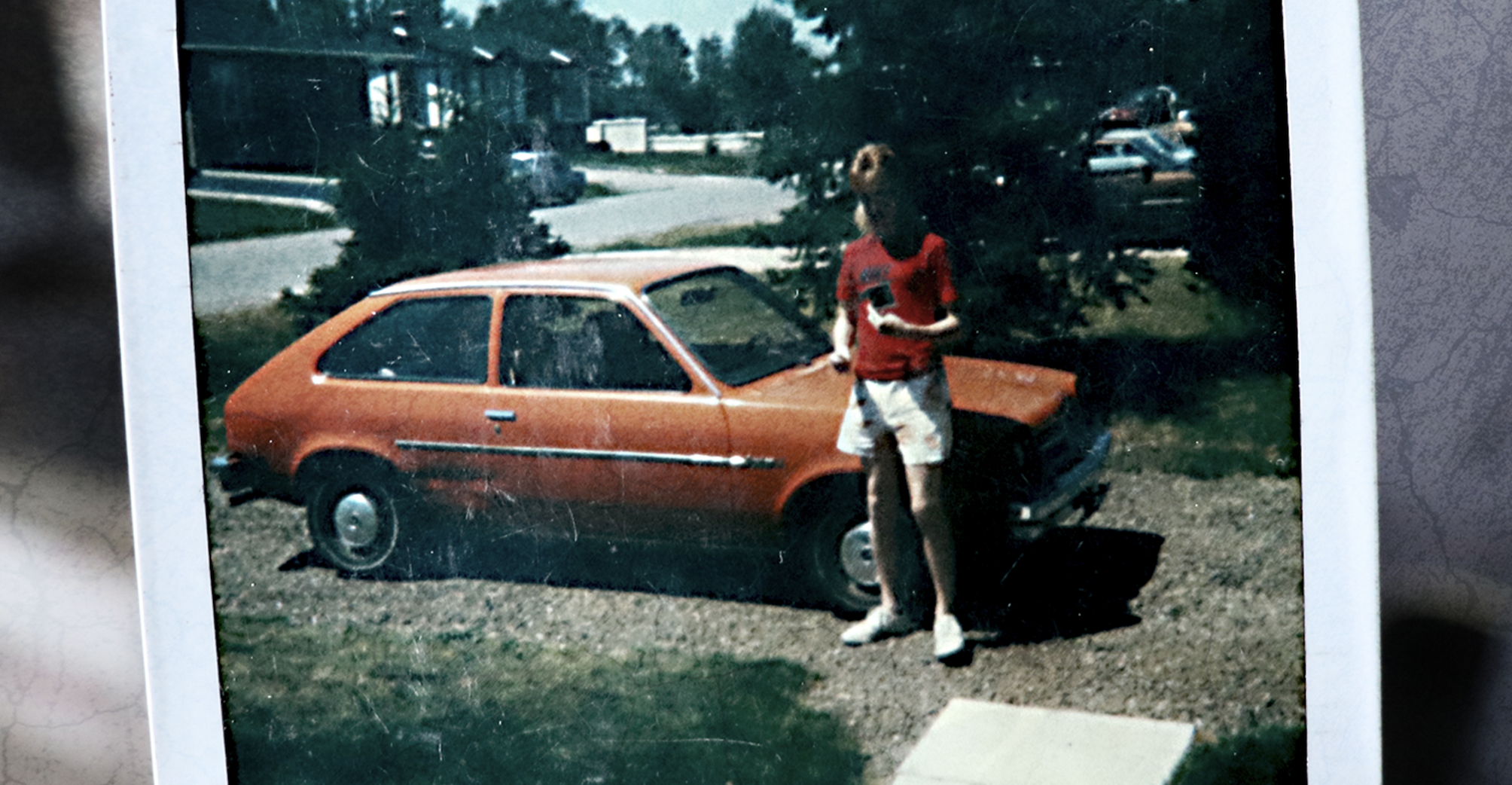
I was listening to Only the Host’s Indie Music Hunt the other day when I heard an upbeat rocker called “Picture” by Eric and the Soo. Turns out the song has been around since 2020, and the band has been around for even longer. From their press materials: Debut album Small Town Dreamer sees Toronto-based songwriter Eric Brombacher looking backwards to his past and his childhood in his hometown of Sault Ste. Marie. His follow-up Modern Dystopia is a concept album that takes a broader outlook, exploring the current social climate and the challenges we face as humankind. The songs touch on themes both personal and societal including isolation, depression, homelessness, conformity and social obedience; while still offering some hope for change, in this imagined pre-apocalyptic future. Are we really free? Or are we just slaves to the machine? Is it too late, or is there still hope for our beautiful world?
I’m curious about your band’s name. What does “the Soo” mean?
The band is named after my hometown of Sault Ste. Marie, (pronounced SUE-SAINT-MARIE) and people that are from there call it “The Sault,” and locals often use the phonetic spelling of “The Soo” when referencing the city, especially in the naming of local businesses (such as Soo Mill, or Soo TV Repair, etc.). Of course my name is Eric, so we christened the band “Eric & The Soo” in honour of that beautiful hidden gem that sits on the banks of the St. Mary’s River just east of the shores of mighty Lake Superior. Incidentally, “sault” is French for “rapids,” and the name therefore translates to the “rapids of St. Mary.”
Ah, that makes sense! How did growing up in Sault Ste. Marie influence you as an artist?
Growing up in Sault Ste. Marie influenced me both as a human being and as an artist. It’s a northern town, and also a steel-town, and furthermore we are quite isolated and suffer long cold winters. The nature and wilderness in the area is some of the most vast and beautiful I have encountered in my vast travels worldwide. With Lake Superior, and the Canadian Shield as our backyard, we had access to some of the best beaches, fishing, canoeing, skiing and winter sports giving us outdoor activity to be enjoyed year round.
My debut album was Smalltown Dreamer and this was in direct reference to the feeling of isolation that I felt growing up. It’s a city of 80,000 people, so not really a small town in the traditional sense, but that fact that the nearest city was over three hours drive away made one feel ‘small’ and perhaps disconnected. With the steel mill being the main employer and the focus on hunting and fishing and outdoor sports, there is a general blue collar sensibility within the community. I am the child of immigrants, and was perhaps a bit at odds with that blue-collar sensibility.
This, along with the sense of isolation that I felt is perhaps what drove me to the big city lights of Toronto. More than a few of my songs reference and contrast that small town upbringing with my current experiences as a big-city dweller. Having spent half my life in Toronto, along with the first half of my life in the Soo, I think gives me unique perspective on life and the contrasts and similarities between small town and big city life. And also importantly, that rich connection to nature and the wilderness of the Sault and surrounding area finds its way into my lyrics over and over again.
I understand that you’re also in a band called Kadelburg. How is that one different from Eric and the Soo?
Whereas “Eric & The Soo” is my Toronto-based band named after my hometown of Sault Ste. Marie, “Kadelburg” is my Sault Ste. Marie-based band named after my father’s hometown of Kadelburg, Germany. Eric & The Soo has a few core members, with guests appearing from time to time, on record or on stage. We generally record ‘live off the floor’ in a professional studio, often as a 6 piece band, with engineering, mixing, and mastering managed by seasoned professionals. Kadelburg is a garage-rock power trio, and we do everything ourselves, recording, mixing, mastering and producing. It started out a little more ragged and un-polished, but as we’ve gotten better at the technical aspects of music production, the songs are sounding tighter and more polished. Kadelburg consists of myself, and Dino Naccarato (who is also the drummer for Eric & The Soo, and also a former Sault Ste. Marie resident), along with my high school friend and perpetual Sault resident Jon Ferguson.
Looking at your Bandcamp page, you’ve been recording as Eric and the Soo since 2015. Has the lineup remained the same? Who’s in the band?
The lineup has evolved and revolved continually over time. Founding members, that are still with us include myself, drummer Dino Naccarato, and guitarist/blues-harpist Ken Yoshioka, rounding out the current core line-up is bassist Tim Bradford. Occasional guest musicians include violinist James McKie, and Juno-award winning pianist Julian Fauth.
How has your sound evolved in that time?
I would say it’s evolved organically. I don’t try to push the sound in any particular direction, but I also don’t resist my natural urges to try different things. Regardless of the genre that any given song is in, I strive to keep things organic, which is why we prefer to record live off the floor, and to ‘human time’ (i.e. not to a click track). We also generally record our songs in one or two takes. I’m looking to capture ‘good human energy’ as opposed to ‘robotic perfection’. I think we started the band and the first album in a mostly Americana-like context genre wise. Over time we’ve slipped some psychedelia into the mix, and even some progressive jazz. It’s hard to say where it will go, but I will say that I am grateful to be independent as I don’t have to limit any of my musical exploration.
I love the concept of “Picture.” The song’s narrator has been reduced to a memory and a couple of photographs—kind of like the Cure’s “Pictures of You,” but in reverse. What was the inspiration for that one?
Without getting too personal, I will share that I went through a dark period emotionally a few years back (“It Got Dark” from 2018’s Modern Dystopia touches a similar vein). One evening, in a moment of clarity, it struck me squarely just how devastating it would be to the people that loved me the most, if I let the darkness win. And the selfishness of it … “how could I have been so shallow, to think that it was all up to me?”
Your more recent song “Moneytown” offers what might be considered a critique of late capitalism. Likewise, your album Modern Dystopia offers a fair share of social commentary. How do you see songwriters—or artists more broadly—fitting into the larger context of social discourse? To put it another way, what’s the role of the entertainer with respect to social issues?
Yes, “Moneytown” is specifically an observation of the effects of over-gentrification on the soul of a city. I especially felt that in Toronto, as rents continued to rise, forcing Mom and Pop shops and local businesses and pubs into bankruptcy, paving the way for chain stores and restaurants. It felt like Toronto was slowly losing its personality; a trend that has already very much affected New York City. Modern Dystopia was my reaction to disturbing environmental and socio-economic trends that had been building (and continue build) over the past 15 or so years.
Personally, the way I see my role as an artist in the context of social issues, is primarily as an observer, and as a sharer of my observations. I don’t profess to know the answers, or what’s right and what’s wrong, I’m really just here telling stories, and sharing my own interpretations of what’s happening around me. And in relation to that, I’m sharing how it makes me feel, maybe in the hopes that the listener will feel something too.
Your song “She’s Older Than Me” is also memorable—especially since the “she” in question is a guitar. Can you share the story behind that one? What kind of guitar is it?
This is our “pandemic single,” and it’s a true story. My wife and I had to move into a small apartment in Toronto, after an extended stay in Europe, during the height of the COVID pandemic. We were required to quarantine in the apartment for 14 days upon arriving into Canada. We had no furniture (just a mattress on the floor), no TV, no internet, and no guitars! I called my friend Brad who owns a guitar repair shop, and he offered to lend me his vintage black and chrome Silvertone guitar. As he came to my door, and handed me the guitar, he whispered “be gentle with her, she’s older than you” … after that the song basically wrote itself.
Your press release raises some heavy questions: Are we really free? Or are we just slaves to the machine? Is it too late, or is there still hope for our beautiful world? What are you thoughts on these issues?
I don’t think it’s too late, and I don’t think we are slaves to the machine. I think there is still hope, I think we are still free (more or less). That said, I do think it’s important to ask ourselves these questions and remind ourselves just how important our freedom and our ability to live well and healthy is, whether weighing socio-economic, political, or environmental factors. On a more individual level, it’s temptingly easy to sacrifice and lose one’s personal freedoms in the name of financial success. In my experiences in the corporate world, I’ve seen more than a few people lose themselves in their careers at the cost of family, friends, health, and happiness. The trappings of success can lead to misery if one isn’t careful.
Any projects on the horizon?
Yes, Eric & The Soo are currently hard at work on a new album, which we hope to release in the summer of 2024!
Awesome! Thanks for taking the time to talk to me!
5 responses to “Smalltown Dreamer: An Interview with Eric Brombacher”
Cool find! By way of Only The Host you say? This surely got some “crispy’s” I would think.
Loads of crispiness!
Eric appears to be a thoughtful, intelligent and gracious guy. And as someone who grew up in a highly-populated place like the San Francisco Bay area (and have since lived in Los Angeles, Sacramento, St. Louis and now the Palm Springs area), I cannot imagine what it would have been like to grow up in such an isolated location at Sault Ste. Marie.
I know what you mean!
Thank you so much for the kind words! I should stress that Sault Ste. Marie is a stunningly beautiful place to live, and was a wonderful place to grow up, and I’m incredibly proud of my upbringing there. If you are interested in hearing a song that celebrates its northern beauty and the dichotomy of my small town upbringing and my current big city life, you might enjoy our song “Goulais Bay”.