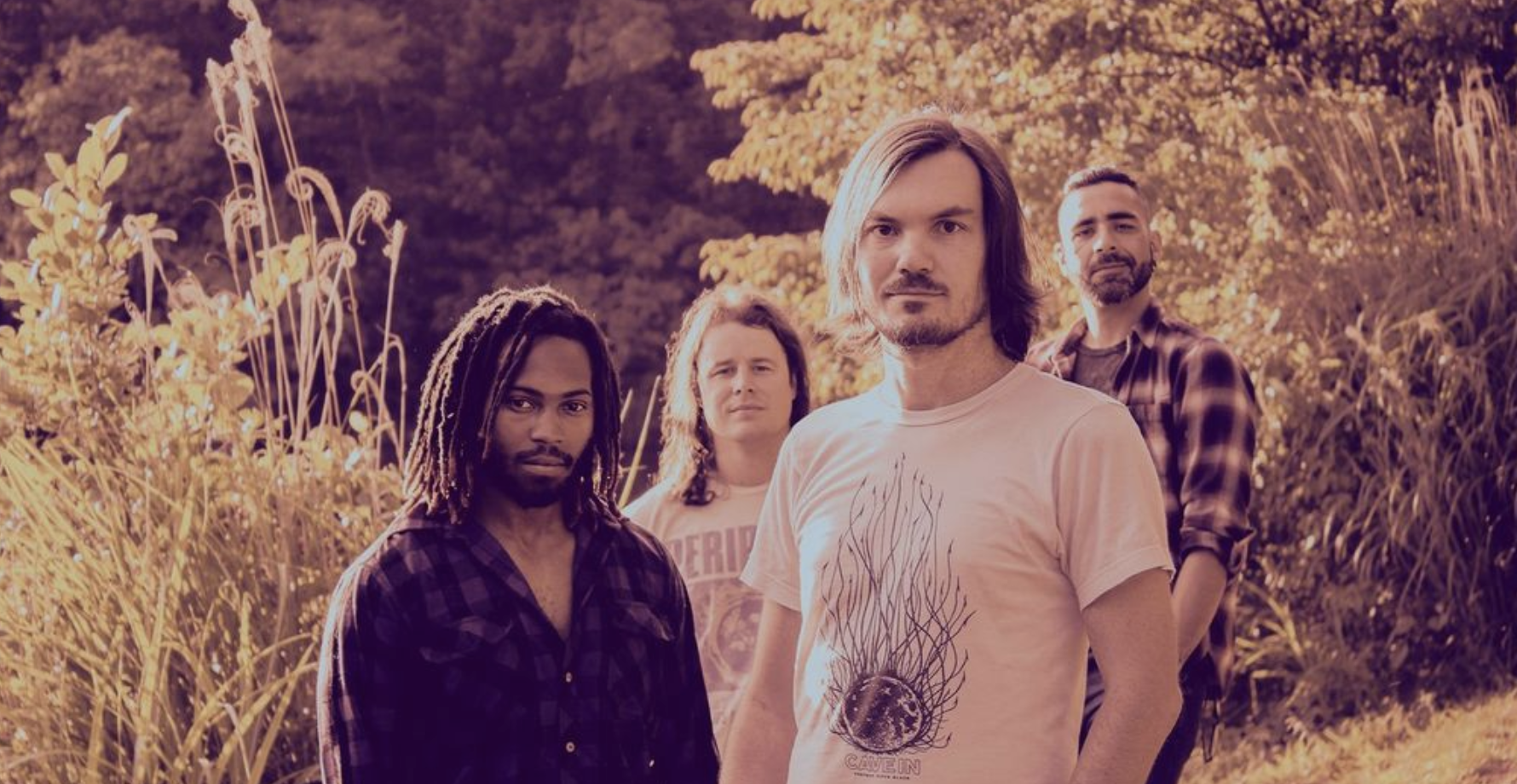
The Welcoming is a genre-bending rock and/or metal band from Asheville, North Carolina, on a journey to explore the gray area between rock and metal with big riffs and melodic vocals. They’ve been compared to bands like Thrice, Cave In, A Perfect Circle, and Coheed & Cambria. Since starting as the solo project of James Ferrell in late 2022, the band has played shows and festivals in multiple states and cities, and their songs are gaining popularity worldwide. Their latest EP, Neptune, represents an evolution in the band’s sound—from the work of a single creator to a full team effort. The EP is a collection of songs thematically linked by water: focused yet diverse; mature yet adventurous; technical yet heartfelt, according to the band’s press materials, along with the following promise: You will not be bored. To find out what’s behind that promise, I reached out to the band’s founder, James Ferrell.
Interesting band name! I’m struck by a couple of things. First, it’s “The” Welcoming—as opposed to a general welcoming. And second, there are the warm and fuzzy connotations I associate with welcoming, which in some ways stand in contrast to the cool and edgy attitudes I associate with rock and (or) metal. Can you talk a little bit about what “The Welcoming” means to you?
Sure! Adding “the” in front makes it more of an event than an action. And it’s a less commonly used meaning, but a “welcoming” can also mean an ambush or betrayal. I liked the contrast between the two meanings of the word.
The band’s logo depicts a hand holding a knife by the blade. It’s a striking image. Who designed it, and what does it represent—particularly with respect to the band?
Appreciate that! I designed the logo to lean into that same dichotomy, with the open palm and the dagger each representing a different sense of the word “welcoming.”
And the band started out as a solo project. Why did it start as a solo project, and what prompted you to expand into a full band?
Oh man. This is actually my second attempt at getting this project off the ground. It started over a decade ago, when I first started dabbling in guitar (I’m a drummer first). I was writing and recording a lot of demos and trying to get the project off the ground, but I couldn’t get a lineup to stick and eventually decided to shift my focus elsewhere.
Fast forward to 2021, one of my goals was to finally get comfortable playing guitar. So I wrote a bunch of riffs, revisited and reinterpreted some of those ideas from back in the day, and before I knew it I had enough material for an entire album.
I had also produced enough vocals with other bands I’ve worked with at that point that I felt ready to attempt lead vocals. I like to challenge myself, and Decayed | Remade was me stepping way out of my comfort zone.
I released the album in late 2021, and the reaction was encouraging enough that I felt it would be worth it to put a band together and play the material live.
What was the transition like? How did you find additional band members who were a good fit, and what did they bring to the project?
Honestly, I lucked out and found a great group of guys pretty quickly.
I was friends with Ken (Mcafee, drummer), and we were already in a band together so he was an obvious choice. Originally, Ken wanted to play guitar, but I was having a tough time finding someone up for the challenge of learning the drum parts and after the most promising candidate bailed on me, I was able to convince him to do it.
As for Vitor (Sá, bassist) and Spencer (Cranfill, lead guitarist), they both responded to a Craigslist ad. Sometimes it works! They’re both great dudes and excellent musicians in their own right.
I imagine there’s a lot more give and take in a band situation. Did you need to make any adjustments or accommodations? And how did your approach to making music change?
There is for sure. It’s important to me that everyone in the band feels heard, and that they’re all a part of the process. We get together now and then and talk about where we want the band to go and what to focus on. And we try to check in pretty regularly via text so we can be on the same page.
I’ll admit that I can be a bit of a control freak, and I’m probably a pain in the ass sometimes. But the guys know I have high standards, and I think they do too. And everyone in the band genuinely respects each other. I trust those dudes and enjoy collaborating with them.
For Neptune, everyone in the band contributed riff ideas, and I worked those riffs into song demos, and then we refined the parts further together during the recording process.

In terms of the final product, can you hear a difference between your debut album and the new EP? If so, how would you describe it?
For me there is definitely a difference. Personally, I’ve become more confident as vocalist and lyricist, and I think that comes across. We also gave the songs more time to develop, even performing them live along the way.
But I think the biggest difference is that not all of the ideas originated from me, and not everything is performed by me. So there’s more inherent variety in the songs, because everyone’s added their own spices to the pot. I also think we’ve more or less pinned down what we want to sound like.
I’m curious about the gray area between rock and metal that you mention in the band’s bio. What makes this area particularly ripe for exploration?
It’s always been wild to me how people take heavy music — which is supposedly rebellious — and feel the need to place it into neat little marketable categories.
My favorite music has always blurred the lines between genres, so I like to do the same with the music I make. My goal is to make music that feels fresh and exciting, but also familiar enough that it doesn’t feel off-putting.
The new EP, Neptune, is thematically linked by water. What drew you to this theme?
I didn’t have the theme in mind initially, but it emerged organically over time.
Both Eulogy and Song & Memory feature a river as a tragic setting. The Unknown is about surviving a shark attack, at least on the surface. The guitars in the beginning of Bitter Air make me feel like I’m underwater, and the lyrics are about tracking someone down in the middle of a blizzard.
Around the time I was finishing up with the mixes, I begin thinking about how to tie the songs together. That’s when I reviewed the lyrics and noticed the theme.
Did working on a full EP about water give you any new insights into the topic?
I learned some fancy scientific terms for the various properties and states of water, but none of it felt as easy to remember or visualize as Neptune, Roman god of water (or Neptune, ice giant planet — at this point you know I like my double meanings).
What’s next for the band?
I think we’re going to keep grinding, leveling up our live show and making friends along the way. In the next few months we’ll be playing some shows in different cities, plus we have a weekend mini tour in November.
We’d also like to make a nice music video or two in the near future.
It might be a little while before we start working on new music again, but I’m sure we’ll catch the bug at some point.
One response to “I Lucked Out: An Interview with James Ferrell of The Welcoming”
Been looking forward to this EP for a while!