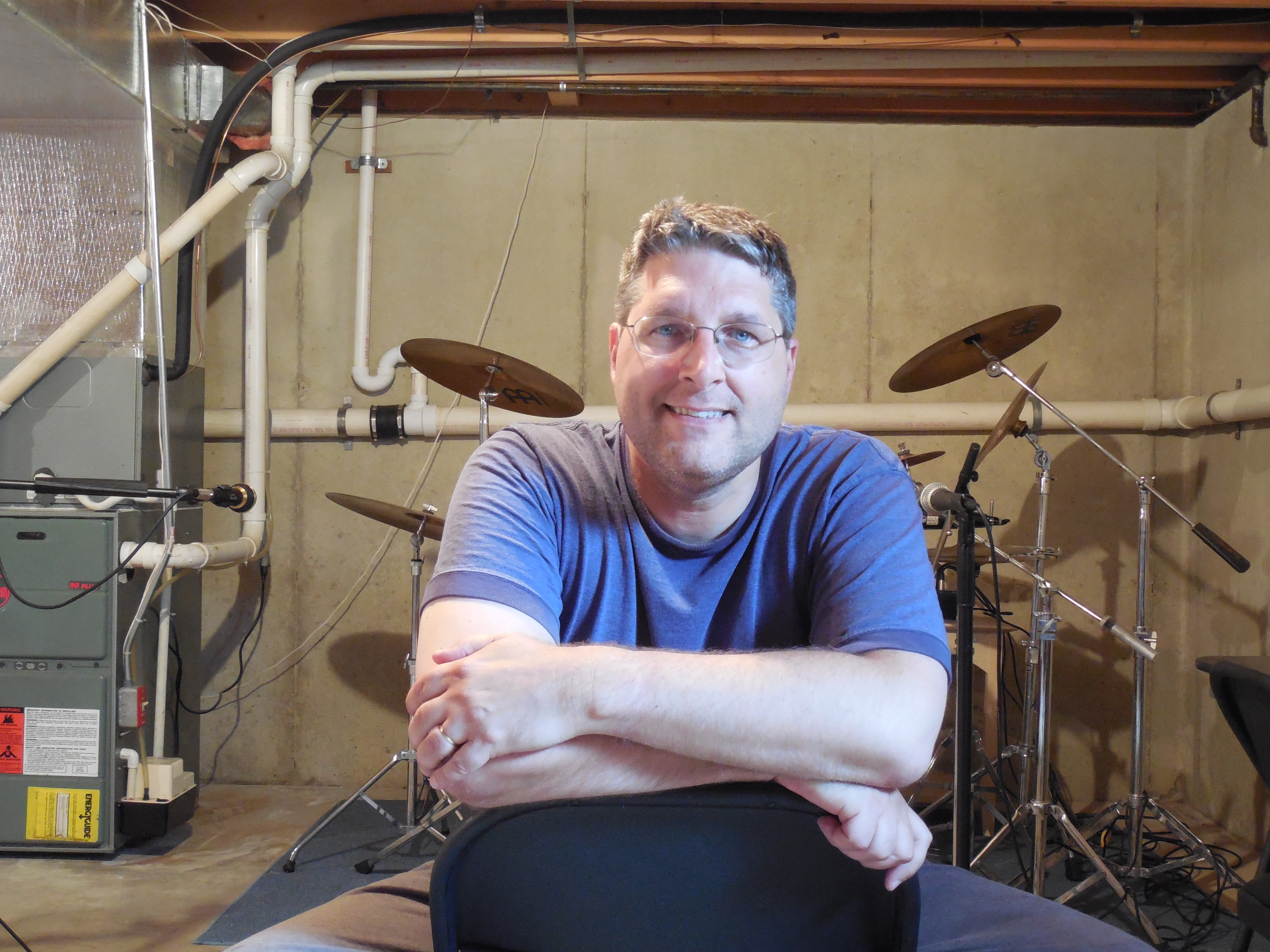
Recording since 1984 and performing for longer than that, Chris Nelson offers what he describes as an odd mix of rock, folk, and blues. Proudly playing loud, scruffy-sounding rock with plenty of attitude, he released a “novel in music” titled Story of a Young Couple in 2017 and bucked convention in 2020 with a mostly instrumental album, Don’t Say Anything. His latest album, Black Light Ambience, is a return to the hard-hitting rock that he is known for, infused with elements of pop, psychedelia, and other styles.
You’ve been recording since 1984. Did you record in a studio or at home? What was the experience like?
My very first recordings were done in local recording studios, since I didn’t have a lot of equipment at that point. My first experience consisted of setting up the equipment and being told when to play, even though I was actually familiar with how to play the song. Most of the local studios were basically someone’s spare room or a back room in a music store. You went in, set up, let the sound engineer place the mics and adjust the equipment and you were on your way.
During the sessions, I observed what the recording engineers were doing and asked a lot of questions. Over time, I learned many things that way, for example, microphone placement and how to use natural echo to enhance an instrument’s sound. I realized there was much more than just recording the musicians playing and balancing their sound inputs. I began to read professional magazines about sound engineering and did a lot of book research. (This was before the Internet was a thing.) That’s when I realized I could do this myself.
I got a Tascam Porta One 4-track recorder in 1986 and I started using it at a practice facility that was near my home at the time. There was a lot of trial and error–mostly error, for the first few attempts. After a while, I figured things out and got comfortable with the recording process. I used the Tascam machine until the record heads wore out in 2007!
How has your approach to recording evolved and changed since then?
When working with tape, there is a very narrow margin for error. In the early days, there would be a lot of re-recording, which could affect the signal on the tape. If you were doing a lot of overdubs, you risked loss of fidelity. Also, if you decided you wanted to move a particular musical passage to another part of the song, you would have to re-record it. In my experience, I’ve found that no two takes are alike and you may have done a far better job on the take that had just been recorded, but for some reason, it can’t be used on the project. Therefore, you risk not getting the best performance on tape. In extreme cases, you could splice the tape, but that was an exceptionally difficult task best left to professionals.
Overdubbing on small machines like the Tascam caused signal degradation, due to the tape being recorded over constantly. You could collapse several tracks into one, but there was some fidelity loss once you did this. I learned that the bigger the tape, the more space you have to work with. The model I had used a standard cassette tape, which has tape with a very thin width. The equipment that major studios had used quarter-inch tape, which could hold a lot more signal without losing any fidelity. I used to master tracks on my VHS recorder, since the audio signal took up the entire width of the tape.
Over the years, there have been many advances in computer and sound technology which allowed do-it-yourselfers like me to get better results. I tried digital recording using Cakewalk and produced a few records with that from 2001 to 2004, but the software became obsolete and I was never happy with my recording process while using that software.

That’s when I went back to using a Fostex 8-track digital recorder. The nice thing was that with this new deck is that you can collapse tracks and not have any signal loss. It worked really well, but I found I had to export the tracks into a digital format to make use of any effects that I wanted to add. The Fostex had some effects, but they were limited. On the last few projects I recorded with that deck, I started importing the individual tracks into Audacity, which is a program available for free download, to apply additional effects and filters.
The Fostex recorder broke a few years ago and I returned to digital recording and started using Audacity for producing an entire recording project. I finally felt comfortable recording digitally and I have been doing it ever since. It got a lot easier to work with the sound at get it the way that you’d like it to sound. I can record as many tracks as my computer is able to process now with no issues. For example, there were a lot of vocal overdubs on “Hard to Believe” and it all turned out really well. In a tape environment there may have been some issues with signal loss.
I think that advances in both recording equipment and software drives the evolution in the recording process. There are so many things, especially effects, that were once considered too costly for most studios to offer that I can get simply by downloading a plug-in for the recording software. It really puts what used to be considered “commercial grade” recording capabilities in the hands of anyone who wants to use them.
What is your current recording setup?
I use Audacity, as I mentioned earlier. I run the instruments through a Presonus USB interface directly into the computer. I get a better signal that way. In some cases, I’ll use a mic on the amplifier, but that is rare. If I’m recording an acoustic guitar or for vocals, I have a dynamic microphone. I like live drums, so for recording those, I have to use Studio One, since I need to record on several tracks at a time. That is actually the only drawback I have found working with Audacity. You cannot record on multiple tracks.
I set up the drums with mics on the left, right, on the bass drum, and one under the snare. All these provide a great way to mold the sound and get the panning right, so they really jump out of the recording. I can also pan drum rolls so they run from left to right, as if you were in front of the set. That sounds really cool in headphones!
My setup is portable, so I can record pretty much anywhere I want to. I used to record mostly in my basement, but when I got a new USB interface, it wasn’t compatible with my laptop, so I moved to the computer in our bedroom, since it’s newer. As I said, since most everything except the vocals is recorded direct, there is no issue with unwanted sounds. The drums are still in the basement and I use the natural echo to enhance their sound.
In the past, you’ve organized benefit concerts to help veterans. Can you talk a little bit about that?
I used to work for the Pennsylvania Department of Veterans Affairs and I was involved with various efforts to support veterans. I am a retired U.S. Air Force member, too, so there is some motivation for “giving back” at work here. I knew a guy that was organizing an event to raise money for the Wounded Warrior Project by walking from Pittsburgh to Philadelphia. That’s not a walk you can do in a day! He asked for people to sponsor him and held out collection cans at some of the little towns the group walked through.
I asked him how he got started and I thought that there could be a way for the local music community to show support and we may be able to raise money for the Wounded Warrior Project. I was familiar with a project coordinator from the Wounded Warrior Project and he was telling me about all the things they were doing to help combat-wounded veterans re-integrate back into society and deal with their wounds. I thought it was a great cause and came up with the idea for the “Sound Off for Vets” concerts.
There were a total of three events, starting in 2010. We got a lot of support from the community. Local businesses would donate prizes for our prize drawings and we always got bands that were interested in doing a non-paying gig in support of veterans. We had some volunteers who would help out at the donation booth and help with the prize drawings. People had a good time and we did raise a lot of money.
Cracks started to form in the relationship with the Wounded Warrior Project over time, however, and they indicated that they were less enthusiastic about little groups like ours raising money as they were more focused on big corporate donations. Things got worse when a story broke on the news about misappropriation of funds and very little of the money that we had raised for them actually went to the cause we were supposed to be supporting! It was rather embarrassing, but looking back at it now, I am glad that I did it. During the time that was in the news, I felt like I had egg on my face.

For the most part, you’ve been a solo recording artist and performer, but you did get a band together in the early-to-mid-two-thousands. How did playing with a band influence your sound—or your musicianship? Did it present any challenges?
I used to record under the name “Fishkill” from 2001 to 2004. At that time, I had always considered my recordings to be standing in for a live band, even though it was only me. Those recordings are still available on many of the streaming/download services.
When I moved to Pennsylvania, one of the first things I wanted to do was start a band. I placed ads in some of the local media and ultimately found a bass guitarist and a drummer. We formed in 2005.
There were three of us; I played guitar, Jack Hawk, who is now in The Keeping Still, was our bassist and Mike Williams was our first drummer. I was the main singer, but Jack also sang. When we began, we would use the recordings I made as a guide to get us started. The guys learned the songs from those recordings. I wanted everyone to bring something into the project to give it an original sound and not sound like me. We all contributed to the song writing and we were able to jam really well. This helped when we were running short and needed to fill out a set! I thought we put on a pretty good show, but not many people actually saw us play. It was really nice only worrying about one or two parts of a song instead of all the parts!
The challenges were working with each other. Everyone has their own way of thinking and we had to make sure all of us were on board with any decisions we made. There were also personality issues, but it was a lot like living with someone, even though we didn’t live together, we had to accept them for who they were, faults and all. Musically, there was chemistry and everyone made a contribution to the project.
Unfortunately, we lost our first drummer and found another guy, but he didn’t really fit into the dynamic of the team and it wasn’t really fun anymore. The dynamics of the group had changed. I pulled the plug on it in 2007.
I love the title of your 2011 song “In Praise of Failure.” What was the inspiration for that one? How might failure be an important element of life?
That was a song that started out, believe it or not, as a punk song. The band did that song for a while. The lyrics were basically about what it means to be a success. You hear people talk about ‘this guy is a CEO, he’s so successful’ or ‘this person is on the fast track for promotion’ but what does that mean? I know folks who throw themselves into their careers and are miserable. Others don’t have any time for anything else. Is that really success? In the song, I say that it seems like I am not moving anywhere and everyone else is moving past me, but still, I’m happy. Could this be right? You have to draw your own conclusions. That was the intent of the song lyrics.
I had stumbled on another arrangement which actually seemed more suited to the song. When I recorded it, it was a soul ballad with an R & B feel to it—a far cry from the punk song that it started as. I thought that really brought out something in the song. That wound up on my second album, “The Invisible Man” which was released in 2010. A local online music ‘zine that is no longer being published today had voted it as one of the best songs of 2011. That was a complete surprise to me!
You describe your album Story of a Young Couple as “a novel in music.” What inspired it? How was writing a novel in music different from writing a more traditional album?
That all started from the title song, which became the prologue for the story. I had written that song as a semi-autobiographical portrait of my marriage and family, since my kids were growing up at the time. About a year or so later, I got an idea for another song and it seemed like it was an extension of song “Story of a Young Couple.” A few more song ideas popped up and I realized I was on to something. I am also a writer, so this was a project that allowed my two creative abilities to cross over each other.
I have to admit, this was the hardest and most complex project I had ever taken on. The first phase was writing the music for it. I was still working on recording the “Once in a Blue Mood” album, so I was spending time either writing songs or recording them. I was driven to building this thing, for reasons unknown to me. It took about a year–at least a year passed during the time I was able to get time to work on it–to complete all the writing. There were some false starts during the writing process, however.
I forgot how to play two of the songs, even though I wrote down the chords and words to them, I had no idea how they went together, and I still haven’t been able to figure them out. I still have them in my files, if ever something comes to me. In addition, I accidentally wrote the same song twice! I didn’t’ realize it right away. I was playing the song one day and thought to myself ‘wait a minute, that sounds like…’ and that’s when I figured that I had to re-write the song. There were also some out-takes that didn’t really fit into the complete project. That being said, there was a lot of writing involved with this project!
As far as the songs themselves, I wanted the characters’ dialog to each have their own presence, as they would have in a piece of written literature. That’s why there are several different styles of music on that album. Each character is speaking with their own style of music. Father speaks in classic rock and alternative, mother speaks in soul, the kids speak in various forms of punk and pop. I’m not sure anyone has actually noticed that, but I did do that intentionally.
I had to spend a lot of time fitting where the songs would be arranged on the album. I did this by arranging each of the lyric pages into the album order so they would make sense. Each of the songs represents a particular scene, or moment in the story. I used albums like the Who’s “Tommy” and Pink Floyd’s “The Wall” as a guide for how was going to put all this together.
The project is a blend of literary fiction and music. The songs can stand on their own, but when listened to together, there is a feeling of movement, like there is a narrative in the background. There is a booklet that contains additional material for the story written in prose, with the lyrics blended in. This gives you additional background to the story. If you read the booklet, you will get the feeling that you are reading a book and the lyrics fit in nicely with that. If you download the album from Bandcamp, it comes with the booklet. Unfortunately, it cannot be bundled with the album on some of the other streaming/download services.
I think it is a great way to tell a story about a family that is dealing with children who are growing up and finding themselves and the parents who have to learn to let the children stand on their own. River of Rock, a local music ‘zine called it “gut wrenching” but I think there is humor and excitement in the story as well as drama. Ultimately, the parents accept their youngest son moving out of the house and the permanent changes this brings about. To me, it seemed more hopeful and optimistic.
I’m curious about that “mostly instrumental” album, 2020’s Don’t Say Anything. What was behind the decision to eschew lyrics for most of the tracks on that one?
I had a bunch of ideas for instrumentals and they were piling up in my head. I used to feature one instrumental on each of my solo records up to that point. “Story of a Young Couple” was the first album that didn’t have an instrumental on it. (Fun fact: the instrumental on the “Once in a Blue Mood” album features Stani Steinbock playing the Kantele, a Finnish folk instrument. I can’t verify it, but I think I’m the first one to ever feature that in an American rock tune.)
After the “Story of a Young Couple” project, I was looking for something a little lighter. The original concept was a virtual jam session with many guests all playing on the tracks. I don’t know all that many people, so I was only able to get a few folks to participate. Those who did help, made some great contributions. John Fiore’s guitar work on “Ghost Hunter” reminds me of Steve Vai. Sinclair Soul’s piano parts in “In Your World” gives it a sound and feeling that I would not be able to achieve on my own. I’m really thankful for their contributions to the this record.
There were only supposed to be three vocal compositions when I began working on the album, but when my father died, I wrote something in his memory and I added it to the collection, making it 4 vocal compositions to 8 instrumentals. I just felt that the production and performance of those tracks seemed to be a lot easier than some of the other recordings I’ve made. Now these instrumentals are out in the open and can be enjoyed by anyone.
And you’ve said that the new one, Black Light Ambience, is a little angrier than the rest of your music. What’s at the root of that anger, and do you feel like music helps you work through it? Was recording the album cathartic in any way?
I think that there is a lot of attitude in those songs. Ironically, they were all written prior to the pandemic, but they somehow manage to reflect everyone’s frustration of the time and it gets into the music. There are a lot of songs that are essentially calling various groups of people and organizations out for their behavior. I may have used some of my own personal frustrations as a starting point. I will say, however that there are a lot of things that are not right and there are things which are now acceptable that would have been intolerable only ten or fifteen years ago.
There is a frustration from loss of control of one’s environment and limitation of one’s freedoms that has become more evident in recent times. In addition, it seems that reality is not at the forefront like it used to be. Most everything has some sort of spin to favor a particular side of an argument. I released a single called “Between the Lies” which covers this topic. I saw this waive of unreality coming for some time and it doesn’t look like it is going away any time soon. The title track “Black Light Ambience” is about how most people seem to be basking in the negative energy that is surrounding us. That negative energy is a by-product of this wave of unreality, in my opinion.
When I write songs, I usually start with a melody or a hook and work from there. I don’t always know what I’m going to write about. There may be a phrase that will start the process and you build on it from there. The anger was probably rooted in those beginning hooks and it spread out from there.
As far as catharsis goes, I am most satisfied when I have a fully-finished piece that is ready to distribute. I also get a lot out of playing music, so when I have a chance to play, I’m usually in a better mood when I’m finished. When I used to play live, there was always a feeling of elation after finishing a set. Hopefully, that answers your question.

The third track on Black Light Ambience is called “Out There.” It begins with what sounds like soldiers marching. How did you record that? What are we hearing?
I got the sound from an Internet search. I simply looked for audio recording of marching feet and downloaded this sound. It is the sound of a drill team marching. I wanted it to be in time with the music, so I had to slow it down a little so that the music would blend into it. That was an undertaking. I had to play the song with the recording and make adjustments as needed. Once I had the proper tempo, I set the metronome to match the pace of the feet. Some of the footsteps got a little off time, so I had to do some creative editing to get them in time with the music. The idea was that we all were marching (or walking) off toward an adventure.
Thanks for taking the time to talk to me!
You’re welcome! I’m happy to have the opportunity to discuss my music with you. For those of you following along, please visit my website at www.chrisnelsonband.com. You can find a detailed bio, links to where my music is located, and my social media sites. You can also send me an email from there, if you’d like to contact to me.
You must be logged in to post a comment.