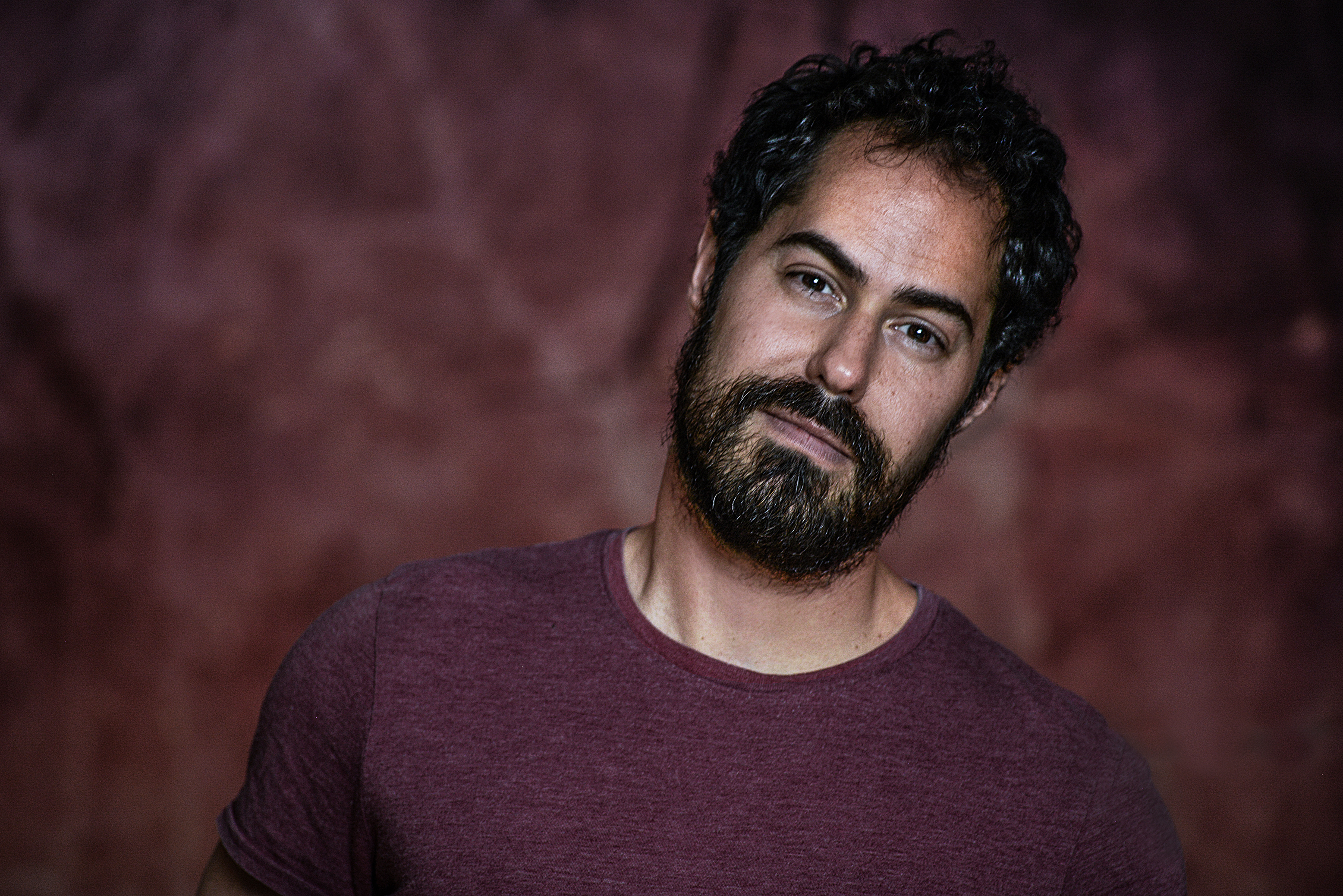
Toronto-based singer songwriter Dany Horovitz cites Aldous Huxley as the inspiration for the title of his latest album, Phanerorhyme. Where Huxley used the term “Phanerothyme” to describe the category of mind-altering drugs that would eventually become known as psychedelics, Horovitz altered that term in a nod to the idea that music, too, can offer mind-altering experiences. To find out more about Dany’s new album, I dropped him a line.
You’ve mentioned that the title of your latest album is a nod to Aldous Huxley’s term for psychedelics. Do you have any personal experience using psychedelics?
I do, in fact. And I have found those experiences to be very meaningful, and even highly creative.
Often the genre of psychedelic music is characterized by an effort to make music sound like a psychedelic trip, but your music is fairly straightforward with very few, if any, effects. That said, I’m wondering if, nevertheless, you consider your music psychedelic.
I’ve always wondered if the people who labelled psychedelic music as such had ever been on a psychedelic trip themselves. I tend to think of a psychedelic trip as being characterized mostly by being contemplative: I am having a discussion with myself about myself (or the experience that I confuse with the self), or the nature of consciousness, or the nature of life itself including the ultimate fact of our mortality. There is no reason why songs that full of special effects should be counted as more psychedelic than, say soft music that nourishes your soul. If there is a “most psychedelic” genre of music it might even be the sound of your own voice while chanting nonsense sounds, which is about far from hard rock with special effects as you can get.
But more specifically your question, I don’t think all of my music is psychedelic but I’d absolutely say that a few are, either because of the subject matter or because of their origin. For instance, I have a song called “Temple In The Sky” on my first album, Free Times, which has all this religious imagery in it as a metaphor for the process of growing older and realizing that the world isn’t as good as you once thought it was, which I think it psychedelic. And to be fair, it starts of very folky but then we start integrating more electricity into it, including a blood-curdling scream at the end. When I asked my producer, Calvin Hartwick, what he thought about my adding a blood-curdling scream into the song he said, I think jokingly, “Every time I’m asked that question, I say yes”.
I have another song called “Morning Light” and although the story isn’t necessary psychedelic the story behind it is: I took a bunch of mushrooms and set an intention of creativity, hoping to write some poetry. I wanted to be inspired so I put on a psychedelic playlist, and I have to say that it was a jarring experience. Normally, I love listening to Jimi Hendrix but on the trip, it was a very distracting and completely unpleasant experience. Instead, I put on a meditation playlist of classical music and my mood shifted entirely, the experience was very smooth and lovely. Near the end of my trip, I felt the urge to put on some folk tunes, to feel some really good vibes. So, I threw on a John Denver playlist, and the next thing you know I was inspired to write a song. I ended up writing Morning Light that evening, which is about the beauty of being vulnerable with someone you love. It is one of my favorite songs and currently my most streamed song too. Anyway, I bet most people would say that “All Along The Watchtower” is more of a psychedelic song than “Take Me Home, Country Roads” but there you have it, at least for that evening. Which just goes to show, no one really knows anything, and music categories can be silly.
In what ways would you say that your music is mind-altering? What’s the change you’d like your listeners to experience?
That’s a great question, and to be honest I do not know how any music will alter the mind of the listener, because it is so specific to the listener. I think, rather, the music reflects how I have been changed by the experience of writing and recording music. I’ve always loved writing songs, turning stories or poems into music, painting little pictures with words and melody. And as I started recording, I also started understanding the power of collaboration. I couldn’t help it, my mind was starting to expand, to re-think the songwriting process. I began writing songs with my collaborators in mind, thinking about instrumentation while writing, thinking about how to tell stories and reveal characters more deeply than I previously had. I think that anyone who reads and writes regularly will be growing their writing steadily, but sometimes you can really jumpstart that growth, and the experience of being in the studio was one of those times. Or at least I tried to level up, and in the attempt wrote some songs that I thought were terrific. But I hope none of this sounds like it was boring. Quite the opposite. I loved every minute of recording my first album, and every minute of writing and recording the songs on The Candle Is Worth The Game (my EP) and Phanerorhyme (my new album). At my core I want to make music that I love playing and singing, and having done that, I hope that my joy and fun crosses over to the listener.
I might not have entirely answered the question, so let me put all this another way: writing and playing and singing my songs puts me in a good mood. It alters my mind in the moment, because no matter what else my day is like, it transports me to a place of calm, focus, and fun.
Do any songs on the album particularly encourage this type of mind-shift? Which ones, and how so?
My opinion on that is that it depends on the listener. There is this idea in art and literary criticism that that author of a work’s meaning is the reader, not the writer. When you hear a song that inspires you to action, or puts you in a place to help you focus mentally on something, or even brings you back to some childhood memory, all of that has basically nothing to do with the songwriter. And it might even be disingenuous of me to insist that my songs, or any songs, have the power to change minds. Let alone alter them. I do hope that people like the songs, and are moved by them. And, for what it’s worth, I do believe that we have put enough memorable sounds and thought-provoking lyrics that they warrant multiple listens. But I can’t say which ones will connect. I suppose I would say, start with the first track and if it grabs you, keep listening and if it doesn’t skip to the next one. If that one grabs you, keep listening and if it doesn’t, skip to the next one. And so on. If your readers are looking for a particular, random starting place, I am partial to the saxophone solo on “Sorry From the Road” and the banjo solo on “It’s No Use Trying To Change Me”.
Your song “Be Good” suggests that people should try to be their best selves, and I’d like to explore that idea little further. What does it mean to be one’s best self?
I like the way the song opens up, with a simple truth that we forget too often:
No one can forgive you
Even if they try
And you so must forgive yourself
And let bygones go by.
We often have a way to “forgive and forget” or “live and let live” and those are powerful, important messages, but they are also outwardly facing. The truth is that the only person you have to live with is yourself. Forgive other people but forgive yourself too – from there, the song kind of describes the world we have, which is imperfect, and the lives we lead, in which regrets are unavoidable. At it’s core, I think you are doing your best at the intersection of good intentions, trying again, and forgiveness.
When I write down what I think about the song it sounds really cheesy, and maybe it is, but I think it is also true and for that reason Be Good is might be my most, or even my only, personal song. Most of the other songs on the album are stories about hearbreak, either from the perspective of either the heartbroken or the breaker-upper. But then the last two songs on the album are so earnest, Waltz Once More being about giving yourself permission to fall in love again despite a rough history, and then Be Good is of course about self-love and acceptance.
Does that idea also apply to art? As a musician, how do you know when you’re being your best self or making your music the best it can be?
I think it applies in all aspects of your life including art: go into it with good intentions, try your best, forgive yourself when your intentions and results don’t match up, then try again.
“Best” might be too abstract a term to really commit to, although I do tend to tell people that my aim is to turn my songs into their “best” versions. It is my aim, but it is also a lofty a goal. Here is a life lesson: beware anyone who describes themselves as a “perfectionist”. Good or even great can be objectively measured, but perfect is just an opinion, especially in art. So anyone who describes themselves as a “perfectionist” is really telling you that they will be super particular and use the moniker “perfectionist” to defend their opinions.
I am very lucky with the collaborators that I have, in particular Calvin Hartwick, Sean Royle, Colanthony Humphrey, and Kara MacKinaly. When they get excited about a song I know that we have made great music.
I have this little rule when writing a song. If I write a song, or a part of a song, and the next day I can remember it, then I know it is a good song and I keep it. So that’s why when I submit a bunch of songs to my producer to pick from, I know that they are all good from my perspective, and it is more a matter of picking the songs that work best together on an album.
And who’s on your team? Who helps you get your music to the point where you’re satisfied?
That is a great question and let me please sing the praises of the following people:
Calvin Hartwick, who produces, engineers, and mixes almost everything I do. His inputs, insights, and instincts are as about a high a level as anyone you will ever meet in the music industry.
Sean Royle is a savant, an extraordinary musician who also understands both in detail and at a high level what makes a great song. His musical arrangements and contributions have been essential to developing my studio sounds and I honestly could not imagine these records sounding nearly as good without him.
Kara MacKinlay, who is an audio engineers in her own right. She engineered Waltz Once More and mixed Be Good. She is also a virtuoso of vocal harmonies. Part of the reason that Phanerorhyme sounds so much fuller than Free Times is that working with Kara levelled up the vocal harmonies.
Let me shout out a few others: Jon Foster and Colanthony Humphrey are the drummers that I have used to date, and their skills drive the songs you hear. When you think to yourself, woah I really like the energy of that song, its almost always because of the drumming and that’s them. Phil Demetro of Lacquer Channel mastering is a mastering genius. There is something almost unquantifiable about good mastering but I can tell the difference between the mix that goes to be mastered and the version that you hear on the streaming platforms. The roundness to the sound and the consistency across platforms and devices, that’s the magic that Phil provides, to wit: the reason that a lot of new songwriters fail to get of the ground is that they do not invest in getting quality mastering, even when their songs have been written, performed and engineered well. I want to give a special shoutout to Dave Schiffman who did the mix on “Sorry From The Road”, this is a guy who has worked with everyone from Tom Petty to the Red Hot Chili Peppers so having the chance to work with him was awesome. Lastly, and sadly, I want to pay some respect to the incredible Henry Gluch, who played saxophone on “Sorry From the Road” and an earlier song, “After Last Call”. Henry passed away earlier this year but his talent was simply immense.
What do they bring to the process?
I won’t repeat all that I have gushed already!
Do you ever get a chance to play live?
I love playing live and wish that I could do it more! When I play live, I do an acoustic set so just me and a guitar playing acoustic covers of my songs. And in many cases, that means playing covers of songs that much or most of the audience does not know. But when I play live, I get to see firsthand how people respond, and getting energy from a crowd is the best feeling in the world. It is also a chance to earn new listeners and direct them to my fuller, studio sounds.
The only thing is, I occasionally get offers to play concerts where they want me to play covers and I usually say no. There are other musicians out there who would do a much better job of covering the huge songs the crowd loves. It is probably a bit of stubbornness on my part, but with all the effort and energy I put into my own songs, I want to play those for the crowd and hope it connects.
What’s on the horizon?
I just finished recording a third album with my team, and those songs will be released one at a time starting in 2024. Meanwhile, we have already started planning the fourth album, which will be recorded throughout 2024, to be released in 2025. Beyond that, I would like at some point to record a “live on the floor” album of some of my songs, which will more earnestly replicate my concerts but with a full band.
Speaking of concerts, for anyone in Toronto I will be playing at the Painted Lady on Dundas and Ossington on Thursday November 23. Show starts at 8.
One response to “A “Most Psychedelic” Genre of Music: Chatting with Dany Horovitz”
I bought shoes from a drug dealer once. I swear they were laced. Had me trippin’ all day!