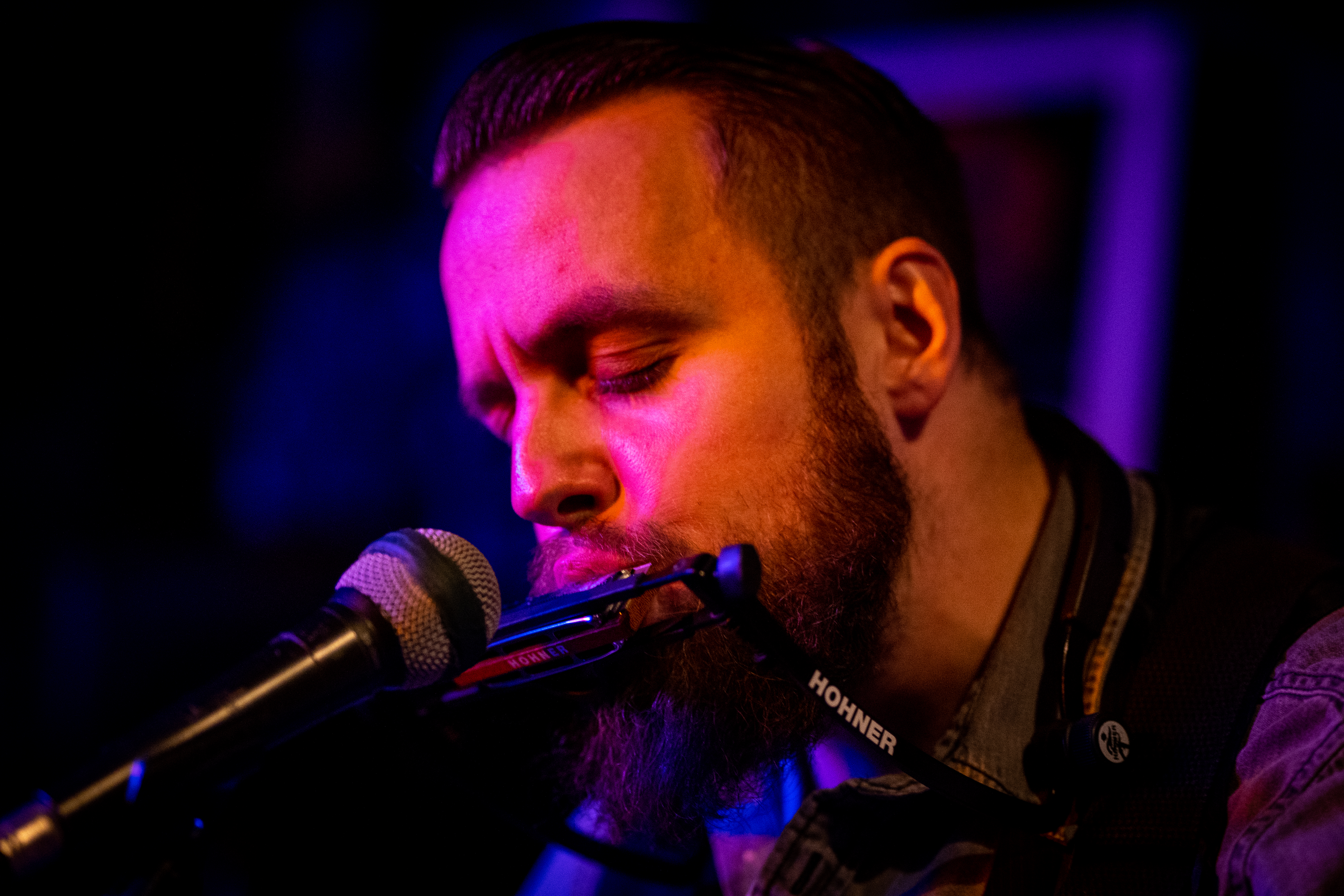
James Gedda is an up-and-coming Country and Americana singer-songwriter with a booming voice and a plainspoken honesty in his lyrics. The Crown Point, Indiana, native has drawn comparisons to the likes of Johnny Cash and Merle Haggard with his earthy baritone (personally, I hear echoes of Warren Zevon as well!), and he regularly covers such classics, but what drives him is writing songs and telling stories with modern sensibilities. He’s performed in such historic venues as The Bluebird Cafe in Nashville, and regularly sings all over Northwest Indiana and the Chicago area.
Your music falls into the Country and Americana categories. What do you see as the difference between the two?
I think, to a large extent, it’s a matter of semantics. That applies to all genre labels, I suppose, but with Country music vs. Americana, I treat it as two different segments of the same audience that have a lot of overlap. Some of the die-hard country fans and performers treat Americana as some sort of derisive term, but to me it serves as a more all-encompassing label for music that’s rooted in tradition and history while not necessarily being tied so inherently to rural, southern areas. I grew up in the Chicago area and little resemble the archetype of a ‘good old boy,’ but the songs and stories from the history of country music have always hit home, and I think that’s true for a lot of people. Country music is, at this point, something of a loaded term and brings to mind the manufactured, repetitive, shallow songs coming out of country radio and the Nashville machine, so I describe myself as Americana to better categorize where my songs fit in today’s market.
What draws you both?
For my take, country music is where the sounds I’m pulling from were and Americana is where they’re headed. I love Hank, Johnny, Waylon, Buck, and the like, but recent tunes from the likes of Willi Carlisle, Sierra Ferrell, Jason Isbell, and Adeem the Artist have moved me just as much as, if not more than, the classics. At the end of the day, a good song is a good song no matter what you call it, and those two categories are where I tend to go to look for what I call a good song.
Your voice has a rich, heartfelt tone. How did you learn to sing—and, perhaps more to the point, find your voice?
I didn’t really sing growing up, oddly enough. My voice dropped to about as low as it is now sometime in middle school, and I hadn’t yet found the skillset to make use of it or the confidence to recognize it for what it was. But I grew to love writing and telling stories, and that helped to inform my persepctive creatively. And when the connections formed between my very adolescent desire to have my voice and feelings heard and the traditional country music sounds I grew up around, my baritone voice suddenly made a lot more sense in context and I started working on it in earnest.
When you’re playing live, what’s your usual ratio of original music to covers?
It depends on the place and the audience, really. I’m still by and large a bar musician, and in my neck of the woods that means 3 or 4 hour performances for an audience that didn’t necessarily come out to hear live music. So that tends to mean leaning on the familiarity of covers and nostalgic songs to get folks to listen and then using an original to try and hold their attention once I have them turned around. So nights like those end up being about 70/30 or 60/40 for covers/originals. But if it’s a shorter performance, like 90 minutes to an hour, I’ll lean on originals a lot more heavily because I don’t have to keep the momentum going as long.
In terms of songwriting, you gravitate toward telling stories. What do you see as the relationship between songwriting and storytelling?
For the kinds of songs I’m trying to write, the storytelling is an intrinsic part. The melody, the arrangement, and the groove have to do their part, certainly, but the narrative carries a lot of the weight. It can very from song to song and what I’m trying to accomplish, a mid-tempo country shuffle can be a good bit more lighthearted and groove-forward compared to a fingerpicked ballad where I’m trying to paint a picture of a character. And sometimes the story is little more than meditating on a certain feeling, but I tend to approach songs from the foundational level as a means to convey some kind of narrative.
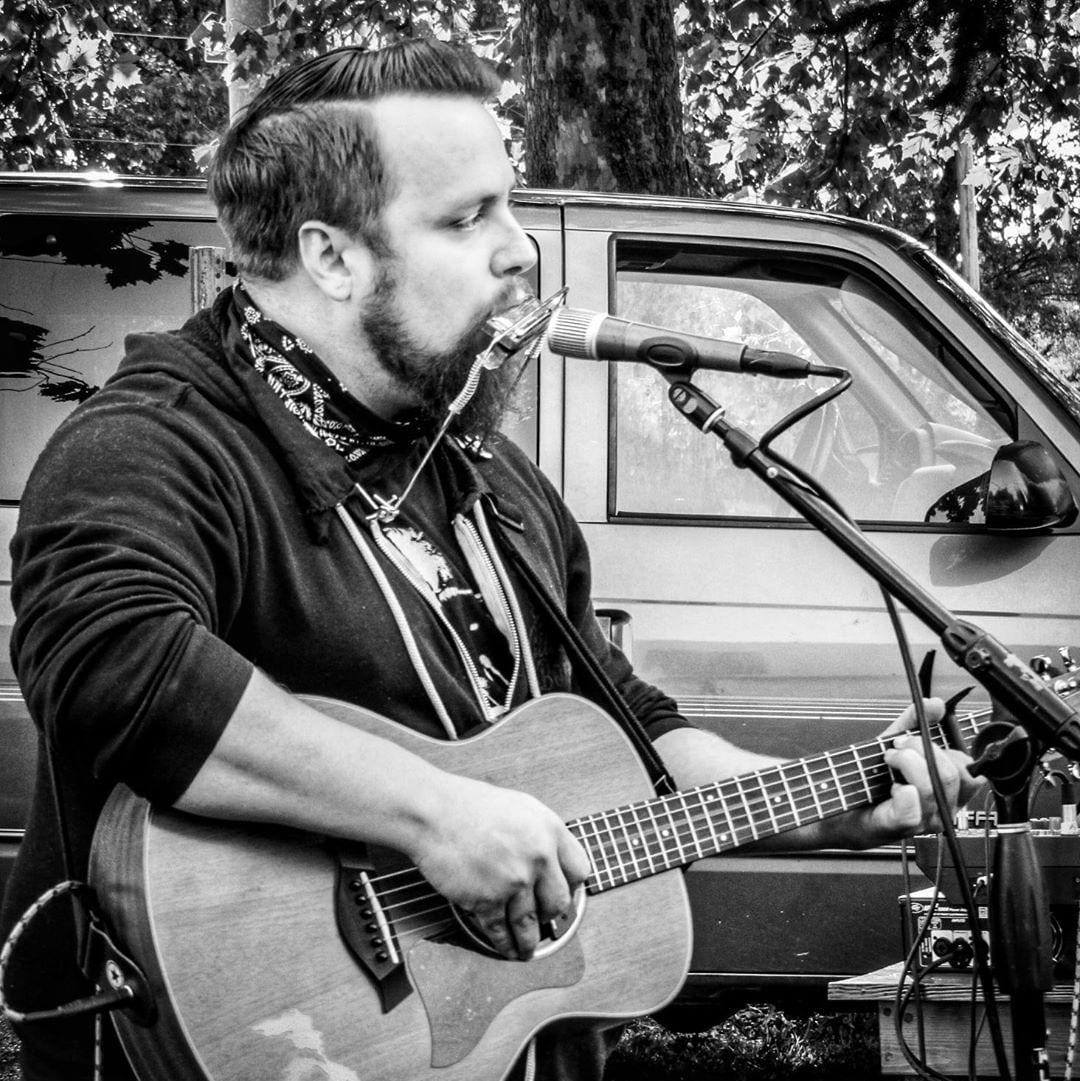
I’m also curious about your plainspoken approach to songwriting. Why is speaking—or singing—plainly important to you when it comes to the stories you’re sharing?
It’s a product of the fact that I can’t really write with a lot of artifice or obfuscation. I love songs that leave me thinking and putting the pieces together, songs like Townes Van Zandt’s “Our Mother The Mountain” or Jason Isbell’s “Live Oak,” but I tend to feel this compulsion to over-explain lest anything be left to the imagination. And that’s an impulse I have to actively reign in and be cognizant of in the editing process. So, by the time a song gets to the finish line, it tends to say what it aims to in a way that can be understood on a first pass hopefully without beating the listener over the head with it.
Can you tell me a little bit about your latest EP?
My latest EP is called Hollering in a Bar, and it’s a collection of solo acoustic tunes that come across as pretty heart-on-the-sleeve. It was recorded a few years ago and in a sense is almost a time capsule of where I was then, so it was refreshing in a way to look at the songs again not just as works that I’m fond of, but as memories of where they came from. Most of them don’t see the light of day perhaps as much as they ought to, and I plan to change that for my solo performances going forward. That’s because I know if I felt as insecure and raw emotionally as I did when I wrote the title track, on any given night in any given small town bar there’s probably going to be someone in the process of going through it. That’s why, in my estimation, sad songs feel so good: because you know you’re not alone.
I’ve noticed that you tend to gravitate toward the EP rather than the full-length LP for your recording projects. Why is that?
Frankly, it’s a matter of time and budget. I’ve always been of the mind that I want my first proper album to be loud, full-band, and as perfectly imperfect as it can be. An EP, especially acoustic-focused ones as mine have been, I treat as a lot more raw and unrefined, for better or for worse. It’s the songs about as naked as they can possibly be, in the state they’re most often sung in. And the intimacy and immediacy of that I don’t overstay. But more from a business perspective, they’re quicker, easier, and cheaper to record and release while I try and work on something larger.
What is your approach to writing and recording music? Has it changed over the years?
These days, I definitely try to write for what I need and record based on that. I don’t need a whole bunch of slow waltzes about heartbreak, as fun as those can be to write and as much as my instincts point me that way. I’ll think, “My live set needs another up-tempo rocker,” or “I don’t play too many songs in the key of B” and I’ll write from some kind of purpose-driven guideline like that. That leaves more repertoire of oringals more well-rounded and in-turn makes any recorded projects featuring those songs a bit more balanced. I wasn’t always able to look at a song as a part of a larger whole like that.
What are your plans for 2024?
My main goal for the first half of 2024 is to release my first full album with my backing band, The Big Breakfast. We’ve been working on it for quite a while now, but hopefully it’ll be ready to be put out into the world by the spring. Still a lot of work between now and then, but I like my chances. Other than that, I wanna play a lot more places and tour extensively. It would be very easy for me to stay in my comfort zone and keep booking the same kinda gigs I’ve been playing, but I want to play new shows in new places for new people! I wanna hit the road for weeks at a time and make new friends and fans along the way, and I wanna do it with my songs. There’s a line in my song “Never Play the Ryman” that’s on my new EP that says, “Maybe next year will be my year.” I think this time it really could be.
Thanks for taking the time to talk to me!
Thank you! It was my pleasure!
2 responses to “By and Large a Bar Musician: Chatting with James Gedda”
James Gedda sounds SO GOOD, wow! I hope he won’t mind it since he’s perhaps tired of hearing it, but Johnny Cash definitely comes to mind. To be clear, it’s really meant as a compliment. To me, it doesn’t get much better than Cash when it comes to country and America.
I love his latest EP “Hollering In a Bar”. He’s a guy to watch, as far as I’m concerned.
Thanks for introducing him and Happy & Healthy New Year! 🙂
I agree! Happy New Year to you as well!