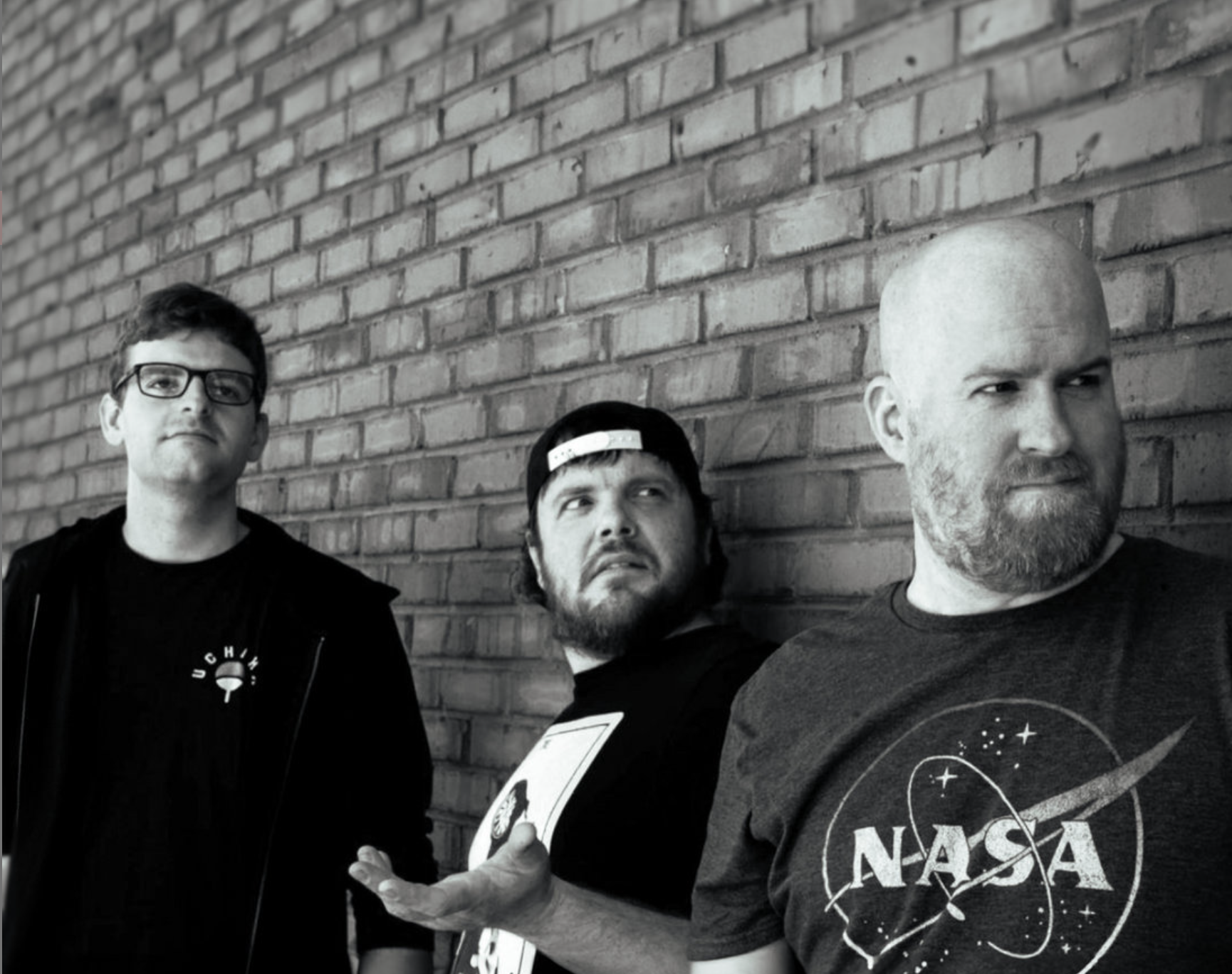
Formed in 2019, Jack the Elbow is a prog rock trio that has spent the last few years writing, recording and rehearsing. Consisting of bassist and lead sing Madison Langham, guitarist Caleb Wilemon, and drummer Michael Tucker, the band started playing last summer and released their debut album, Crush, in January. Just under 50 minutes long, Crush consists of nine tracks that echo prog acts old and new: Coheed and Cambria, Rush, Yes, and more. While the typical changes in key and time signature that characterize prog rock may be part of their modus operandi, their primary focus is on songwriting, a topic that came up when I recently interviewed Caleb Wilemon.
Before we go any further, how did the name Jack the Elbow come about and what does it mean to the band?
That’s a good question. It’s a unique name! Jack The Elbow is basically a joke about breaking people’s bones. The three of us have known each other from training in a martial art together for many many years before we ever formed the band. To “jack the elbow” or the shoulder, or anything else, is a humorous way of saying “attack” that joint. When we named the band, we had some really awful and cliche name ideas come up. Jack The Elbow was the one that seemed to be the most original, and it also captured our shared history and passion for martial arts.
I feel like prog might best be described as an acquired taste—and people who love it really love it. How did you personally discover—and fall in love with—prog?
For me personally, it came about by accident. I was into the 2000’s emo / Guitar Hero rock craze as a teenager. That era fostered an interest in guitar for me and I came up on electric guitar playing those really accessible, power chord driven songs by bands like Fallout Boy and My Chemical Romance. I had a friend who was also learning guitar, and a bit of friendly competition between us drove us both to appreciating more complex stuff as we were learning.
I got into the metalcore craze and started trading out the power chords for chugging rhythms and cool lead parts from bands like As I Lay Dying and All That Remains. I think that foray into metalcore got me thinking about the guitar part as a counter-melodic, continuously moving part of a song, rather than just a droning chord progression.
My love for the aggression of metalcore waned a bit and I found myself looking more and more at bands with clean vocals who did interesting guitar work. Coheed and Cambria dropped their Afterman double album and it blew my mind. I started looking back at the albums that they had released in those emo / Guitar Hero days that I hadn’t given much thought, past “Welcome Home.”
It was a new world, for me, of interesting guitar and vocal melodies that wove a more complex tapestry of sound. I began seeking that out in other bands and discovered other proggy and djent acts like Karnivool, BTBAM and Periphery and Tesseract. I pretty much found myself immersed in modern prog as a result of wanting to hear interesting guitar parts. Then I went back and gave the more “classic” names a more serious look.
And how did Jack the Elbow come together?
As I mentioned in the name bit, we all train in a martial art together. We have known each other for a long time, due to that. The three of us independently had experience playing our instruments and being in band projects, but we never really did anything together. Tucker, our drummer, had the idea to start a band in the summer of 2018, as we were all moving to the same city for the first time in years. And the rest, as they say, is history.
Given the year of the band’s formation, I imagine COVID 19 had at least some influence on its evolution. How did lockdowns and social distancing shape the band?
COVID definitely threw at least a year-long wrench into our plans. On top of that, our singer, Madison, who built the studio we recorded in in his basement, experienced a ton of flooding issues… in his basement. We vacuumed untold thousands of gallons of water out of a space designed to house our music gear during the year after COVID. By some miracle no gear was ever damaged and he was able to get it fixed. I like to think the Rona + the Great Floods probably held us up 2 full years. It makes me feel better to say that, at least, when I think about how long it took us to release our album and start playing live.
Given the complexity of prog rock, I’m curious about how the songs come about. At this point, you have nine of them, so I guess you’d know as well as anyone. What’s the songwriting process like for you guys?
Our writing process begins with a scratch track. A demo. One of us will come up with either a musical idea or a musical + lyrical idea, and we will record our part, laying out the whole song from start to finish. From there, the rest of the band will write parts to it. They might suggest tweaks, as well. Then we practice it together and try to hammer it all out.
We find that co-writing songs can be very difficult if you try to start from nothing together. You need the freedom to do whatever feels right when you are exploring a musical idea. It is hard to have that freedom if you are aware of the competing expectations and ideas of others, even if they are your friends and bandmates. For us, it’s much more efficient to bring demo ideas for full songs that we can then flesh out together than to start from zero as a group. The complexity part is just a result of us feeling that the idea of “prog” gives us license to write whatever we feel, even if it colors outside the lines of what would be expected on the radio.
Along similar lines, how do you approach recording?
Well Crush is all self produced, so we definitely got lots of experience recording through it. We learned as we went and developed a system for the order of recording that went something like this:
First demo guitar and vocals would be laid down. Didn’t have to be glorious, but it did have to be spot on the click. Then we recorded drums. After that, I would re-record guitars, for real this time, as wide doubled tracks with much more attention to detail. Then Madison would record bass. After that we would fill in some space with whatever synth ideas or second guitars seemed right. Then we recorded vocals. I would run the vocal session from the studio downstairs while Madison sang in the dead center of his living room surrounded by fiberglass DIY bass traps to catch as much reflective noise as possible. We ran a giant cable down the stairs and communicated with talk back through our in-ears and the studio monitors. Once vocals were done, we would see if any parts needed touch ups, then move on to the mixing phase.
The whole thing was fun but also awful. I enjoy recording and I also hate it. I have said many times, there is almost nothing else in the world that I feel so passionately thrilled and angered by. It is horrible. I love it.
Are there any challenges in translating the music on Crush to live performances?
If there is any challenge, it is that though we are a three piece, we tend to think about wide instrumentation in the studio. We like a broad sonic sphere, so we add in lots of elements in the studio to thicken things up. Little ambient guitar leads and synth parts that we write and record flesh out our sound, but we have no desire to add a 4th or 5th member to the band to achieve that sound live. We prefer the total creative freedom we have as a three piece to take or leave those elements as we see fit
We manage to bring those elements with us to live performances with the use of an in-ear monitoring system. We play to a click that cues up all of the little filler parts and plays them in the background along with us. The only challenge was figuring out the technical aspects so that we can deploy our system quickly and efficiently every time, without becoming “one of those click bands” that leave front of house workers with a sour taste. We have gone so far as to rehearse deploying our system so that sound guys don’t have to wait around for us.
I’m also curious about what it’s like to play to a live audience. Obviously, some audiences are going to be predisposed to loving prog rock, while others might not be ready for it. How might your music win over the skeptics, as it were?
I think we have two things going for us when it comes to winning over crowds who may not see themselves as prog fans. First and foremost, we value songwriting over all displays of music theory or technicality. When I say songwriting, I’m alluding to those intangible qualities that make you want to sing along. We don’t know what to call ourselves besides prog rock, but we also don’t really need to prove to anyone that it is “prog.” We just make riffy rock that you can sing along to. It happens to dip into different time and key signatures here and there, but those “elements of prog” serve the song, not the other way around.
I think anyone could see us live, having never thought of the term “prog,” and walk away thinking we were a really fun hard rock band with some cool metal riffs. The odd times and constant key changes are less important, and less obvious or out of place feeling than the emotional trip from verse to chorus to bridge and back. The intellectual part is secondary to feeling, for us.
The second strength we have is tightness. It’s not to say that we are fabulous, technical musicians that can blow anyone away… But the truth is, we rehearsed a full album set to a click for like 2 years before ever taking a stage. Actually we rehearsed that same material without a click for a couple years before that. We can play it pretty well. That click in our ears and the ability to bring in album backing tracks makes for a pretty solid concert experience.
I think we win people over with that because they are somewhat surprised to hear the sort of show we put on in a small local music venue. I wish there were a more humble sounding way of expressing this, but the truth is… we’re kind of good.
With those skeptics in mind, is there a track on Crush that might serve as a gateway to your music?
To me, Shame and Fly Away make for decent candidates just because they are shorter. They also don’t feature any crazy key or time changes, though Fly Away does have some unique guitar riffs. Those would be decent starting points, but I also think anywhere on the album would be okay. We aren’t all that wild, as far as prog goes. Compared to some of the out there stuff I like to listen to, I think Crush is quite accessible.
What’s on the horizon for Jack the Elbow?
We’re working on a concept EP that we’d like to get out this year. We have studio time booked to begin recording it soon. We’re very excited to NOT be recording ourselves and to be able to defer to someone else’s expertise. That, and we’re hoping to play a lot of shows outside of our home city to try to build a fanbase that isn’t entirely local.
Thanks for taking the time to talk to me!
Thanks a ton for having me!
2 responses to “We’re Kind of Good: A Chat with Caleb Wilemon of Jack the Elbow”
Prog rock isn’t one of my favorites, but they sound pretty good! Very tight performances and arrangements, which I’m guessing are even more crucial with prog rock.
I think you’re right about the tight performances and arrangements. There isn’t much room for error — or, I’m guessing, much improvisation — in prog!