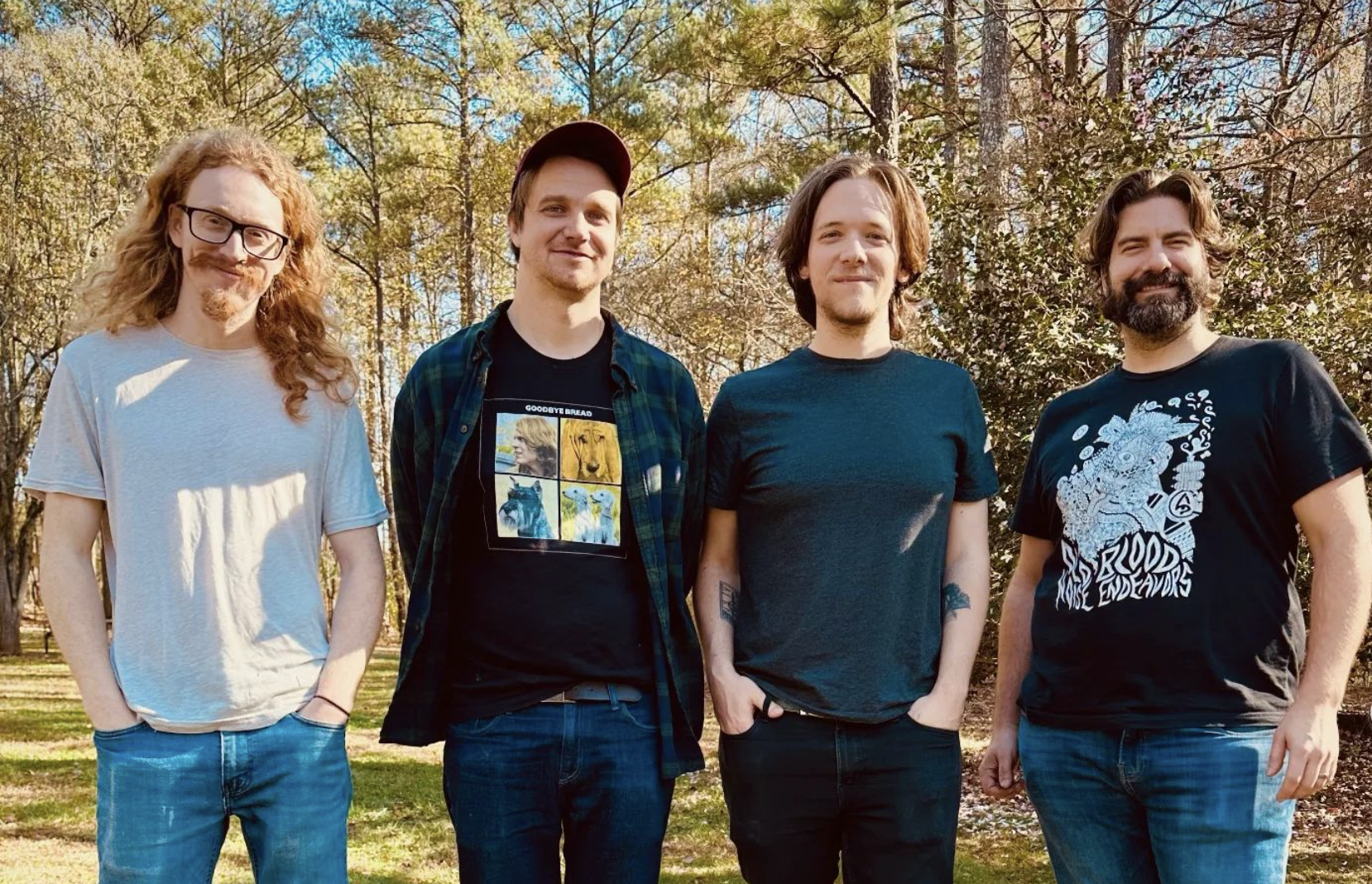
Formed in 2022, The Silver Doors is made up of Justin Lawrence on violin, Brett J Kent on vocals and bass, Bryce Alberghini on drums, and Alex Cox on vocals and guitar. The Silver Doors, existing in a space you could call Appalachian Desert Rock, they blend elements of psych, garage, blues, and more, giving equal homage to both the psych genre as well as the Appalachian Mountains they call home. The live shows are where they shine, showing off their range of genre-bending dynamics: everything from headbang-able riffs to trippy psych grooves, from delicate verses to walls of sound, all while intentionally orchestrating an effects-laden violin.
I love the band name! It reminds me of a lot of things… The Silver Beetles, for example, and, obviously, the Doors—but it also makes me think of Andy Warhol’s factory when it was covered in foil in the 1960s. What does the name mean to you?
I love those interpretations of the name! I came up with the name originally, and funnily enough, our bass player and singer Brett got the same references from it that you did. I originally got the inspiration from the song title “Sleepy Silver Door” by Dead Meadow. I love that band a lot and it’s just a killer song. But I love the images you got from it, and my hope is that people have their own interpretations and images when they see the name!
I also like that you use the phrase “Appalachian Desert Rock” to describe your music. How did that come about? What’s Appalachian about it, and what’s desert? Where do the two meet, and what happens when they come together?
“Appalachian Desert Rock” is kind of the closest approximation of our music that we could come up with. It’s really a product of where we are located geographically combined with what our influences are, and less about “we’re in the mountains so we have to call it this.” The Appalachian Mountains inform the music. Our violin player Justin (who happens to be from Long Island) plays in bluegrass groups around town, so he adds that flavor of bluegrass violin, while taking it into new territory with effects like fuzz and delay. In addition, Bryce and myself were both born and raised in the area (Asheville, NC), so we grew up in a place rich in blues, bluegrass, folk, country, etc. Bryce and I originally met in college and played in a previous band playing heavy blues rock, and we both bring a love of blues to the table. Brett brings more of a punk and garage rock background to his bass playing and vocals.
The desert rock portion comes from our collective love of bands like Queens of the Stone Age, Yawning Man, The Black Angels, La Luz and All Them Witches. Bands that include repetitive trance-like sections to their songs, guitar riffs, effects, and elements of blues and psych. In high school, I landscaped in the summers and would spend 8 hours a day mowing yards and listening to the entire Queens of the Stone Age discography front to back.
When those things come together, you get songs like “Redeemer” – a bluesy/folky intro recorded on a 12-string acoustic that transitions into a heavy rock song with a trance-like repetitive middle section. Or “Losing Hand,” a song that starts with an atmospheric violin part but shifts into a riffy rock song with a heavy outro. Or on the softer side, songs like “Shattered” that include a repetitive reverby guitar part in the background combined with a melodic fiddle section in the middle.
Violin plays a key role in the band’s sound. Why is that?
The seeds were originally planted when we were looking for a fourth member. We were open to someone who could maybe play guitar, but were especially interested in other instruments you wouldn’t typically see in a rock band. Early on in that process, Brett said “what about violin?” and I called Justin that night. I had worked with Justin in the past, and had jammed with him one-on-one with guitar and violin. I knew that he had a great ear, great technique, and a mutual love of effects pedals and improvisation. Justin said yes without hearing a single demo and as soon as we all played together it was a great fit. He’s a key role because he is such a fantastic player that has such a defining element to our sound, and it would be a disservice not to highlight it! Justin brings that “x factor” that I think makes us stand out- not only because you don’t typically see violin in a rock band, but because he is such a talented individual on top of that.
Your bio mentions “intentionally orchestrating” an effects-laden violin. Intentional in what way, and as opposed to what? Why is it important to be intentional in this regard?
I suppose that comes from the fact that we spend a lot of time considering where the violin is sitting in relation to the other elements and treat it as an equal part of the sound, as opposed to a background or textural element (which it can be too, if that’s what’s appropriate at the time). If we were the types to go the “easy” route, we could have seeked out a 4th member and found someone who played keys or guitar and been satisfied with someone who stuck to the root notes and basic melodies or background, without objectively challenging the music itself (nothing wrong with that either!).
Justin challenges us. Not only do we collectively consider what texture, tempo, melody, or key the violin is bringing to every part of any given song in relation to the vocals and other strings, Justin is usually the one to ask “what imagery are we trying to invoke? What is this song about and are we achieving that with what we’re doing?” We often consider what our “string section” is doing in relation to our “rhythm section” and I think approaching it like an orchestra makes for more intentional and interesting arrangements, as opposed to having the violin drone the root note underneath us on every song.

Looking at your calendar, I can see that you play out a lot. How are live shows different from your recordings?
I hope it’s not too cliche to say that our live shows are more raw than our studio recordings. But in a more tangible way, the live shows may involve more improvisation and more dynamic variations from loud to soft than the recordings. In the live show we may have sections of songs that are so soft you could theoretically talk over them in a normal voice, and in the same set have sections that are (hopefully) a wall of sound that sounds pretty epic. We strive for both ends of the spectrum.
You’ve been playing together since 2022, and your first album is due in April of this year. How did your music take shape over that period of time?
The music has evolved a lot. Technically speaking, our first recording sessions were in December of 2022, when we had only been practicing and playing live as a four piece for a couple months. We had follow-up recording sessions in the summer of 2023 that finished out the album. But as any other musician can probably attest, playing a song live changes how you approach it and potentially how you record it. You may realize that a certain texture or approach to a song may not come across live how it does in the recordings. So you adjust as you go, taking the feedback you get live and applying it to the studio, and vice versa.
I’m struck by the art on the singles that you’ve released so far: black and white images of Victorian houses. There’s something ghostly and haunting about them. How do those images correspond with your music?
I took those photos on film over the past few years, and they resurfaced while we were brainstorming choices for art for the singles. We landed on them for a number of reasons – for me, there is something magical and textural about film photos that is akin to that feeling you get from listening to music on tape or vinyl. Something about physical mediums scratches an itch in a certain part of my brain. And they are photos of places around Asheville, so there’s the local tie-in. We’re happy to be a rock band in a relatively small town in the mountains of North Carolina, so we like incorporating those local elements into our aesthetic. Speaking of, the album cover is a local piece commissioned by my friend Charlie Goldberg, which depicts a mountain and a stream and natural elements, another tie-in to the beautiful nature here in the mountains.
You recorded the album at Drop of Sun Studios in Asheville, NC, with Alex Farrar. What was that experience like? How did he help to shape the sound?
As anyone who has recorded there can attest, Drop of Sun is a magical place. They have everything you could want in the way of musical gear, so you’re really only limited by your imagination. Alex and Lawson (additional engineering/recording/overdubs) are so supportive of your vision. We got to layer fun instruments into parts of songs, try different amps and pedals, and experiment. If anyone (including Alex or Lawson themselves) has a “what if…” moment, it’s always fair game. If you need a megaphone to yell into for a vocal part, they know a guy.
How does the band handle songwriting?
A song may start as anything from a riff to most of a song, and one of us will bring that idea to the band. We then flesh it out and each person adds their own elements and ideas and flavors to it. It’s a pretty democratic process. We typically say that we don’t judge each other on our bad ideas, but our good ones. So we’re open to trying different arrangements, chord changes, and other things in hopes of finding what can get across the emotion or subject of the song in the best way. We have one song (that has yet to be recorded) that has completely changed in arrangement and delivery from when we first jammed on it as a demo, which I think speaks to our adaptability to what the song calls for and not being married to any one idea. Playing the songs live changes them as well, so we’re trying to wait a little longer to record the next batch until they’ve had time to incubate!
What’s next for the Silver Doors?
An album release show at Eulogy in downtown Asheville on April 18th, then trying to play out regionally as much as our schedules allow this year. And we’re always workshopping new songs and ideas. It won’t be too long before we’re in the songwriting/demo/studio phase again. But ultimately we’re grateful to be doing this at all. We love making music together, playing live, and recording, so as long as we’re able to, we’ll keep at it.
Thanks for taking the time to answer my questions!
Thanks for having us!
Presave: https://distrokid.com/hyperfollow/thesilverdoors/the-silver-doors-4
4 responses to “Appalachian Desert Rock: A Conversation with Alex Cox of the Silver Doors”
Their sound is arresting and dark, yet melodic, and I can hear the Queens of the Stone Age influences. Great interview Marc!
Thanks, Jeff! It’s an interesting and compelling sound!
Thanks for the kind words Jeff! <3
Thanks for having us Marc! Thoroughly enjoyed the chat!