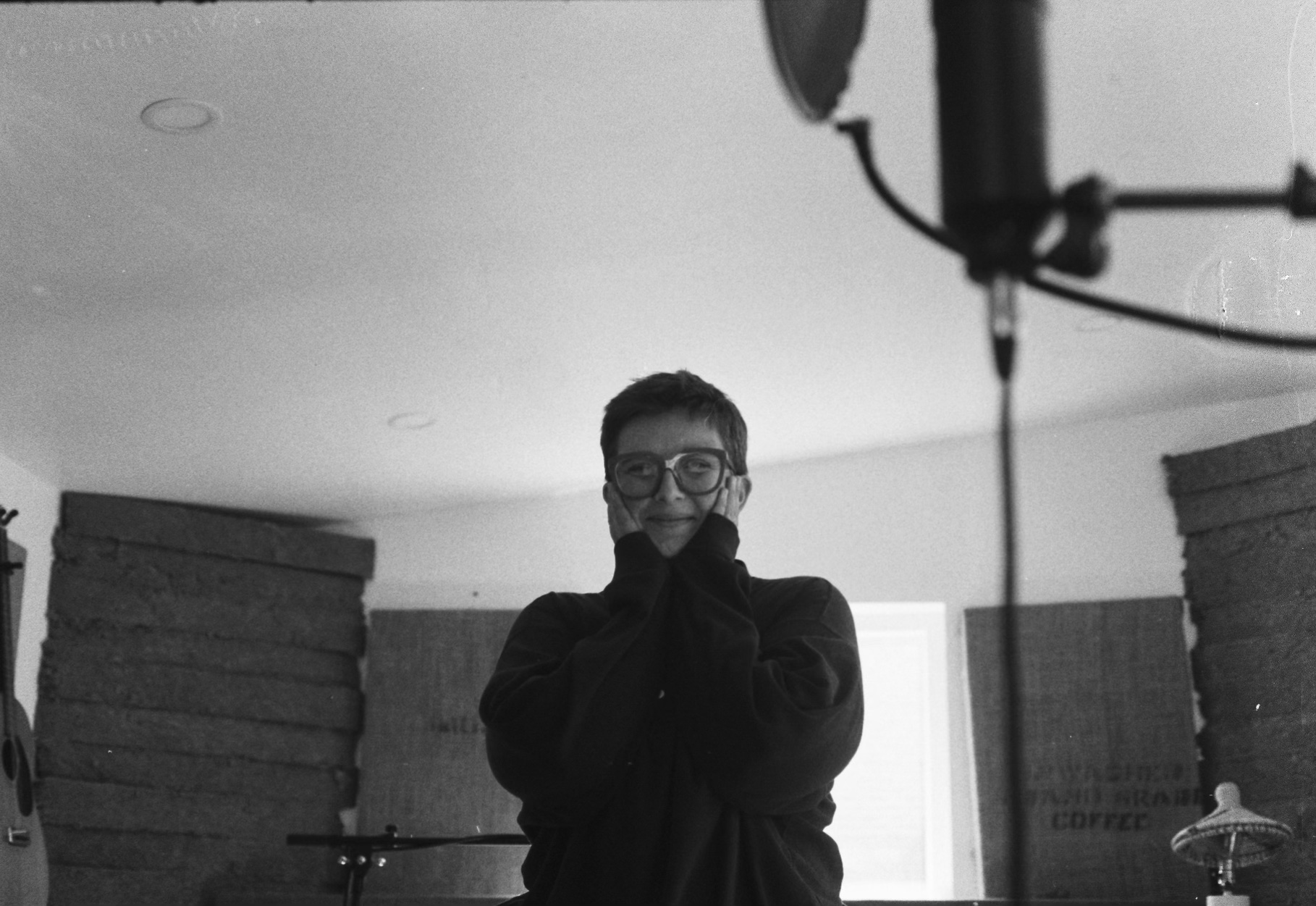
Nashville-based Purser’s latest single, “Zero Sum” is a mesmerizing track that delves into the many shades of grief in the wake of a relationship. Drawing inspiration from folk-rock storytellers like Adrianne Lenker and production-heavy pop artists like The Japanese House, Purser infuses the song with their signature blend of indie rock and electronic elements, creating an experience that is both shocking and immersive. From the whispered vocals to the metallic instrumentation, every aspect of the song has been meticulously crafted to evoke an addictive unease.
Your new single, “Zero Sum,” is incredibly evocative. I particularly like the couplet “Checking every memory for freezer burn/Tossing out the ones that make my stomach turn.” It makes me think about how people can—and probably need to—curate their own lives in order to maintain a sense of equilibrium. Sometimes we hold onto things that we shouldn’t, and sometimes we even hold onto things we thought would be valuable long after their value has passed. I suppose that’s less of a question than an observation, but maybe you can shed a little more light on that couplet and how it relates to the song as a whole—and your approach to songwriting?
Oh so we’re diving RIGHT in.
When I wrote this song I was still grieving this relationship, and sorting through old memories was how I spent most of my time. The present felt unreal, I was so consumed by the recent past: trying to make sense of it, trying to forget it, trying to capture it.
Once I got accustomed to the grief of losing the relationship, I started to grieve the increasing staleness of the memories. Even the ones I’d worked so hard to preserve started losing their color and taste; pleasant memories soured and unpleasant ones stank of our expired future. It was too much, and I had to let go of my memories as I let go of the person I made them with.
It feels shameful to admit to editorializing the past, but we all do it. We have to make room in our brains and bodies for new life and new relationships. I suppose writing this song – and every other song – is about giving a memory its own body so it doesn’t have to exclusively live in yours. That’s also why it’s a gift when we consume each other’s songs: we don’t have to condemn our memories to a half-life in the freezer, we can offer them up and maybe someone will get fed.
You’ve described “Zero Sum” as a postcard from your rock bottom. Was dredging up those memories difficult for you?
Writing “Zero Sum” was a relief in the way an exorcism is a relief. Recording was equally cathartic and painful. Singing about dissociation sometimes triggered dissociative episodes.
It’s also a very technically difficult song to sing because it requires you to be breathy without giving you a chance to breathe, so when you’re singing it you’re kind of always hyperventilating. Whoever wrote this song was trying to kill me.
Why is it important for you to share those memories in song form?
Even during that limbo of loss and conflict, I knew I was experiencing something pivotal. It was a sacred time of transformation, and I wanted to get a head start on redeeming the pain by making art.
I also love the vibe of that song. It’s hypnotic yet jarring in places as well. The credits for the song suggest a team effort, with you providing the lyrics and music, Cassidy Gephart playing keys, Emma Lambiase playing bass, and Simon Knudtson playing percussion and producing the track. In this age where technology allows artists to “do it all” as it were, why was it important for you to bring other musicians in on the project?
To me, that’s like asking, “Why is it important to have friends?” I have so much respect for artists who do it all by themselves, and I’ve learned that cannot be me. I experience infinitely more motivation, joy, and inspiration in collaborative settings. Making art as a community is a Top 10 human experience, plus my friends are way too talented for me not to bother them with all my projects.
I’m particularly curious about Simon Kundtson’s role. What do you see as the benefit of working with a producer as opposed to producing the track yourself?
I could talk about Simon’s role in my musical life for hours.
Simon and I hung out for the first time the day I wrote Zero Sum. I originally called him because I needed drums for “Out of Hand.” The next thing I knew, we were in his studio completely re-imagining the whole track. We started building the sound and creative relationship I’d always hoped for.
Simon creates without ego and challenges without pushing. He’s organized, playful, and deeply considerate. His technical knowledge is impressive enough, but coupled with his emotional instinct and relentless attention to detail he becomes a fierce advocate for your art who won’t give up until it’s right. I can’t even answer the second half of this question because I genuinely don’t know where I’d be without him tirelessly translating my emotions into odd little sounds.

I’m also impressed with the video for that song. Throughout, you fill a horizontal landscape ratio with three vertical shots of the same footage. (Sorry to my readers for not describing this technique as well as I could! Check out the video at the end of this interview to see what I’m getting at.) What was behind this decision? Does it represent anything, or was it more of a practical technique?
I wish I had some deep answer to give you, but it’s just because I filmed the original video for TikTok and needed to make it work for YouTube lol. I appreciate you asking about this, though, because in hindsight I do enjoy the disorienting, kaleidoscopic effect of the triple-take video. It feels like you’re rewinding a fractured home video of a bad dream.
Like your music, the video is a result of collaboration—in this case among yourself, Kat Elizabeth, and Sissy Dinkle. What did each of you bring to the video?
Kat Elizabeth and Sissy Dinkle are incredible indie artists in my community, so they know how to make art on a budget. The three of us spent a night passing our phones around, finding candid footage. I paid them with a trip to Sonic afterward.
Sissy had the idea to play the role of “Dark Figure No. 1 / Sleep Paralysis Demon” to make me appear haunted by the memory of someone, and Kat gave us the inspiration for those brief flashes where I break the fourth wall like I’m being watched. Those are both some of my favorite moments in the video.
You’re based in Nashville. How does living and performing in a city renowned for its music influence your own approach to music?
I’m not gonna lie, it’s the best thing ever. The sense of shared purpose is undeniable. An industry vet once told me that in the pre-internet days of Music Row it was common to run over to the studio next door to borrow equipment if you were short on mics or cables. That spirit of hospitality and collaboration continues now in the streets of East Nashville where we send out the bat signal for borrowed gear on Instagram stories and organize regular meetups to share resources.
Regarding the music itself, I’m lucky enough to see incredible DIY shows multiple nights every week, and about once a month I’ll hear something so powerful it changes how I approach my next song. I still can’t believe I’m neighbors with my favorite songwriters. In addition to Kat and Sissy, I’m thinking of Macho Planet, OTNES, Cass Hart, Demiatrix, Wilby, and Ally Westover, just to name a few. Nashville is home to so much more than country music.
Your press materials mention a commitment to pushing the boundaries of indie rock. What are some of the boundaries you see yourself pushing, and why is it important to push them?
I want to keep indie rock openhearted.
Sometimes it’s easy to fall back onto assumptions that our genre has a specific sound or only addresses certain themes in a certain lyrical style.
I firmly believe indie rock can be as sonically versatile as classical music (Moses Sumney), employing an orchestra’s breadth of instrumentation, including production-as-instrument. It can also be as powerful of a storytelling vehicle as country music (Madi Diaz), deftly probing the remotest corners of our shared experiences.
I’d love for my music to pursue a vision of “indie rock” that goes beyond “romantic heartbreak on electric guitars.” Also real quick please ignore the fact that “Zero Sum” is just romantic heartbreak on electric guitars hahaha
What’s next?
My live EP “3x” comes out in April while I’m on tour, followed by two studio singles completing the “Zero Sum” EP. I can’t wait to send these songs back into the ether with gratitude.
Photo credits: Parker Van Der Hyde (top) and Will Baldwin (middle).
2 responses to “Diving Right In: An Interview with Purser”
A very interesting lady, and her song is both jarring and darkly beautiful.
Excellent interview, Marc & Purser! I agree, indie music is much more wide-ranging & stylistically diverse than the “sad songs with guitar” idea that some have.
I should start bribing collaborators with trips to Sonic, too!