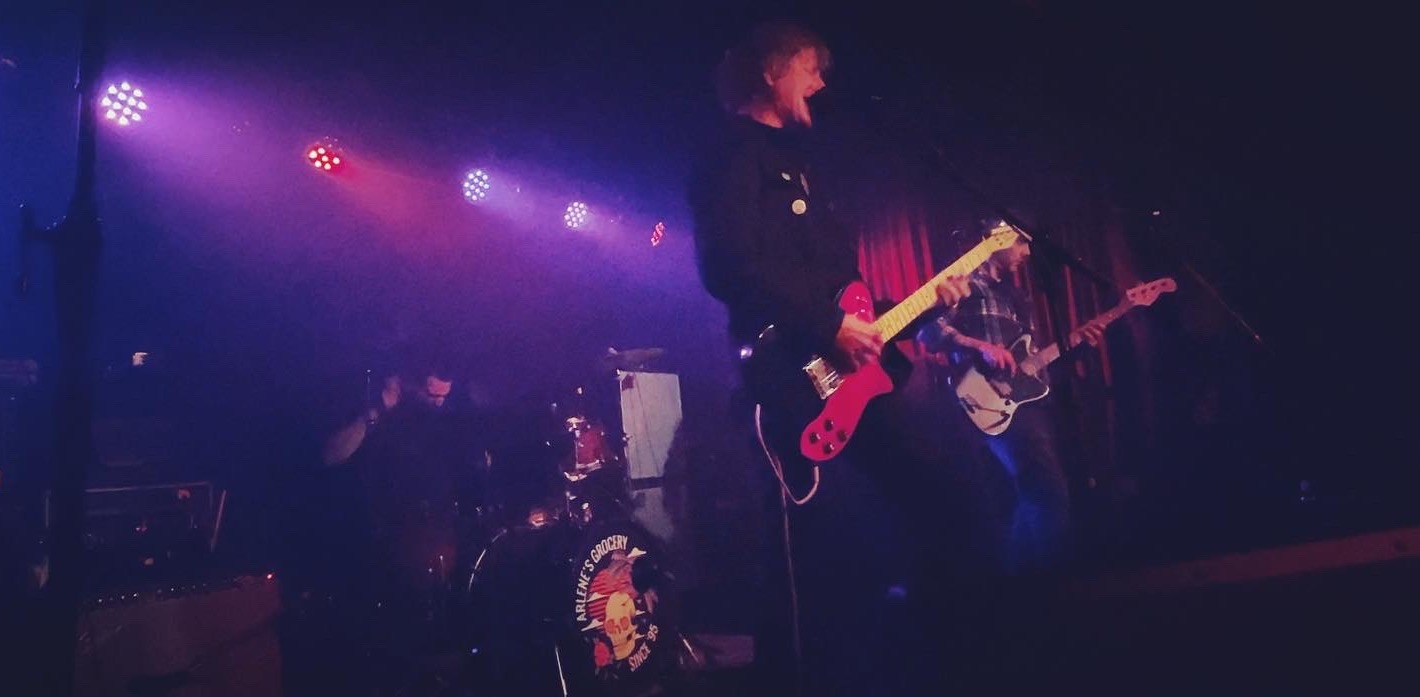
Longtime readers of this blog will know that I’m a huge fan of Snap Infraction. Last time we chatted was in November of 2022, and we talked about a wide range of topics, including their love of the Beatles, the strategy of slow-dripping an album, and the history of the band. Turns out they’ve been busy since then, having released two singles in anticipation of their album Eephus, which was released on May 3rd. Curious to learn more, I dropped guitarist Steve Karsch a line…
Last time we talked, the strategy was to “slow-drip” an album, releasing two songs at a time with the intention of bundling them all together into a single album once all the tracks were released. This time around, you’re taking a more traditional route by releasing a couple of singles and then the full album. What was behind this decision?
You just reminded me that we never DID end up putting all those tracks on an album. Hah! I guess we should do that. Maybe sometime next year!
Anyway, the thinking behind doing things in a more “traditional album” fashion this time around was kind of two-fold. First, we are all fans of the album as a musical entity. And I don’t mean concept albums or whatever. Just a collection of songs that were written and recorded in roughly the same time period. A time capsule of sorts. Not every song has to be single material. Albums are supposed to flow, so, yeah, of course you hope there’s a “hit” or two, but the rest of the tracks are there for a reason, too. They’re not just filler. When I look at an album like “Synchronicity” by The Police; it’s an incredible album, right? Lots of hits. But “Mother” and “Murder By Numbers” and “Miss Gradenko” are great, as well. If The Police were to just put out the singles, those songs might never have been heard. But as part of that album, they’re a perfect fit.
The second reason was because I think it’s important to have a different approach to each “band project.” We get bored pretty easily. So, we did the EP thing (twice), we did a year of singles, and now we did an album. The next project is Snap Infraction: The Movie (kidding).
Did thinking of the project as a fully-formed album change your approach to songwriting?
It definitely did. When we did those singles in 2021 it was basically an experiment in writing to a deadline. Some of those songs had been in a partially-written state for a while and just needed finishing, but more than half of them were like “OK, *that* song’s done, now I need to write/record/mix two more in two months.”
With “eephus” my plan all along was to spend 2022 writing and fully-demo’ing all the songs before we even *thought* about going into the studio. All of the songs were written in that timeframe. Well, except for the riff on “Leave Without A Fight.” I had that as part of a different song a decade ago and Tony liked it so I *had* to use it. But, other than that, everything was written in 2022.
When I listen to those demos now and compare them with the finished album, there are some changes, but not a ton. 90%+ of the album is there, in place. I probably changed a couple of lyrics, but it’s all there. Obviously, the album sounds WORLDS better than the demos, but all the pieces are there. Maybe for the 20th anniversary “deluxe reissue” we’ll release the demos. On cassette! Ha!
That being said, when I was writing the songs I didn’t sit down and think “OK, track 3 of the album needs to be a reset song, a little slower” or anything formulaic like that. They pretty much just came out how they came out and then we put them in order and I think (hope) they flow well together.
For previous projects, I recall that you did what a lot of us in the indie music scene do: sending files back and forth and recording parts at home. This time around, I understand you went into a studio to record. What was behind that decision?
As I mentioned earlier, we just wanted to do something different. We have a low boredom threshold so we need to keep ourselves motivated by trying different things. Not *drastically* different like “Oh, we’re gonna write and record a electronica-thrash metal album” but just things like “This time we’re going to release a single every 2 months” or “This time we’re going to do an album in a studio.” Truthfully, I just wanted to get out of my basement for once.
How did recording in a studio influence the songs?
It didn’t really influence me from a songwriting perspective. Although, one thing I tried to do was keep the arrangements pretty light and tight. There’s not many (or any) songs where there’s, like, 10 guitars going at once. There’s a lot of vocal harmonies, but instrumentation-wise we kept it pretty straightforward, and I think that’s because, since we did it in a studio, we were really happy with how the drums sounded so we didn’t have to throw a bunch of layers on top to try to cover up any deficiencies in the recordings.
It also forced us to be better planners. In our “singles” era, I would quickly demo a song with a rough arrangement, send it to the other guys for them to record their parts, they would send it back and I would finish writing the song *as* I was recording my parts.
This time, we had everything worked out ahead of time. To the point where when it came time to cut vocals, we had written down what notes we needed to sing in the harmonies so there wouldn’t be any questions or time wasted trying to figure things out.
Looking at the credits on two singles you’ve released so far, I see, they were recorded and engineered by Matt Weber at Gradwell House Studios. What did working with an engineer bring to the process?
I really can’t say enough good things about Matt and Gradwell House. Matt very clearly knows what he’s doing and is so easy to work with and is a super-quick worker. There was never a time where we were sitting around while the engineer figured something out, or fixed a faulty cable or whatever. Everything went super-smoothly and that’s largely due to how excellent Matt is. Even when I ended up tracking some things at home and would inevitably run into a problem, I would think “Where the hell is Matt when I need him?” Haha. It is immensely freeing to have that level of trust in the people you work with, and we had never even met him until the day of the first session. Also, if you work with Matt, bring him Skittles!
It was the same with our mix engineer, Mike Ian at Eyeball Studios. Tony and I have known Mike for an eternity, it seems. And he has the most amazing ear. I swear he hears frequencies that 99.99% of humanity doesn’t hear. And he’s a virtuoso-type player on a ton of instruments. We were totally psyched when he had some availability to mix our record because we just knew he would do an incredible job. And he did. Again, we trusted him totally. We never had any questions about the mix, maybe a few tiny notes here or there, but everything he did was awesome! And Tom Volpicelli at Mastering House has been mastering our stuff since we did the “Stiff Arm” EP and he did an incredible job per usual.

The lead single from the new album is called “Keeping Score,” and it’s actually about learning not to keep score. Why do you think people have a tendency to keep score—especially in relationships—and why might that be a problem?
The story behind that song, or at least the title of that song, goes back a long way. When my wife and I got married, we were all at the after-after party at the hotel and our friend took Tony’s video camera (this was before the advent of smartphones) and went around asking people at the bar, who weren’t even there for our wedding, advice for the newlyweds. And this woman looked straight into the camera and said “Don’t keep score” which is one of the best pieces of advice I’ve ever received.
I think it’s human nature to keep score. We’re always keeping tabs on what others are doing and comparing and judging ourselves. I’m certainly guilty of it but that woman’s advice from years ago is etched in my brain. And I’m thankful for that, because it reminds me that I’m doing whatever I’m supposed to be doing at whatever pace I’m supposed to be doing it.
The second single, “Nothing Has Changed at All,” reminds me a bit of The Beatles. In particular, the “Do-do-dit-doo dit-doo doo-whoo” lines make me think of “Mother Nature’s Son.” Who are some other influences on the new album?
Ding ding ding! Yeah, that’s *totally* Beatle-influenced. It’s no secret that they are my favorite band in all time and space and they greatly influence my songwriting. I try not to go too deep into Beatle-pastiche territory but that song certainly treads carefully (or not so carefully) in that area. It was written not long after the “Get Back” documentary came out which kind of reminded me that this is supposed to be fun, you know? For all their quarrels and whatever, when they got down to playing, it was fun. Or it *looked* fun, at least. The “do-do-dit-doo” part was another instance where I’d be listening to their songs where they do that and I thought, “huh, not EVERYTHING has to have a lyric.”
Anyway, as far as influences across the rest of the album: Tony was on a really big Cars kick so he said to me “you need to write more songs like The Cars.” That’s where “Keeping Score” came from. He said that, and I had a little keyboard on the desk next to me and I just hit the first four notes, kind of randomly: G A B D and it just sort of grew out of that randomness. I seem to remember that one coming together pretty quickly, the drum intro and the bass bit and everything. I tried to make the guitar part like something Elliot Easton would play. And we knew from day one that it would open that album.
There’s all kinds of little influences scattered across the album, like early Fleetwood Mac, Joe Jackson, etc but really the biggest influences *were* bands like The Cars or The Beatles or The Police where every song on the album is strong. Even “You Tried To Get Away With It All”, which is not necessarily in our wheel-house stylistically…I like it for that very reason. Not every song needs to be hit material, but every track needs to be as good as we can make it. A no-skipper, if you will. Of course, that’s for the listener to decide.
I’m also curious about the title of the album. What does “eephus” signify, and does that idea tie the songs on the album together in any way?
That was kind of a last minute decision. We had another title for it, but our previous EP titles, “Chin Music” and “Stiff Arm”, are sports slang and the temporary title we had was not sports-based. Tony and I were talking about baseball during the last Phillies playoff run and we may have been talking about a pitcher who gave up a home run and I said “yeah, he threw up an eephus.” It’s a nothing pitch. Like a big looping lob of a pitch. It has nothing to do with the record or the songs but it’s a funny word and it has to do with sports, so that’s why we used it.
Are there any plans for the band to play live?
Our shows are few and far between but we *did* just play one at The Fire in Philly, which was a lot of fun, and I think we have a few lined up in the summer/fall in the Philly area as well. Stay tuned.
What comes next?
Good question. I’m always writing and I have some songs ready for whatever we do next, which we haven’t even really discussed yet…I vacillate between doing another full-length album vs doing more EPs vs just doing singles. I think once the album comes out I’ll start the process of going through my newer demos and seeing what we have to work with.
Thanks for taking the time to talk to me!
It’s always a pleasure, Marc!
2 responses to “We Get Bored Pretty Easily: A Conversation with Steve Karsch of Snap Infraction”
If you enjoyed this interview, check out this interview with Steve Karsch that Jaimee Jakobczak did on the Crooked Forest blog: https://crookedforest.ca/2024/03/04/a-casual-conversation-with-steve-karsch-snap-infraction/
Lot of relatable conversation here. I too get bored too easily and love the Beatles. And am a fan of this band as well!