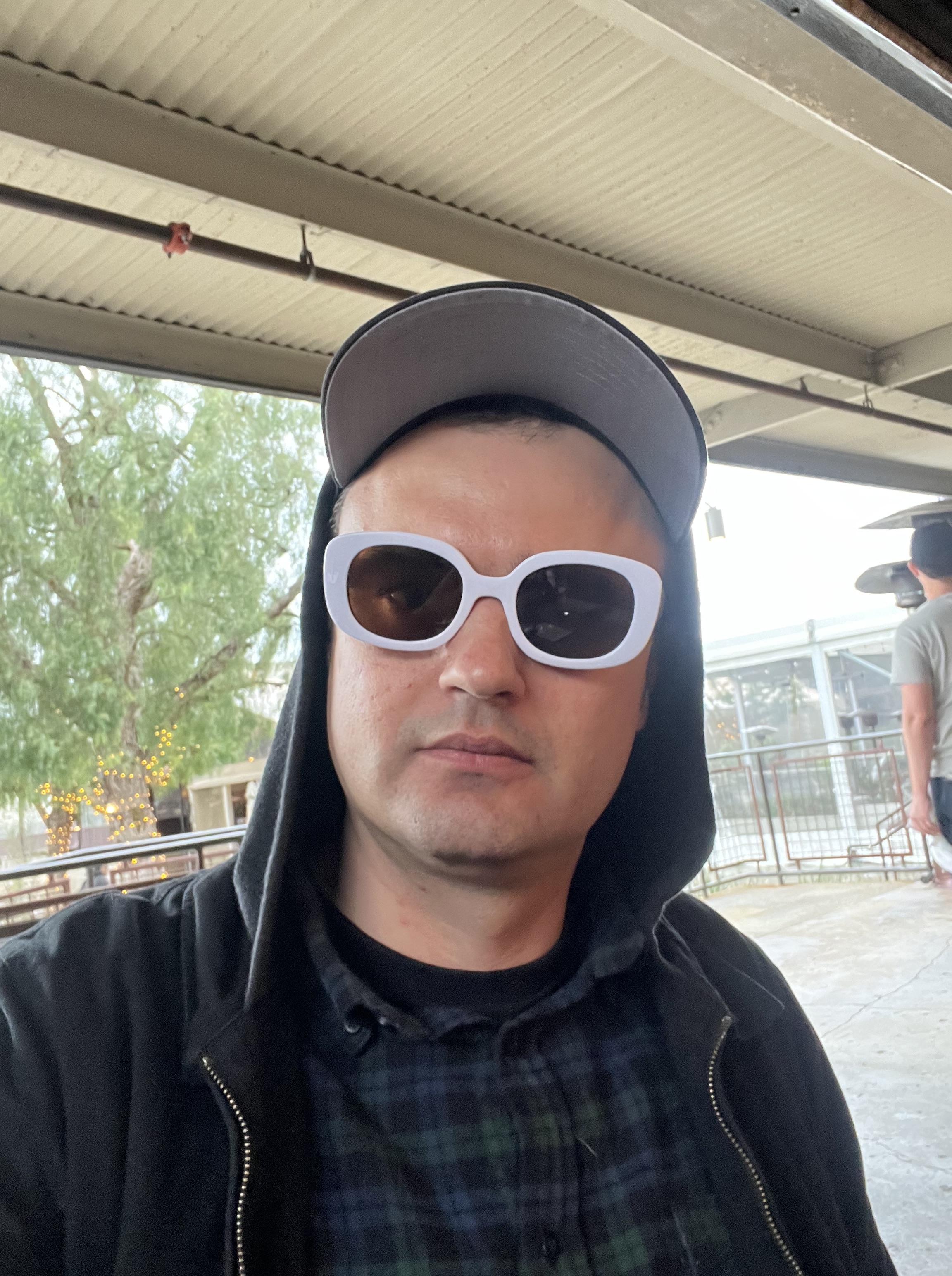
When I heard that Dima Zadorzhny recorded FOG, the latest album from Storm Clouds, on a four-track cassette recorder, I was immediately brought back to 1990s when I used to play around on my Tascam Porta-03 for hours. These days, of course, I make music on (or is it in?) a DAW, happy for the flexibility, limitless tracks, and the all-important “undo” function, so I reached out to Dima to find out more about the project–and the motivation behind it.
Your new album is called F.O.G. with periods after each letter, suggesting an acronym. What do the letters stand for?
“Fear, Obligation, Guilt”
I’m familiar with all three! You recorded the album on a four-track cassette recorder. What was behind this decision?
I first got into recording back in high school through listening to a lot of lo-fi music. My first recordings were on Audacity and I later went down the analog rabbit hole and got a cassette four-track. After college, I decided to try pursuing audio engineering as a career and I got an internship-turned-part-time job at a recording studio, where I learned all about Pro Tools, plugins, and digital recording, but I got too busy to work on my own music and after a few years I felt really uninspired and burnt out on music in general. So the decision to use the cassette for this one was a way to try to reconnect with what inspires me in music and embrace a workflow that’s more immediate and sort of forces you to actually finish something, even if it’s unpolished, instead of endlessly adjusting plugin parameters trying to make everything perfect, which is what I struggled with in the past.
Had you done any recording prior to that? If so, what was your medium? In other words, analog tape or digital?
I made an album of some really primitive Audacity recordings back in 2009 that I was too embarrassed to show anyone until a couple years ago. There’s no effects or plugins of any kind, just a microphone straight into the laptop’s soundcard, and if you wanted to EQ something you had to highlight it and wait for it to process before you could hear the changes. That was my intro. Around that time too I recorded some acoustic-pop-punk songs on a Fisher-Price toy cassette recorder, just like one mic, one take, no overdubs. Those are lost forever to the MySpace server cyber-abyss. While I was working at the studio, I recorded and mixed a handful of EPs and albums for other bands on Pro Tools, and I put out a little EP of my music in 2016 that started on cassette, but 95% was finished on Pro Tools. That one has a cool sound I know I could never recreate without access to all the nice studio gear.
What model recorder did you use? Did you use any additional gear like pedals or pre-amps? What was your setup for recording?
I have the Tascam Portastudio 424 mkIII! Guitars and bass went straight into the preamps on the Tascam, no amps. I used this little homemade tape-delay guitar effect on a lot of the songs (more info here). Big Muff clone fuzz pedal on a lot of the guitar tracks as well. Bass I used a compressor pedal and a RAT clone on a few of the songs. Same compressor pedal for recording vocals, and then an Alesis digital reverb for vocals when mixing down. All of this was at my little desk in my living room. For drums, I used a friend’s practice space and that was just one mic, one track.
What was your approach to recording? Did you bounce any tracks, or was there a hard limit on four tracks per song?
Most of the songs I recorded a scratch drumbeat from a little toy keyboard, then two tracks of guitar along to that. Then the real drums on the fourth track, then erase over the scratch drum track to record bass. So four tracks of drums, bass, and two guitars. I mixed that down to a stereo track on a regular cassette deck, then printed that instrumental mix back to tracks 1 and 2 on a new tape on the Tascam. Then I had two open tracks to record vocals. That was the majority of the songs, but a couple of them, like “kosmonaut,” were a little different.

What kinds of challenges did recording to cassette present? How did you overcome them?
Yeah, definitely its own set of challenges. Things kept breaking down in the middle of it. The Tascam really needed some TLC but I was stubborn and trying to make it work. Jiggling the cable for the output and having to get it just right just to be able to hear anything. Display going in and out and having to whack the side of it to get it to come on. When I was ready to mix-down to the regular cassette deck, I realized it was broken too, and I had to decide if it was time to bite the bullet and continue in digital. I went on this whole side-quest trying to figure out how I could mix it down to a VHS instead… which didn’t pan out (I ended up getting the cassette deck fixed and using that). Also obviously, very limited with what you can do mixing-wise. Volume, panning, a basic EQ. No way to autotune/pitch-correct the vocals. But in a lot of ways the challenges help the creative process along, which is what I like about it. I like having the limitations because I’m indecisive and don’t like having unlimited options.
Assuming you had recorded digitally before this project, did any of those techniques translate to four-track?
Yeah, definitely, but it’s hard to say what exactly. In my early experiments with the four-track I always got confused and frustrated and never really finished anything, and this time I think I just had a better general understanding of how everything works, the signal flow, and just more confidence I guess.
How did you mix the album? Did you mix to cassette as well, or did you mix to something digital like a laptop?
Like I mentioned above, with this workflow the mixing was kind of embedded into the recording stage of the process. Like, record instruments, mix instruments, record vocals, mix vocals to the already-mixed instruments. So it’s a bit of “no going back” at some point, which is nice being forced to commit like that but also scary. The first mix-down was done to cassette but the final mixdown with everything was to digital, so that I didn’t add another generation of noise and frequency loss. Once it was in ProTools, I didn’t touch it besides just the fade-outs at the ends of the songs, then that mixdown is what got uploaded to Bandcamp and everything. Mixing analog is a lot of fun too because you have to do everything, like volume “automation,” as the song is playing, and if you get any part wrong, you have to rewind and redo everything. It usually takes a few tries but it’s fun, it’s like a little dance or performance in itself.
Was there any post-mix mastering? If so, how did you handle that?
I was going to, but I skipped that part. There was some interview with one of my musical heroes, Rick White, where he said he was against mastering in general. So I went with that, haha.
Appropriately, you’re also releasing the album on cassette. What draws you to that medium?
It’s fun. I love all types of physical media and I still use an iPod. There’s been a big boom of DIY bands that release music on cassette in the last 10-15 years, and I love buying albums in that format. I think physical media is important in how people consume and relate to music, and there’s always going to be a need for it. You want to hold it and feel like you own it, you want to put it on the shelf and show it off to your friends, you want to give money to your favorite artists but still feel like you’re getting something in return. It’s like a physical token of something that otherwise only exists online. Vinyl is too expensive for a small band, and it takes too long to press. CDs don’t feel as special, but I think that’s been changing recently. Cassettes are fun, cheap, easy to make yourself, pretty durable, and can sound almost as good as a CD. They smell good. They clatter around if you shake them. They whirr and get mad at you when you rewind them. It feels good to clunk them in the deck and push a real button. I was born in ’91 so I probably saw a few of them getting used when I was a baby, but it was all CD and MP3 by the time I was sentient. So there’s like a nostalgic fascination with this kind of ghost from your early childhood. It’s probably the same reason teens today are bringing back CDs and iPods and everything else.
What are you planning for your next project?
I want to work on some electronics projects, kind of like that tape delay. Make some stuff with my hands that isn’t artistic. Then, I don’t know, record some weird shit. Maybe less shoegazey, or maybe more? As long as I’m doing something and I don’t get stuck, I’ll be happy.
2 responses to “Challenges Help the Creative Process: An Interview with Dima Zadorzhny of Storm Clouds”
Cool interview! The sunglasses, there they are again. Seems like we all love those pair. I’m with him about physical media, I just still like it. Can’t really explain why, and I’m speaking from a music consumer perspective, not just an artist one
Those sunglasses are inescapable… I’m wearing mine right now!