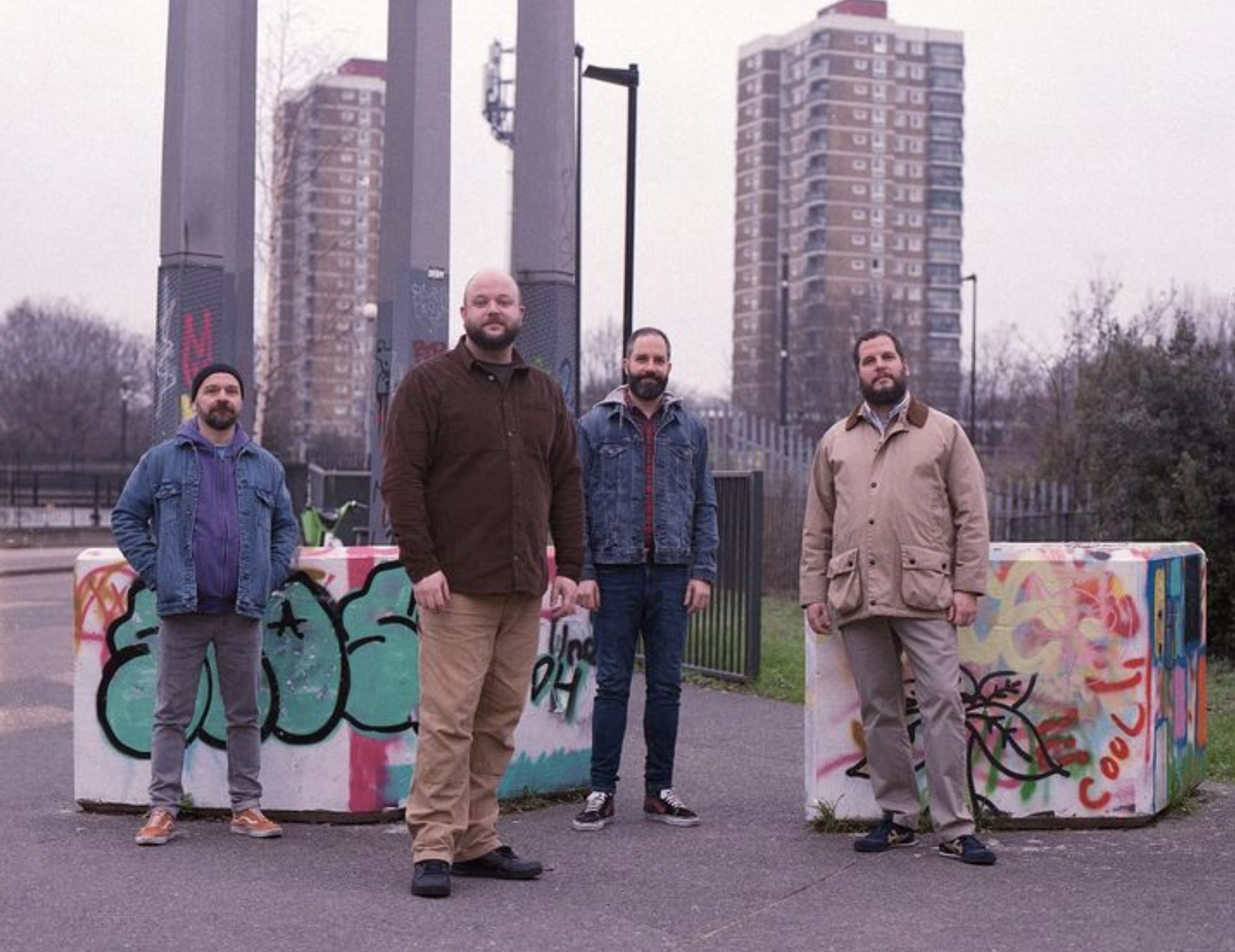
Formed in the summer of 2022, devices is a London-based band consisting of Fadi Borgi, Martin Llavallol, Louis Richardson, and Robin Footitt, who joined the band in early 2023. Their Bandcamp bio notes that “devices is what happens when left to your own devices: a London four piece with elements of art rock and grandeur,” with Richardson elsewhere saying of the band that “Four gay guys getting together and playing music is liberating. We are powerful together through music.” Their debut EP, Husband #1, is now available. To find out more, I dropped the band a line…
Interesting band name! What inspired it?
Robin Footitt: When I joined in early 2023, the band hadn’t settled on a name as they didn’t have a singer. There was a running joke that he was always late for practice and Fadi had mentioned that if they ever did play live they would carry on with that assumption that the singer never showed up.
Fadi Borgi: It all started with the bassist insisting on a jam session with the guitarist who was trying to get out of the jam session, because he’s quite shy deep down and didn’t know the drummer who was joining shortly afterwards…
Robin Footitt: Once I gained the confidence and I felt like I had established my place in the group I suggested devices. The idea that we are left alone to make whatever sound we want for 3 hours a week in a soundproof room at Brockley Studios has become such a highlight of our week that it became a sort of asymmetric palindrome mantra – devices is what happens when left to your own devices.
Martin Llavalol: We are strong in spirit when we are together. Time and time again we prove to ourselves that the input of the other three always takes these musical ideas further than we could do on an individual basis.
Who’s in the band, and who does what?
Louis Richardson: I play the drums and am the Instagram admin for the band. I try and book the gigs but it’s not exclusive to me. I was born and raised in Portsmouth, Hampshire (UK). I then moved to London at the age of 25 to study drum technology. I have been in and out of bands since my college days (Syrup, Joana And The Wolf, GUTTS).
Fadi Borgi: Guitar is a passion of mine – I grew up in Lebanon listening to my parents’ vinyls and cassettes, I discovered rock much later. My brother and I used our pocket money to buy tons of Rock cassettes from a questionable music store in Beirut. I also work on our music recording and video production.
Robin Footitt: We share a lot of the communications as it’s such a collaborative process, so you could be talking with any of us at one given moment. I think it’s fair to say that I’m the creative lead as I’m a visual artist (studying at Royal College of Art and Central Saint Martins) and enjoy shaping of our identity from both sides, how we may be perceived and to give the strongest representation of what we do and how we do it. I was in a band at art school, singing doesn’t come naturally to me but it was coaxed out of me in the past year through encouragement and my general lack of stage fright. I write lyrics and enjoy wrapping them around the melody like good seasoning.
Martin Llavallol: I play bass and occasionally write on guitar, I was born in Buenos Aires, Argentina and grew up listening to a mix of Brit, American and Latin rock and pop, and from time to time even folk or tango.

Your press materials describe devices as an art rock quartet. I’ve liked that label ever since I heard it applied to Talking Heads many years ago, but I’ve always wondered what, exactly, it means. Any thoughts? And what makes that term an apt descriptor for devices?
Louis Richardson: For me art rock is where the music can take a different direction from its conventional form. Moments of expanse and tension/release sections in songs, as well angular rhythms all add to the music that should paint many colours.
Robin Footitt: Exactly, what I enjoy most about the idea of rock is its context – by taking the materials of guitar, bass and guitar outside of itself to tell an alternative history and placing ourselves within it we can generate some very inventive worlds and sonic stories. The cover art is another exponent of this storytelling, a way to internalise what you are experiencing with icons and signals.
You’ve mentioned that devices is “a band with something to say.” What does that mean to you—to have something to say? And do you feel like there are bounds out there that don’t have something to say?
Louis Richardson: devices for me has been a breath of fresh air. Four gay guys getting together and playing music is liberating. We are powerful together through music. I can’t stress enough how well we clicked into place musically.
Robin Footitt: The message is as relevant now as ever, to be free to express yourself – do it your way and own it fully. It’s not something that I have always felt possible and perhaps I might have never made this step without the support of my bandmates. devices is a new experience to me and it’s important to keep finding those life surprises. I don’t claim to be sole representative or owner of anyone’s experiences but I am open, inviting you to listen because you are all welcome.
Along those lines, I was listening to your song “Gun Boy” on Bandcamp. Can you talk about that a little bit?
Martin Llavallol: I developed the song around a very simple but powerful riff. The lyrics were inspired by turning on the telly and watching the news: mass shootings in the US, Paris, New Zealand, anywhere, you name it. Anyone with enough ‘TV hours’ could have written them. The verses tease with the false, conservative belief that music influences youth to act violently, against others or themselves. We grew up listening to Radiohead and haven’t committed suicide. Hardcore metal listeners don’t go invariably punching people in the streets. The chorus states our position not only against lack of gun control, but also against public policies that generate exclusion and are in detriment of people’s mental health. We intentionally accentuated this juxtaposition between verses and chorus using distorted and clean vocals.
Robin Footitt: We also collaborated with puppeteer Chris Barlow (https://chrisbarlow.me) on a music video showing a contrasting pair of characters delivering this exaggerated swing between clarity of message and performance on a medium such as TikTok. There’s something equally humorous and unnerving seeing the song being lip synced by such adorable fluffy creatures. https://www.youtube.com/watch?v=pfWJrsPPXSM
I’m also curious about “Hold Your Tongue.” The line about raising “a glass half drunk, half tightrope oasis” struck me as particularly poetic. I won’t ask what it means, but I would like to know a little more about the technique that inspired it. How does the band write songs?
Fadi Borgi: One of my personal highlights is how the song Hold Your Tongue came together (we basically started jamming on the guitar intro riff, and the whole song came out, in one go. We even have this little miracle on video :D).
Robin Footitt: The title came directly from Fadi’s mouth as we were playing it and I called him out! I’d wanted to write a song about the feeling when you go out of an evening and you think you’re invincible, you’re celebrating the pure joy of being there but ultimately you can’t keep those feelings going as you push for more and it’s just not possible, these moments come in a limited supply. That’s where the “tightrope oasis” came from and it makes perfect sense – you are balancing everything on the idea of finding answers, pure escapism through drinking. I had a bout of this after the pandemic, when it felt good to be with friends again but of course the reason I was there was also to equally push away thoughts of isolation I had just encountered.
Martin Llavallol: What strikes me the most about this band, is our ability to create great songs almost without trying, in rehearsals and jam sessions, all four adding ideas. “Hold Your Tongue” is a great example of that.
Similarly, what’s your approach to recording?
Fadi Borgi: We are very diy – recording straight from the rehearsal room. Originally out of necessity because of limited resources, but more and more now because we love doing it, it’s great fun! And we like to challenge ourselves to get the sounds we want ourselves. It’s a point of pride and enables us to define our ‘sound’ and style. We feel we own our music and our sound this way.
Moving on to the new EP, Husband #1, I love the opening bars of the opening track, “Afterlife.” They make it sound like the listener is entering a club to listen to the band. How did you get that effect?
Fadi Borgi: We wanted the ending of Afterlife to be in a very different style, which ended up being a disco throwdown. Robin suggested that the intro should start with something muffled. After some experimentation, the intro ended up being a section of the ending, looped and automated. This is how I described the vibe to the band a while ago on WhatsApp: ‘You’re outside, it’s 9pm, it’s raining, you can hear the thump thump of the music in the club. It’s reminiscent of a broken record, skipping. Dare you go in?
You go down the stairs, carefully, and the music becomes clearer. You start making sense of the words and then… Boom! Headshot! A surgical snare hit and deadly bass dive: Welcome to our world, we are devices and we’ve been left to our own for too long!’Listen to it and tell me I’m wrong!
More specifically the effect produced is 1 measure of the ending, looped to a length of 6 measures, with a low pass filter automated to open up gradually, from 151Hz all the way to 20kHz. The actual recorded drums come in at the 3rd measure along with the looped section, also with an automated low pass filter opening all the way to 20k by the time the looped section ends. The rest is Rock :-).
Martin Llavallol: “Afterlife” is a whole band collaboration. It started as a jam session from the early days, and when Robin joined, he added the melody and lyrics. It’s a fun song to play, a crowd favourite and it has a great – and unexpected – funky section at the end. The bass solo is a reminiscence of the ‘bass-guitar swap’ we used to do with Fadi: I would use a pitch shifter to bring the bass one octave higher, while Fadi would tune down his Peavey guitar one octave down to play the role of the bass.
You’ve described the track “Cap It Off” as “an inventive break up song between creativity and the need to support oneself financially.” Since the band still exists, I’m guessing that breakup never really occurred, but how do you find balance between creativity and financial stability? Or do you?
Robin Footitt: The break up was much more to do with my upbringing in suburban London rather than the band which is a creative release from all of our current 9 to 5s. There is a general feeling where I’m from (Sutton, Surrey, UK) that doing anything creative comes at a cost and you have to shield yourself from the chance of failure because there is no safety net. My brother and I were of the first generation to go to university in my family and studying fine art was a question I had to answer in conversation with everyone in regards to my career goals. I won’t lie, it’s not a stable place and you have to think on your feet financially but that burning desire never goes away. I’ve even tried to mix the two with lucrative art commissions in the past but the stress of expressing myself for someone else brought me out in ulcers! Lyrically I always seem to end up disagreeing with myself and the wordplay of Cap It Off is one of those situations. “I heart. You brain” makes no sense whatsoever until you pick apart that one can hurt the other if not looked after properly.
Louis Richardson: Cap It Off is a song that is quite different from the others as it has an odd structure and is quite ‘angular’ musically in places. The chorus is quite sparse in a sense as my drumming is only concentrated on the kick and snare rhythmically. It’s the song I seem to listen to the most from the EP.
What’s on the horizon for devices?
Robin Footitt: ‘Husband #1’ is released on 31 May so we are focused on playing the record live as much as possible this summer – we already have a couple of gigs booked for June and July in London. Beyond that devices are looking to tour this autumn either on a support slot or potentially our own steam (offers welcome!) and we are steadily working towards writing and recording for our first album.
One response to “A Band with Something to Say: An Interview with Devices”
An interesting band with an international pedigree and terrific name! Also nice to see a rock band composed of all gay men. Their song “Gun Boy” is quite powerful and provocative, with brutally honest lyrics set to an edgy psychedelic groove.