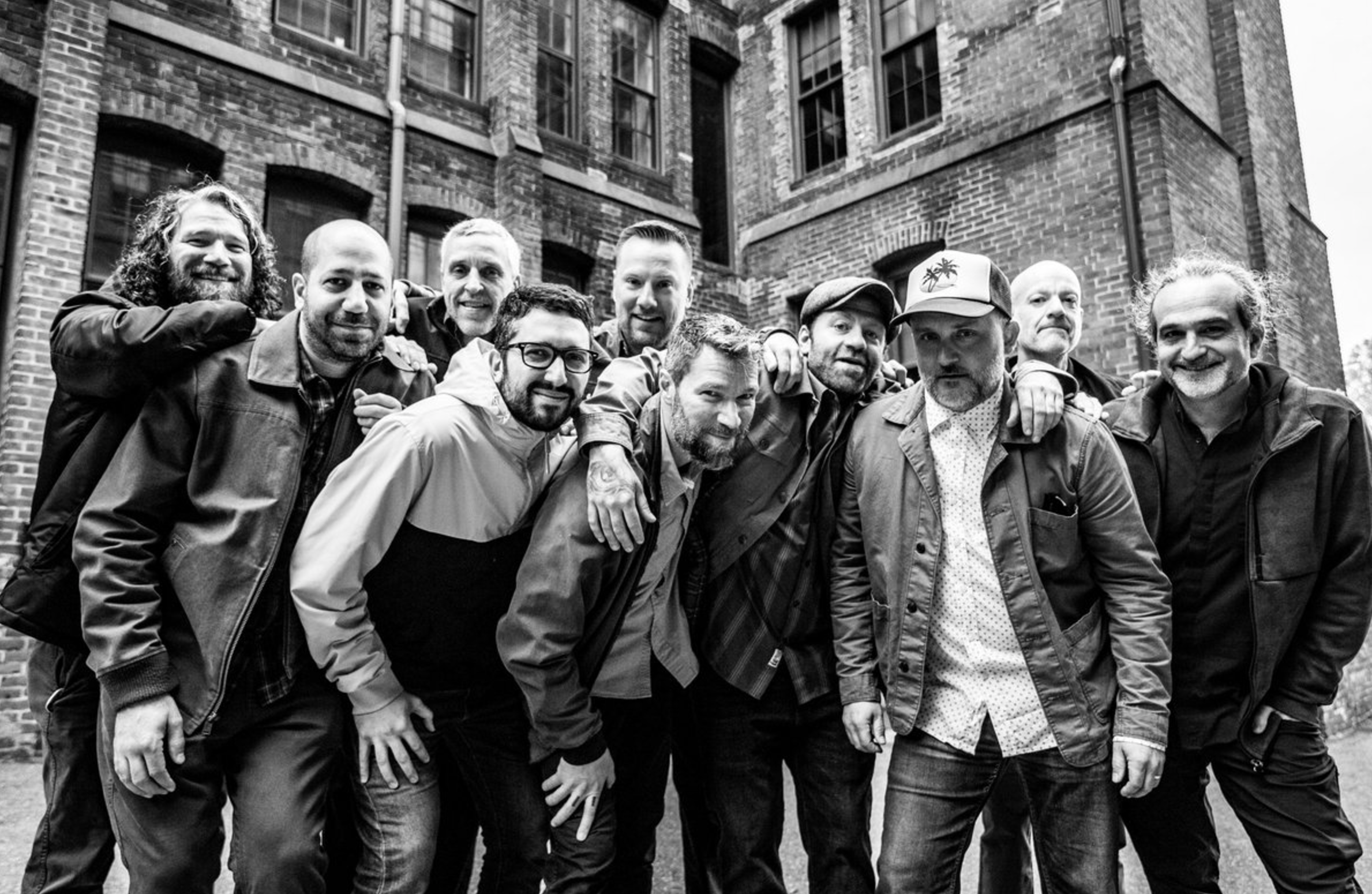
All I can say about the Macrotones is that they’re an amazing band. Beyond that, I’m dumbstruck, so I’ll just share this info from their website: Established in Boston in 2007, The Macrotones are a 10-piece unit steeped in off-beat funk & soul rhythms from all over the globe. Blazing horns meet mighty hooks for a progressive mix fit to fill any dancefloor. The band’s tightly-honed grooves and infectious sound has shared the stage with like-minded practitioners such as Lee Fields & the Expressions, Durand Jones & the Indications, the Budos Band, Grupo Fantasma, Orgone, Ikebe Shakedown, and Sierra Leone’s Refugee All Stars. Since typical genre descriptions fail to fully capture the scope of the Macrotones’ sound, new monikers need exploration: imperial funk, astrobeat, or even “a soundtrack for spies” all fit.
The Macrotones is a ten-piece band that’s been around since 2007. Has the lineup remained the same all that time?
More or less, yes! If you can believe it. We’ve had other members in the past come and go, and have seen some take a hiatus and then return, but most of the group is still the same as it was when we started. We like to attribute that to our collective nature. If you’re in the band, you get a say in where and what we play, and how we play it.
How did adding vocalist Phil Desisto change your sound as well as the internal chemistry of the band?
We have dabbled with vocalists in the past and always saw it as an extension of our sound and catalog. We knew Phil for a while from the local scene and recorded one track with him a while back that everyone loved. When Phil said he was interested in writing more with us, it naturally turned productive. The songs we write with Phil are obviously more focused on vocals and also lean more to the soul side of things as opposed to the afrofunk that we started out playing. But the Macro sound is all still there. The main difference is there’s now usually an extra step where we get a tune ready, then send it over to Phil, then we polish it up once he adds vocals.
How have you kept your momentum going?
A steady rehearsal schedule has always served us well and kept things moving. And after ten-ish years of mostly instrumentals, we’ve added our new vocal song repertoire to keep things interesting and provide an outlet for us to explore new sounds. We are all just extremely dedicated to the music we write and if we keep creating more, we keep up the momentum.
How has the music industry — or music more broadly — changed since the time of the band’s inception?
For us the main change we see in our Boston area is the lack of venues to play. Many of the smaller clubs/bars that fit our draw just don’t exist anymore, and nothing is opening to take their place. Luckily many breweries now feature bands and that provides new opportunities.
And how has the band’s sound evolved in that time?
We started out doing more traditional afrobeat music, but soon incorporated a lot of rock and funk into that to create our own style. Over time our music has become more complex in terms of arrangements, but also smarter in terms of song structure.
I was looking at your website, and you guys play out fairly regularly. How do you coordinate everyone’s schedules with so many people in the band who, I’m guessing, have lives outside of music?
Like you imply, it can get messy! Lots of email and Google calendar work. We won’t book a gig if there would be more than one or two members missing, so it takes effort. And patience for when things just don’t work out. Luckily we have a number of other bands that have Macrotones in them, so sometimes it’s easy enough to pass along the date to someone else.
Do you ever play with alternate or smaller versions of the band?
When we’re down a few players for a gig, we lovingly call it a ‘Microtones’ show. But in reality, we can’t do a lot of our music once you start pulling apart the pieces. Much of our instrumental parts fit together like a puzzle, and missing pieces makes an incomplete picture.
Our members are in a number of other bands that are within the Macrotones orbit. Anything on our label, Music ADD (musicadd.com), will feature some of us. Flying Vipers (dub – flyingvipers.com) is a good example. Other related bands include Kotoko Brass (African drums-centered party music – kotokobrass.com) and The Pomps (post-ska – thepomps.com).
In June, you released your latest album, From the Void, and followed that in October with From the Void (Instrumentals). What was behind that decision?
From The Void is our first record of exclusively vocal songs, which realized a goal put forth when we started working more with Phil. The idea of an instrumental release came mostly from our enjoyment of instrumental album versions by other bands in the genre (e.g. Monophonics), and perhaps felt right since most of these songs began as instrumental ideas. It’s just a different way of enjoying the music. Also, it was a nice opportunity to put out 2 new instrumental tracks which we had recorded in the same sessions, but have a style more akin to earlier Macrotones records.
I love the cover art on both versions! It has a great retro sci-fi look that really complements the music. Who designed it?
Our percussionist Marc also designs our albums and fliers, often incorporating 70s pulp comic pin-ups and strange sci-fi covers or kaiju posters. With From the Void, we fully embraced this aesthetic and worked with resident Music ADD artist KTRON to create an original painting heavily inspired by these bizarre and often psychedelic pulp images. The music also creeps into dark themes, lyrically and melodically, and the 10 “Macrobats” were added as a fun representation of how we felt after being semi-dormant in our Covid caves, finally boarding our ship to return to reality – or perhaps escape from it…

And the backstory on Bandcamp is cool—the fact that the band rehearsed in the same building where Singularity Black was developed, along with the four-year struggle to stay together and complete the album despite COVID. What was your previous approach to recording, and how did the pandemic change it?
Over our history we’ve done a bunch of different recording sessions (this is our 10th official release). Some of it was opportunity, some intentional, some for variety. We self-recorded our first record in a cabin way up in Maine. We’ve worked with Grammy-award winning engineers/producers in the studio such as Sean Slade and Benny Grotto. We’ve recorded completely live as a band and also with overdub tracking. We recently set up our rehearsal space (Arkade) so we can record completely on our own. The pandemic may not have directly influenced any of this, but we did appreciate having options. During the worst of it, we set up outside in the woods in New Hampshire and recorded a live set with video production:
And now that the COVID is behind us (fingers crossed it stays there), what are your plans for the future?
The Macrotones always have a half-dozen songs or so in the queue. Sometimes we’ll nail one down in a rehearsal, sometimes we’ll bang one around for a year or two before playing it publicly! We’re already developing material for another release. And we have about enough tracks now for an EP featuring another member of our crew, vocalist Rob Carmichael of Destroy Babylon (destroybabylon.com), who has a long history of playing and singing with The Macrotones.
6 responses to “It Can Get Messy: An Interview with the Macrotones”
Another excellent interview. Wh
Glad you enjoyed it!
These guys are terrific!
They really are! Cool groove and a great sound!
I just had a listen on YouTube to your music. Wow. Love it. The group sounds crisp and smart. I’m checking out your album w vocals. I’m lead singer in my Blue Dirt Girl band so I’m curious how Phil fits in. Bravo.
Another great interview Marc.
Thanks! Glad you enjoyed it!