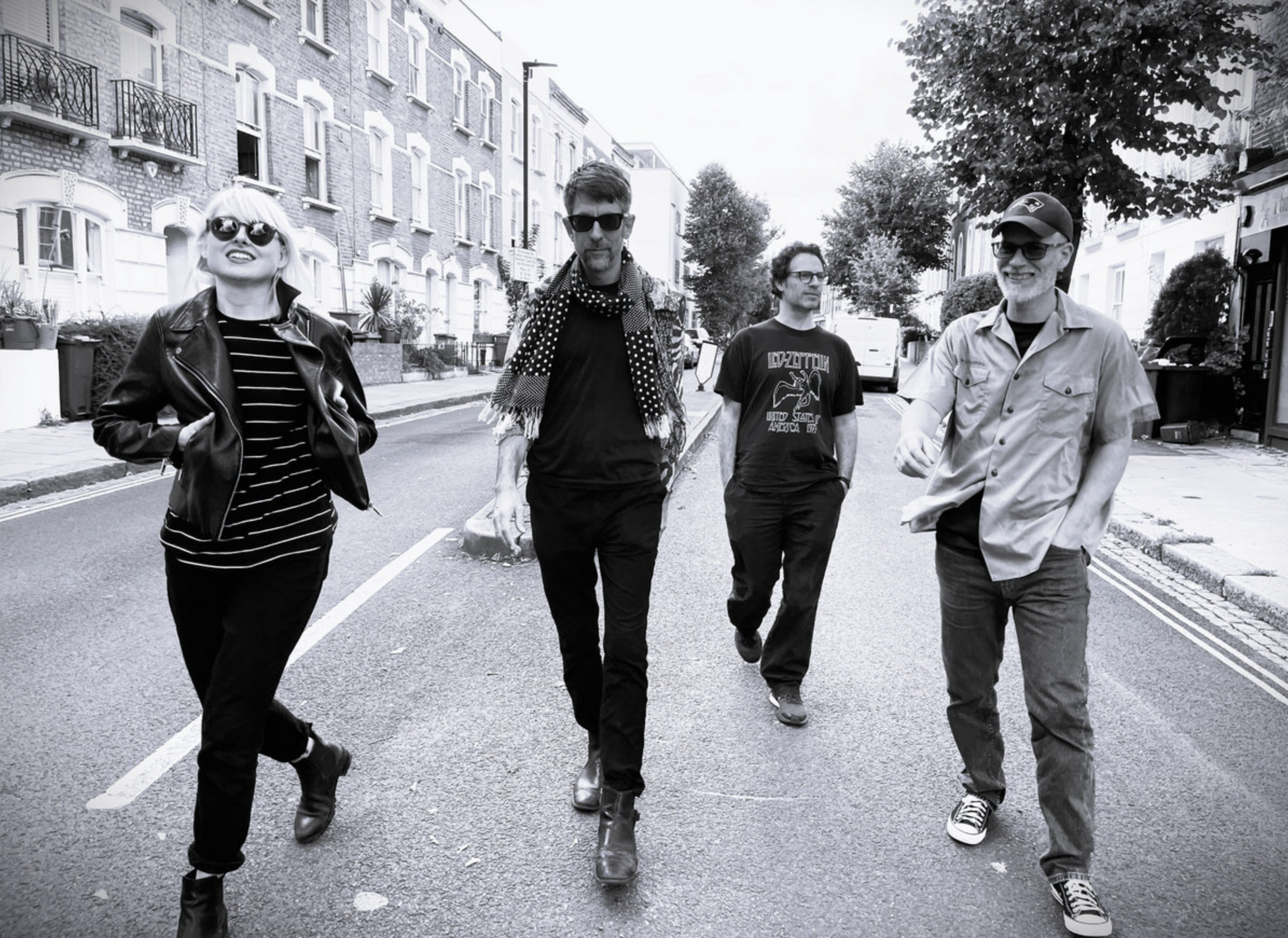
Composed of members from Sleepy Kitty, Harvey Danger, and Say Yes, Do Nothing, The Open Flames are the latest group to join the recent post-punk revival, bringing equal parts attitude and experience to their rough-edged, literate alt-rock.
Your website describes the Open Flames as “pop noir.” I love that description. What makes your music pop, what makes it noir, and where do the two meet?
We love the “pop noir” description, too! We didn’t even know pop noir was a thing, but it might be related to bands like The Velvet Underground. We worship the VU and their noisy storytelling, so we’ll take it! “Pop noir” was coined by a French reviewer of “Drop a Coin” and it stuck. Our lyrics are indeed dark yet our melodies and harmonies are bright and singable.
The band is made up of members from a few other bands: Harvey Danger, Sleepy Kitty, and Say Yes, Do Nothing. Who’s from which band, and what kind of musical sensibility do they bring from each?
Evan was the drummer in Harvey Danger and Dave slept on their floor for a while but he was never a member. Evan and Paige are now in Sleepy Kitty together and split their gigs between NYC and Paris. Dave was the leader of Say Yes, Do Nothing and Len sometimes played along. Dave brings the stories and song structures, Paige the harmonies and expansive guitar sounds, Evan the rhythm and musical direction, and Len the grooves.
Your forthcoming album is called Same Time Next Year. Does it have an over-arching theme in terms of music or lyrics?
“Same Time Next Year” was recorded in bursts every six months, hence the name. It is also a reference to a famous theatre play. We think the ambiguous lack of a comma reflects the album’s trippy sounds and mysterious lyrics.
Can you share any details about recording the album? Where was it recorded and who produced it?
The album was recorded at Map Studio Café in London in the back of a vegan restaurant with a Rasta fry cook. Duncan Thornley engineered and produced it. He played keyboards, and he also played the studio like an orchestra. We love the richness of his production. He’s the fifth Flame.
Your music is also described as “literate alt rock.” Who are some writers that inspire you? What do you like about them, and how does their influence find its way into your music?
The sparse, heavy, honest language of Robert Frost and Ernest Hemmingway and the gonzo journalism of Hunter S. Thompson inspired the storytelling. MAD Magazine inspired the warped view on life.
“Drop a Coin” includes the phrase “Alia jacta est.” I’ll admit that despite three years of Latin in high school, I had to look it up. I knew jacta est, but alia threw me. Lyrically, though, it makes sense to use a dead language in a song about death. I guess it goes back to the point about being literate. Why do you think it’s good or important to challenge listeners with your lyrics like that? Or are you even trying to challenge them?
Alia jacta est is fun to say, like a tongue twister, but it’s not fun to sing. Dave needed a few takes, so we suppose it challenged him the most. The phrase was uttered by Julius Caeser before beginning a civil war, and means, “The die is cast” or that a point of no return has been passed. It seemed to suit the imagery of stepping though massive Rodin-esque doors into an Inferno. We may not aim to be challenging, but we do aim to be interesting, because we get bored quickly ourselves.
Your latest song, “Eat Alone,” touches on death as well; your EPK describes it as casting “an unsparing eye to the bond that unites a caregiver and their loved one in their final moments.” What inspired that?
Dave wrote the song thinking of the passing of his father, who died alone by choice. The chorus of “Eat Alone” includes the line, “Those who eat alone/die alone,” an Italian maxim celebrating the benefits of togetherness. Dave’s Italian wife said it to his daughter because she wouldn’t eat, and his daughter countered, “Yeah, but they die last.” (Most of Dave’s lyrics are snatched from the air this way.)
Sonically, it harkens back to the mid-90s. What do you like about that era of music?
At its best, we think 90s music connected with audiences through its creativity and raw emotion. It sought to upend the music industry, but as one critic wrote, Nirvana didn’t change that much after all. We guess the Internet did that for us. Still, we share its ambitions.
You’ve been touring recently, with a number of dates in UK and one in Paris, plus you’re hitting New York and Washington DC in February. Do any memories from your travels stand out?
In France, we remember seeing police in Robocop riot gear in preparation for the Paris May Day demonstrations. We found that sometimes staying inside with a good book is a good idea.
Plus you do a radio show: Eardrum Buzz Radio. What’s the format, and where can people listen to it? Also, how does being a DJ influence your own approach to making music?
Dave hosts “London Calling” which airs every fourth Monday at 11am PST. Dave interviews UK and European musicians, asking “Why do we keep playing music, despite all the pain?” In other words, it’s an hour of comradery, with edgy new music, especially shoegaze.
What’s on the horizon for you and the Open Flames?
We will unleash “Same Time Next Year” upon the world in early 2025 – wear your riot gear. Alia jacta est!
2 responses to “Alia Jacta Est: An Interview with the Open Flames”
Excellent work, Marc! Looking forward to their upcoming release.
Thanks! Glad you enjoyed the interview!