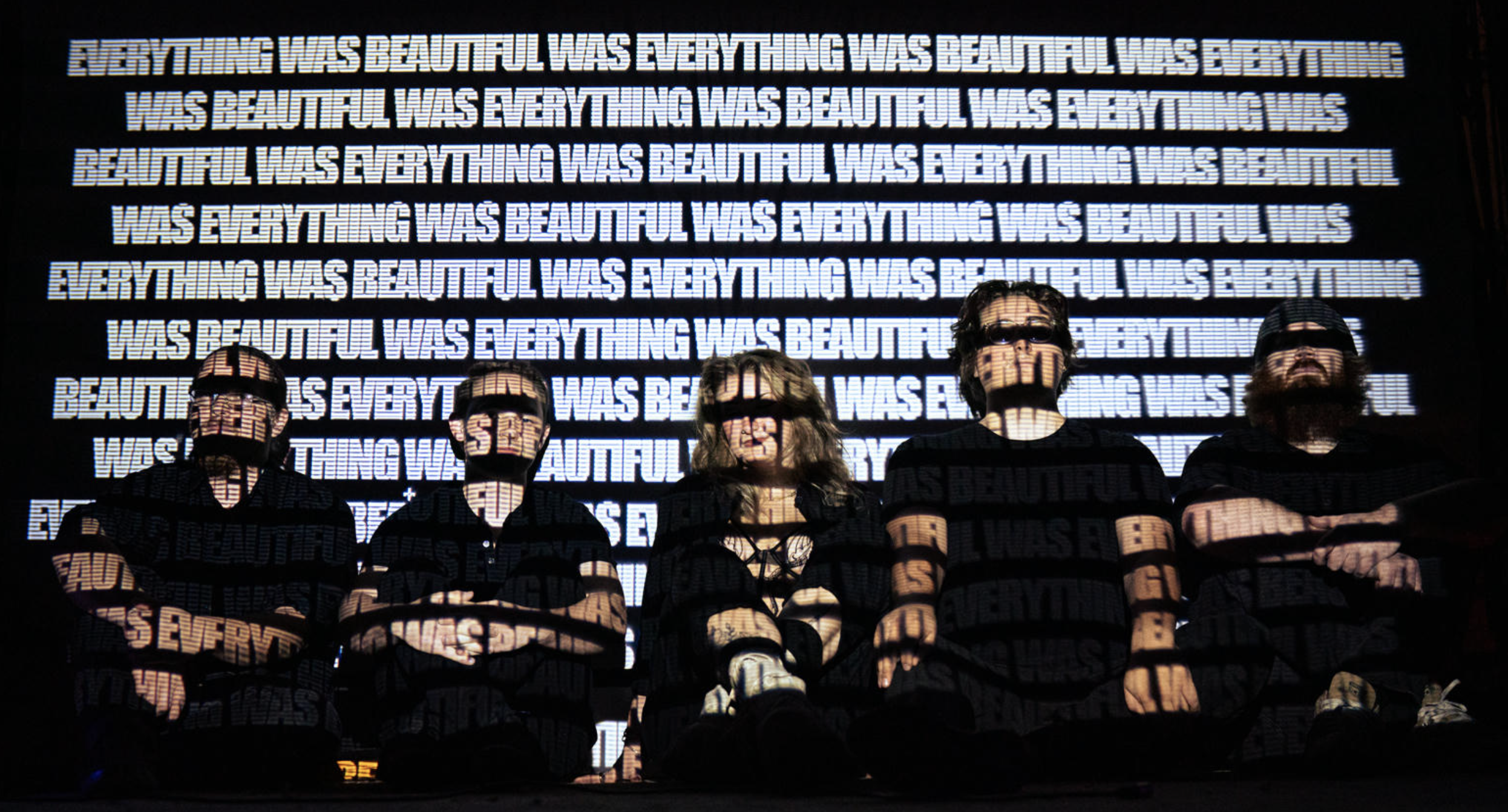
As longterm readers of this blog may know, I’m an English professor by day, so my curiosity was certainly piqued when I read that Megan Rose, who leads the band afters, holds a degree in English Literature that informs her musical sensibilities. Drawing inspiration from artists like Lana Del Rey, Lorde, and Black Country, New Road, the band blends atmospheric, confessional indie pop with a literary sensibility unique to the mind of a woman who feels equally at ease in a musty bookstore as she does in a nightclub…
What does the name afters mean to you, and how is that meaning reflected in your music?
At the surface level, the name afters is simply another word for afterparty– when I use it, it’s usually in reference to some sort of post-2am shenanigan that takes place when an event ends, but the night doesn’t. I often hear people say, “nothing good ever happens after midnight”, but I’d counter that watching the sun rise with the people you love after an all night excursion is a strange and beautiful experience. I find that the vast majority of my lyrics could very well be (and often have been) a retelling of a sunrise conversation. The rawness that comes when the emotional tank is empty, the honesty and passion, that’s what I want to sing about. The name afters begs the question of what came before, and what comes next.
I love that your bio refers to you as having “a literary sensibility unique to the mind of a woman who feels equally at ease in a musty bookstore as she does in a nightclub.” Who’s your favorite author? Is that author an influence on your songwriting?
I’m sure that you’d agree this is a very difficult question to answer without giving you a fifteen page report on all of my favorite authors. However, I’m willing to choose a couple that have been especially influential to my songwriting. For this record in particular, it would be wrong of me to not give Kurt Vonnegut the first nod after naming the whole body of work from a quotation of his (but we can discuss that a few questions from now). I’ve always loved the way Vonnegut narrates his writings– unreliably and drenched in satire– and how he creates protagonists that are derivatives of himself and stories that are semi- autobiographical. I tend to create my art this way too. The narrator in my songs is a form of myself, but I don’t tether myself to write only about experiences that can be seen or touched. The stories that have only lived in my head are just as real to me when I write about them. This has allowed me so much freedom to explore the world that my music comes from. I also have to mention Mark Helprin, whose whimsicality, humor, passion, and beautiful, thorough descriptions move me to tears time and time again. His ability to weave a lush portrait in the mind’s eye has always left me feeling inspired to find the perfect words to convey what I’m feeling.
Beyond song lyrics, do you do any writing yourself?
I do! I’ve loved to write poetry and fiction for as long as I can remember. Admittedly I don’t write stories as often as I used to, but I genuinely look forward to the day when my life slows down a bit and I have the time to revisit that love. When I was in elementary school I filled notebook after notebook with a fantastical story about a family of deer living in the Badlands of South Dakota… maybe I’ll start that one back up!
As an English professor, I really appreciate that you studied literature in college. How has that experience prepared you for life in the “real world,” as it were—both musically and otherwise?
Studying literature in college prepared me for the “real world” in the sense that it really developed my ability to think deeply and critically, and to express myself in a way that reflects that. It also exposed me to perspectives and realities far different from my own, making me a very empathetic person, as well as instilling in me a grand sense of wonder and hunger to continue to learn for the rest of my life. Has my degree led me to get a well- paying job in my chosen field? No. But I never really expected to follow a traditional path, so I don’t consider myself to be a failure in the “real world”. I always laugh about how I put myself into debt from college just to turn around and become a musician, but my studies led me to find my unique voice as a lyricist and as a human being. I would go back and make the same decision in a heartbeat.

I noticed a quotation from Kurt Vonnegut in the background of one of your publicity photos—or half a quotation, anyway: “Everything was beautiful.” The other half, of course, is “and nothing hurt.” I’m wondering if you left the second half out on purpose: Everything was beautiful, but it hurt? Or am I just reading into it too much?
I love this question. In Vonnegut’s “Slaughterhouse- Five”, as I’m sure you’re aware, the words “everything was beautiful and nothing hurt” appear as the epitaph on a tombstone. In reference to the protagonist in the book, a WWII veteran suffering from PTSD, the words at first glance feel satirical, like only the opposite could be true. But I believe that Vonnegut was an optimist at heart, despite living through experiences that could very well have left him hopeless. To me, the quote has always read as a raw acceptance of existence, an expansive declaration celebrating the unbreakable human spirit. I chose to use only the first half as the title for our album because it invokes a sense of nostalgia that I experience often when looking back on previous parts of my life. I don’t think foremost about whether things hurt or not, just that they were beautiful. The music in this album is generally retrospective, remembering times that have passed, or imagining myself in the future looking back at what I’m experiencing currently. Although so much of life hurts, despite being beautiful, that is not the part I want to take with me.
I’m curious about your song “Apocalypse Girl,” which references music for the end of the world. Do you feel like we’re living in apocalyptic times?
Short answer, no, I don’t feel like we’re living in apocalyptic times. The sun only burns when I’m out in it for too long and the earth hasn’t parted to swallow me up (yet). I do think, however, that we’re living through times that are dark enough to warrant the idea of armageddon to run rampant through our minds. “Apocalypse Girl” is an end of the world love song, a conversation about looking back on the simple joys of wasting time, a fantasy set in an uncertain and brutal future.
You’ve described your music as confessional, which I imagine puts you in a somewhat vulnerable position. How do you decide what to confess and what to keep private?
Truthfully, I don’t think about it too much. Writing honest music is healing for me, and I write what I need to in order to find peace in my experiences, and in hopes that others will find some solace in it too. Although most of my songs are purely biographical, some are an amalgamation of many different encounters with many different people (some real, some fictional), or a thought experiment of putting myself in a situation I haven’t necessarily been in. When editing, I sometimes remove details that feel too specific to experiences with certain individuals, but I definitely wouldn’t be surprised if someone from my past listened to a certain line on the record and thought, “Huh. I think that might be about me.”
Another theme that appears in your music is “isolation in the postmodern world.” What do you think accounts for this isolation?
I think this isolation is caused by the general unease that comes from the uncertainty of reality. We have access to so much conflicting information all of the time that it is easier to live in our own little worlds, so to speak. The internet makes us feel more connected than ever (and there are so many great things to be said for that), but it also tends to keep us from seeking meaningful connection within our immediate communities. We suffer from unfettered individualism and the yearning to be known, while also being able to hide behind the mask of social media. And if the world only sees us how we want ourselves to be seen, are we really known at all?
And just because I find the topic endlessly fascinating, how do you define postmodern? What, to you, marks the world as postmodern?
To me, the indicators of a postmodern society are that 1) the concept of “reality” is subjective to individual experience rather than being an objective truth independent from humanity, and 2) EVERYTHING is a commodity.
In our world (or at least in our very individualistic Western society), we have become skeptical of objective truth and moral values. And how could we not? The twenty four hour news cycle is a constant barrage of information presented to us as undeniable fact, but the facts change completely depending on who is relaying them. It seems that our experiences are not dependent on reality, but rather our reality is dependent on our experiences. Often, the differing version of “truth” each of us is faced with is based upon our already existing beliefs, and sold to us via confirmation bias, or as I like to call it, The Algorithm.
And then there is the commodification of every aspect of our lives. Our beliefs, our passions, our fears– all just ingredients to be purchased, repackaged, and sold back to us. Our appearances can be altered and identities curated (through products, of course) and sold to an audience that wants to purchase a bit of us. Our traumas and joys are sensationalized and repackaged as a representation of the real thing. Religion, tradition, and politics are a spectacle rather than a tool to build community and create a better world. I think, maybe, that this is moreso the cause of our skeptical landscape than an effect of postmodern society. It’s all cyclical.
What’s on the horizon for you?
After working on our debut album for two years and finally releasing it, I am honestly just so excited to start working on new music again. We have some great live shows coming up (our album release party on January 30th at Amsterdam Bar & Hall in St. Paul, MN and another gig on March 21st at Green Room in Minneapolis, MN), a couple video projects, festivals, etc, and in general I’m looking forward to continuing to experience life and creating art.
4 responses to “What Came Before and What Comes Next: A Conversation with Megan Rose of afters”
Wonderful conversation, definitely going to lead me to their music. Fantastic group photo!
Great photo, indeed! And I’m always a fan of a band with a literary bent!
Congrats on the interview, Marc. I can picture how intriguing it must have been for you to chat with Megan Rose. Fun fact: while I would never compare myself to a talented music artist, when I was a child, I also had the habit to fill little notebooks with stories I made up as I was writing them. Unfortunately, it never led to writing lyrics that were any good, not to mention songs!
Thanks, Christian! Imagine if we gave kids little notebooks rather that iPhones and iPads. The world would be a much more imaginative place!