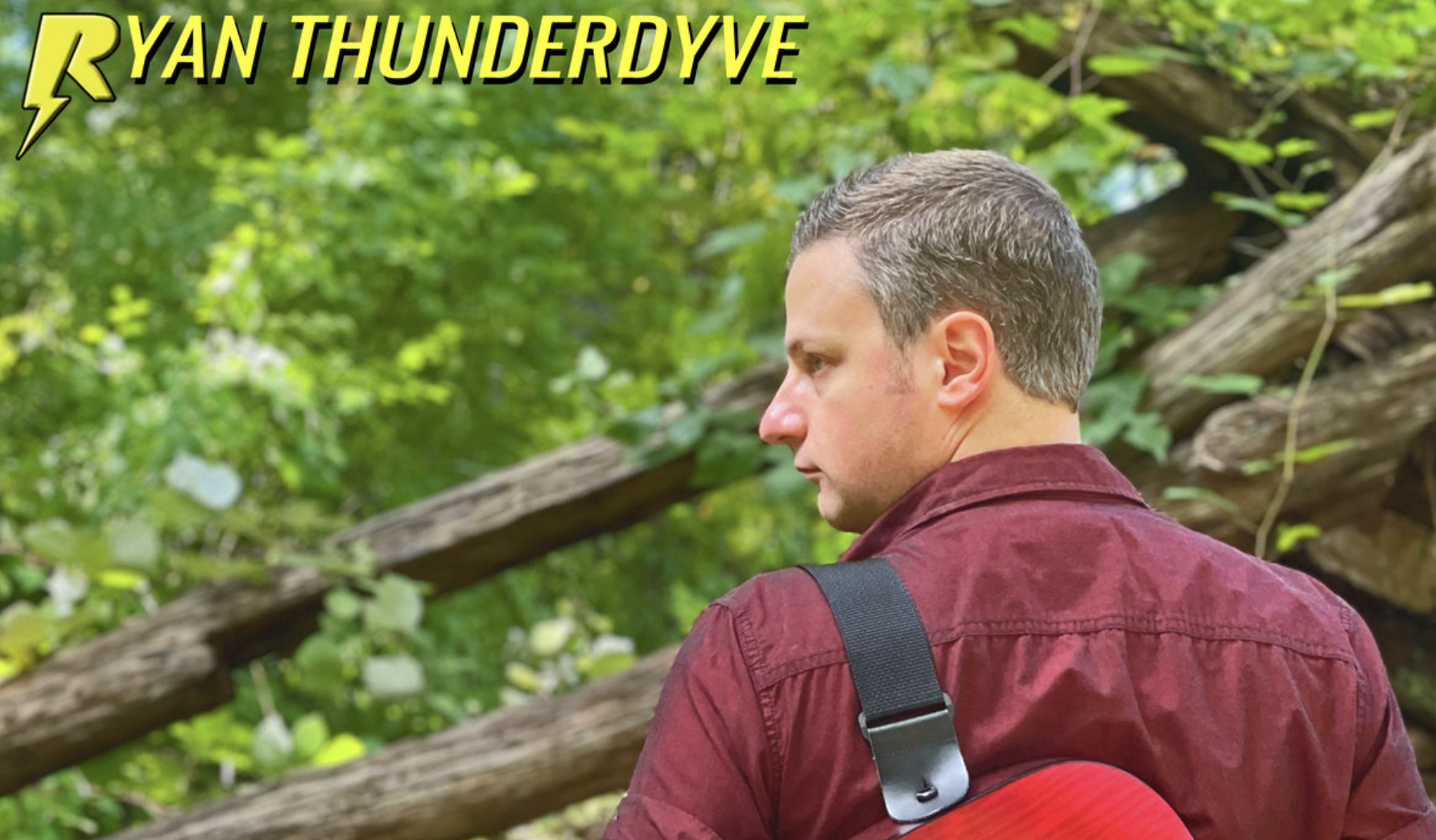
I first met Ryan Thunderdyve when I dropped by A&G Music to get my guitar repaired a little while back. As luck would have it, he lives less than a mile from me and is an avid musician. His debut album, Postcrisis, came out in 2023 and offers an electric introduction to his musical stylings–a catchy blend, as he explains below, of rock, metal, pop punk, and video game music. To find out more about the album and Ryan’s recording process, I dropped him a line…
Let’s start with a little bit of background. What’s your history with music? When did you start playing?
I started a long time ago in grade school on trumpet and played in concert band throughout the years, and had also joined marching band in high school. However, the trumpet section had been getting a little crowded with much better players than me, and so I switched over to French horn in my senior year. After that, it was a few years with no music focus in general, but I had decided to expand my musical tastes around 2010 by exploring different artists that suited my tastes, and then again in 2015 when I finally decided to stick to learning guitar (after a previous failed attempt in 2006). I also love video game music. There is something so appealing about the urgency of it, and the fact that the main melody has to be so prominent in order for the game designers to evoke the emotions they need to. It is a strong influence in the music that I create today. I couldn’t imagine my life without music!

How would you describe your music?
I would describe my music as combining my favorite instrumental parts of rock, metal, pop punk, and even video game music. I’ve been told it has a post-punk vibe to it too. I tend to like energetic music that has an urgency to it, and with strong and prominent melodies that stick with you. And hopefully that reflects well in my work!
The tracks on your album Postcrisis are all instrumentals, but looking at the titles, I feel like they tell a story. Can you talk a little bit about that?
Sure! When I set out to create my first album, Postcrisis, I wanted the overall theme to be about the different emotions and feelings that someone can go through after enduring a personal internal or external crisis. Anxiety and depression are becoming more understood than ever now, and those emotions can have a devastating impact on us. However, the more I worked with the album throughout the production and mixing process, the more I realized that it could also be a representation of the process of grief. While listening to it more and more, I believe that all five stages of that process could be found here: denial, anger, bargaining, depression and acceptance. The process of grief can look different for everyone, and I believe those five steps don’t necessarily happen in that order for every individual. One or two of the steps might not even happen at all! Life is messy. The album also ends on an optimistic high note with the bombastic energy of the closer track Vitality. It was important to me that the listener walks away with a positive mindset after the album ends: “You’ve got this!” Or, you can just ignore all of that and enjoy some really cool songs. My hope is that the listener can find at least one song on the album that can really resonate with them, and I hope that they enjoy the album as a whole!

One of the tracks is called “Stoic Fortitude.” Does Stoic philosophy factor into your music at all?
For this song in particular, it does! I studied quite a bit of Stoic philosophy during those tumultuous lockdown years of the early 2020s, and it was a huge help in articulating the processing of emotions, the dichotomy of control, and living a virtuous life. I wanted this track to convey the difficulty of enduring a personal crisis and applying Stoicism at the same time. You’ll notice that there’s a brief moment of “peace” around the middle of the song, but goes right back into chaos soon after. The heavy ending and the way it fades out is meant to convey reaching a point of acceptance with the messiness of life.
There’s an argument to be made that we’re currently living through a moment of national crisis. I imagine Stoicism helps at least in the sense that it provides tools for approaching problems with a clear mind. Or am I just grasping at straws?
No straws here! The problem with Stoicism is that it’s often misunderstood as just “blocking all emotions” and remain stoic. Far from it. It’s actually about allowing all of your emotions to happen naturally, observing them from a distance, and deciding how to react. Whether that be through acceptance, deciding to take action, or continuing to observe. Stoicism is meant to be a guide, not a cure. And it might not even be the right tool for the situation at hand. But you still might be able to carry some of its principles with you.
The album took you two years to record. What was the process like?
Looking back at my notes, the first song that was completed was Nightmare Machinery way back in 2019. The process was…painful. I remember trying to set aside an hour each day for recording for about 3 days a week on average. Sticking to that hour was crucial too, because if recording wasn’t going well that day, you could say “ugh, finally, done for now!”, but if it was going well, it builds exciting anticipation for the next recording day. I was using a DAW called Mixcraft, and on a desktop PC from 2013. That’s pretty ancient in tech years, so recording latency was a constant problem. I had to constantly stop and playback stuff I recorded, and if I liked a given take, I had to adjust it perfectly so that it lines up with the beat or measure. The audio driver was also buggy. Constant static noise during playback would be a problem every 15 to 20 minutes. Thankfully, that’s all behind me now with a new PC and a new DAW.
What’s your approach to songwriting? Do you start with an idea? A riff? A mood? Or is it always different?
There’s a few ways actually! For example, if I hear a song I really like, sometimes it’s just a matter of saying “This song’s awesome, I want an original song that sounds like this!” and going from there. A lot of times I start with a song title to help set the mood, and construct the main riff around it, and crafting a complete song from that! And sometimes it’s stumbling upon a cool riff when practicing and furiously writing it down to remember, then applying the song title!
I imagine that recording an album is the kind of activity where you learn a lot along the way, both in terms of how to record music and also in terms of your own sense of self. Do you feel like you learned anything about yourself as you were working on the album?
I guess one of the main things I learned was that I had no idea of the massive undertaking the entire process would be. Songwriting, recording, producing, and promotion is a lot of work all by yourself. But I felt so determined to release an album to the public so that I can look back on it with pride. Ask any creative person and they’ll immediately tell you a list of the things they would go back and change in their past work. But any creative person has to learn how to stop at “good enough”. Working on this album taught me that. Would you rather be working at one song, constantly dialing in those perfect tones, volumes, plugins, and taking years to release it? Or, would you rather have actual art that you can share with the world?

What about recording? Did you pick up any interesting tricks or techniques along the way?
The most interesting trick I picked up along the way was…record on a better PC. Seriously. The last thing you want when recording music is your setup and instrument fighting back. It’s the worst.
Any plans for a follow-up album?
The second album is in the early stages of progress now actually! I’m keeping the premise a secret for now, but rest assured it’ll be a fun listen once it’s done!
Thanks for taking the time to answer my questions!
Sure! Thanks for having me!
5 responses to “Determined to Release an Album: An Interview with Ryan Thunderdyve”
I always enjoy your interviews Marc. I think that being a musician and songwriter yourself – not to mention that you’re a highly intelligent guy – enables you to ask really thoughtful questions that usually result in more thoughtful responses from the people you interview. That said, Ryan’s quite an impressive guitarist!
He is! I invited Ryan over to my house to play some music with me and Tim Simmons recently, it was a lot of fun!
Terrific work, Marc! Always thrilled to see a new interview on here.
Thanks! Glad you enjoyed it!
Great interview, especially liked to hear about Ryan’s influences and how he pushed past making his 2019 album.