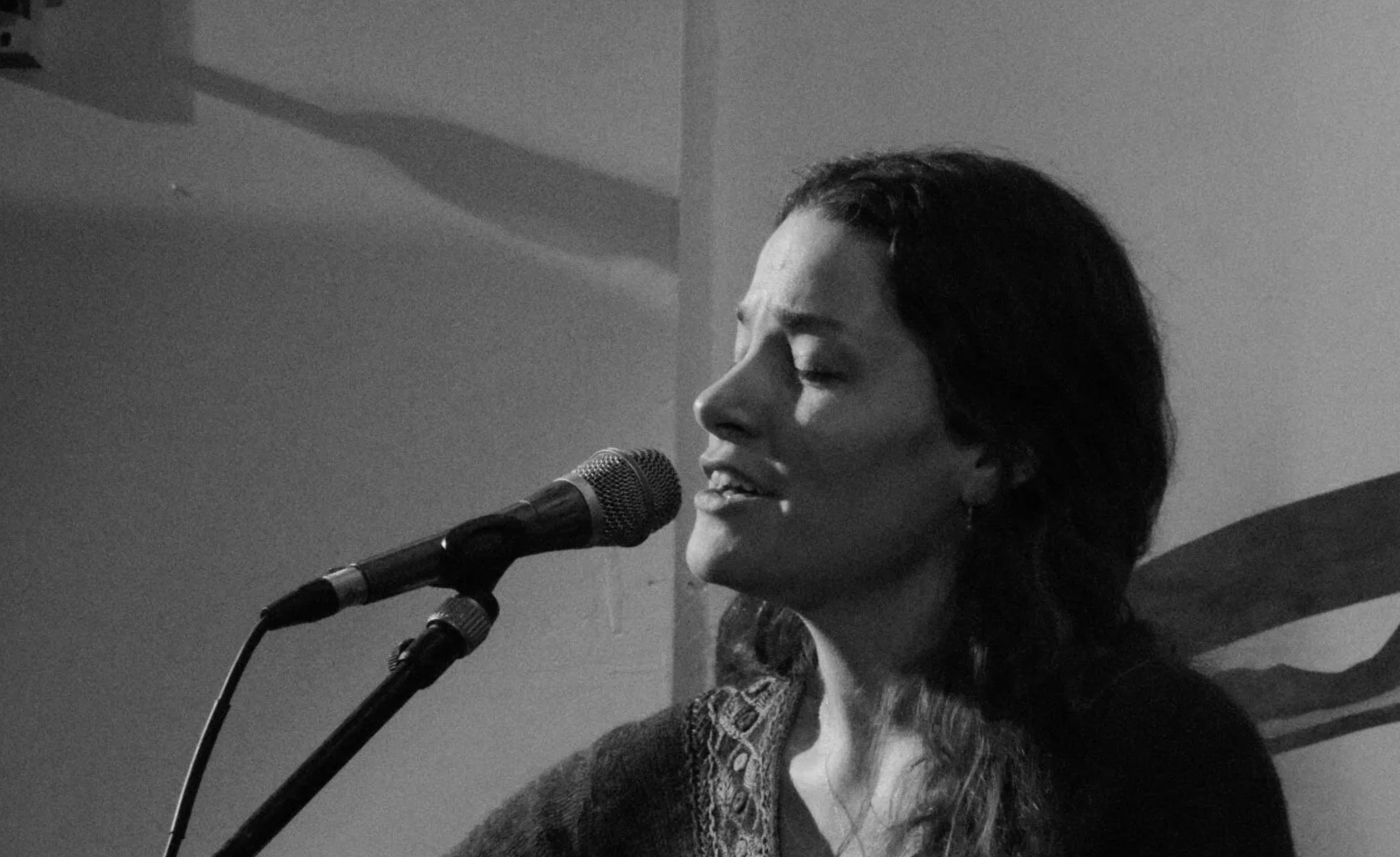
I had the good fortune of meeting Anna Spackman a few weeks back at a music release party for an artist named Frostbyt3 (more on him in a future blog post). The party was actually held at a record shop called Forever Changes that’s owned and operated by her husband, Shawn Cephas, in Phoenixville, Pennsylvania. Coincidences abounded that evening. I was at the party with my friend Tim Simmons, who, it turned out, went to grade school with Shawn and who also happened to be good friends with one of Anna’s friends. Less of a coincidence was the fact that we’re all a little suspicious of the music industry and its increasingly inscrutable practices — and also, of course, that we’re all interested in championing independent music.
How long have you been making music, and how did you get started?
I started playing piano around 6 years old and guitar around 10, and then started writing songs around 15/16 as I started going to (and then hosting) open mics at my school and surrounding towns like West Chester and Phoenixville. Going back even further, I always loved to sing, and I’m told that I started recording cassettes of myself singing when I was around 3. Apparently I was fascinated by recording and listening back to the sound of my voice over and over – I haven’t really strayed too far from my origin story.
You work in hospice care. How does that inform the music you make?
Recently, my work as a hospice music therapist is what inspired the songs on my newest album, Precipice. The songs are not about specific people (music therapists follow HIPAA too!), but more like collages of the impressions and feelings and images I came back to after a day at work – exploring the “imprints” on me left by others. I am still fairly new to working in hospice, almost 5 years at this point, and since I often use songwriting to process my experiences and feelings, the songs reflect my experience of entering that world and helped me hold the weight of it all. I don’t know that I would write another album with that explicit focus – in fact, my songwriting has significantly shifted since I released the album a little over a year ago – but those songs served me well and continue to do so.
In a more general sense though, I think that working in hospice has taught me how to slow down and proceed with curiosity instead of an agenda. I find that you really can’t have a fixed idea of how a hospice session is going to go, and songwriting is often the same. It’s an intuitive dance of listening and responding, guiding gently, and a kind of surrender to a greater process working itself out. Sometimes my ego still gets in the way in both settings, of course, but I think being in this role has helped me bring that approach to my songs and create space for the song that wants to come out, rather than trying to write something specific.
Do the two worlds feed into each other? Does your music-making also inform your work in hospice care?
I do think they influence each other in that way, definitely – I can bring that curious, unhurried songwriting approach back into sessions with me. Some people I work with are really excited by the idea of writing a song even if they aren’t musical, and therapeutic songwriting can be a great tool especially in hospice. I feel like I used to be a lot more awkward with it when I first started this work, and now since I’ve had more practice suspending my internal editor and trying things out without the pressure of it being “good,” I can just riff on an interesting phrase they’ve said and build from there, or leave space and let them fill it in. The dance, the process over product – it’s all there.
Your most recent album, Precipice, is beautifully arranged and recorded. I’m listening to “Some Love” as I’m typing these questions, and I love the subtle blend of synthesizer, acoustic guitar, and percussion. Can you talk a little bit about recording the album? Who are some of the musicians you worked with? What was your approach to writing the songs?
Thank you so much! I really appreciate you saying that, particularly because Precipice was the first album I recorded and mixed 95% myself. The vocals and instruments are all me, with the exception of the drum track on “Imprint” and the bass on “Every Open Door.” My brother Donnie Spackman recorded those and mastered the album as well. Donnie has done incredible work on my past albums – he’s a multi-instrumentalist, producer, and engineer – and while I love working with him, I wanted to take my time exploring different sounds and possibilities for each song. I also got a MIDI keyboard over lockdown which was a total game-changer – I could basically add any instrument (some sounded better than others, but still.) I had a lot of fun, even as I struggled with the more technical elements of engineering. Donnie gave me some great input, as did Jamie Hill, who is part of the Shannon Curtis musical duo and has an excellent Substack on sound engineering and production.
The cover art for Precipice is a photo of a cloud coming into contact with a mountain. What does that image represent to you, and how does it reflect the music on the album?
I love this image and was immediately drawn to it for the album cover because – is the cloud actually coming into contact with the mountain? Where does the sky stop and the land begin? There is a hazy light running in between them, which felt like a perfect visual metaphor for the feeling I was trying to convey through Precipice. There are liminal spaces we encounter in our lives, where we are not quite in one place or another. This has definitely been my experience with people who are dying, but also falling in love (are we really separate or are we one?), moments going in or out of dreams, etc. There is a great mystery and a sense of the infinite in these places.
I found this out after the fact, but another cool aspect of this photo is that it was taken in Alaska around midnight. Day or night? Both? Neither? Mystery.
The credits describe the photographer, Cairn Anam Neely, as a “Vitamin N Specialist.” What is Vitamin N, and what are its benefits?
Cairn is a good friend of mine and has the actual title of “Outdoor Chaplain” – I had fun playing around with different ways of describing his contributions to the album. He refers to nature as Vitamin N, as in, “did you get your Vitamin N today?”, which he did ask me frequently through the album’s creation. I don’t know the research, but for me personally, I know that time in nature is essential to feeling calm, grounded, human, and alive.
How does nature factor into your music?
I do a lot of my songwriting outside, for one thing. Throughout my life I’ve gone outside with a guitar and blanket into whatever natural setting I could find, weather permitting. We don’t have a huge backyard in town but it has grass and trees and songbirds, and just being able to settle into this tapestry of colors and sounds and life is so connective. I also find a lot of metaphor in nature, so a lot of that imagery shows up in my songs (seasons, oceans, etc.)

I get the sense from your music that, for you, music is inseperable from community. Is that fair? What’s the connection between the two?
It’s so interesting you ask that, because for Precipice especially, making music can be a really solitary experience. Writing and recording those songs alone was very insulated – not bad, but just kind of surreal. On the other hand, sharing the songs live for the album release concert was one of the highlights of my life – feeling people react to the songs in real time, sensing this collective emotional experience as I was playing. Performance is a huge part of what I love about being a singer-songwriter, and that communal experience of music feels sacred to me. Additionally, so many of my close friends (not to mention my husband!) came into my life because of a shared love of music, whether making it or listening to it. The craving for that kind of connection and transcendent experience naturally brings people together, and music can absolutely be a way of building and cultivating community.
Your husband, Shawn Cephas, owns a record store called Forever Changes. Has your proximity to that aspect of the music business given you any insights to how the inner working of the industry or influenced you approach to making music in any way?
I love this question because we spend so much of our time musing about (or railing against) the inner workings of the music industry! I know we went on a collective rant against the streaming model of music-listening when you were at the store recently, so I won’t go into that now… but Shawn is such an incredible wealth of knowledge about music, and really has a pulse on the artists who are doing innovative things and inspiring people. In terms of how to be “successful” within the current model — I don’t know if anyone really knows. That said, I always go to him for insights on how to communicate what it is I’m doing and what my music is about, because marketing yourself is an important aspect of being an artist and it’s difficult for many of us to do. He has a really good sense of what captures people’s attention and curiosity.
This isn’t the question you asked, but honestly being part of the business and getting turned on to all the incredible current music has given me a lot of hope and motivation to keep making music. It’s heartening to see the success of truly talented and original artists in an age of “there’s no good music anymore” (I can’t tell you how many times a week someone says that to me!)
You and me both! Do you and Shawn ever record or perform together?
We actually met at the Steel City Coffeehouse open mic almost a decade ago (each of us playing originals), and I joined his band Street Greek playing keys for a couple years! Over lockdown we had a weekly Saturday night concert series we livestreamed from our living room where we sang covers together and raised funds for different organizations. More recently he recorded harmonies and bass on one of my songs “Take Our Time,” and he may be recording a bass track for an upcoming song. Our lives are considerably crazier than they were ten years ago, but it’s really special when we find opportunities to sing or play together.
What’s on the horizon for you?
I have been writing a lot of new songs over the past year or so. I make music that helps me hold what is weighing on my heart, and because of the moment we are in right now, where so many are losing their rights and our democracy is in incredible danger, my new songs reflect those realities. Pretty soon I am going to be releasing a live set from my recent show at The Gem in Spring City, where I share a lot of these songs. The name of the show was “Sunlight Returning: Songs of Hope,” and as much as that may not make sense given what I’ve just described, I do consider my songs to be hopeful. The practice of bearing witness without looking away, telling the truth, and reaching out across our differences to connect with other people – all of these are expressions and practices of hope.
Photo credits: Header image: Bianca Muniz. Additional image: Lauren Ariel.
4 responses to “An Intuitive Dance of Listening and Responding: An Interview with Anna Spackman”
Yet again, I have to praise your wonderful interviewing skills Marc, as your astute questions nearly always result in thoughtful responses. And being a hospice music therapist gives Anna a deeper connection and to both people and music, I think. Her songwriting is deeply insightful and her music and vocals sublime.
Thanks, Jeff! I feel very fortunate to have encountered Anna and her husband Shawn. It’s always great to meet like-minded people who care about music — and people — as much as you and I do!
Indeed it is, and I forgot to mention that I appreciated her comment “so many are losing their rights and our democracy is in incredible danger”, sentiments both you and I strongly agree with.
Absolutely!