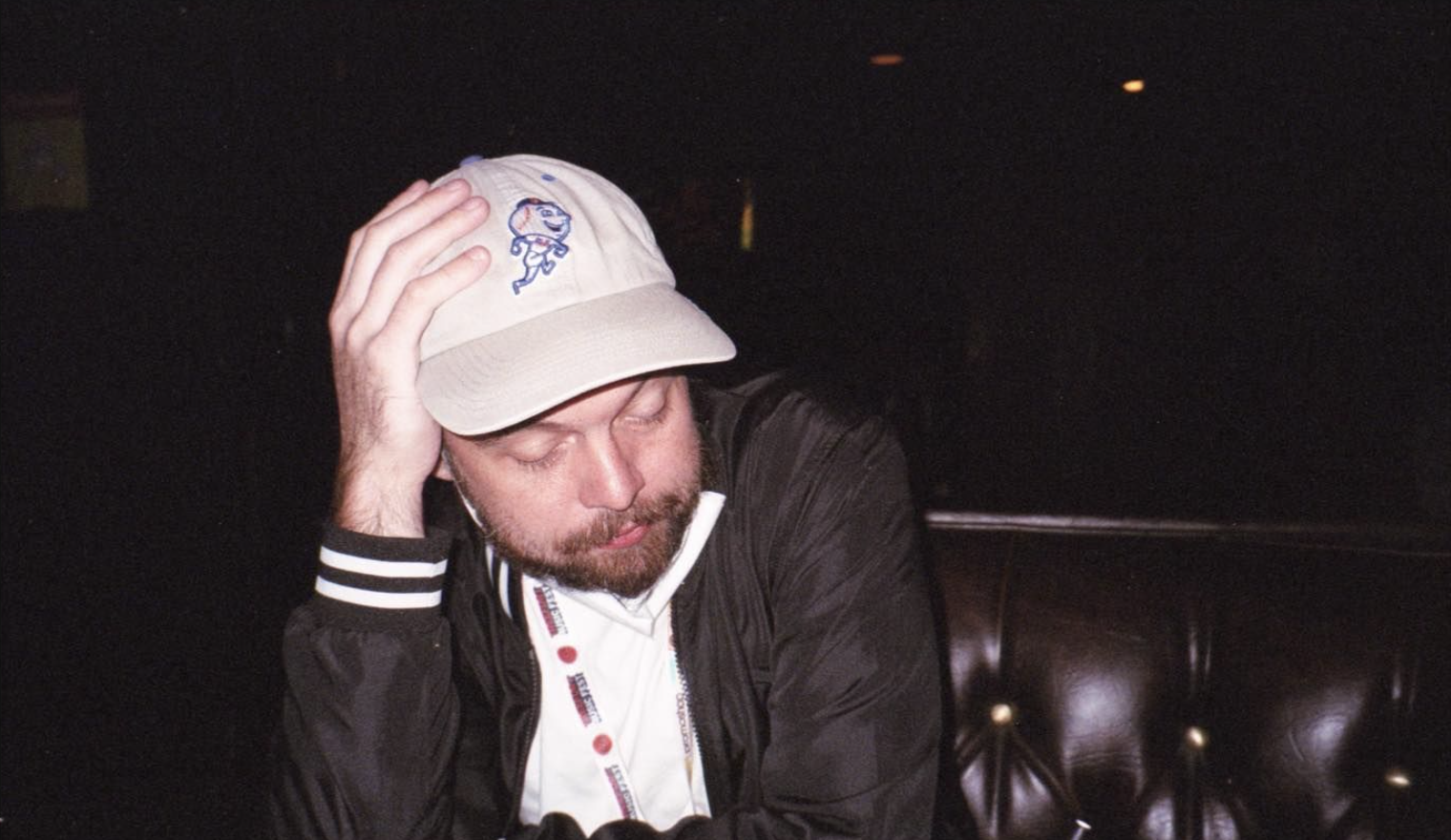
Regarding his new album, Alexei Shishkin has this to say: “Good Times is a collage of spur-of-the-moment inspiration. Process-wise, the album features surrealist techniques (automatism, collage, improvisation) both in the music and the lyrics. It was created from scratch in four days at Big Nice Studio in Lincoln, RI. For me, it was a vacation and a chance to play music with friend and producer Bradford Krieger. No road maps, no strategies, no blueprints. We started with a few loose, solo bass lines from Dave Kahn, around which Bradford and I built up the album. In a way, Good Times serves as a diary that tries to capture a lucid yet fleeting, four-day escape from reality.” To find out more, I dropped him a line…
You describe yourself as a “DIY nobody of the internet void.” Is that self-deprecation, or do you take pride in that label?
Both, I think!
You’re very prolific, with three releases in 2024 alone. What’s your workflow—or your approach, more broadly, to making music?
I think improvisation is what really informs my approach. I enjoy banter, yapping, making things up on the fly, sort of flying by the seat of my pants through conversations and encounters. The music is similar: there’s really only been two albums of mine, I think, where I tried to come to the sessions with fully-written demos, charts for everyone, etc. And I eventually realized, that’s not my style – I’d rather just figure it out as we go and enjoy the discovery process, rather than dole out militant instruction.
In terms of technical workflow, there’s nothing too special about it. I generally start with a chord progression or two that I like.
Then, if I’m recording at home, I find some drum loops I like. Then I lay out my progressions as I see fit, I loop whatever parts I’d like, I improvise a ton of bass takes in succession until I’m getting ideas I like, I chop those bass takes up and put them where they need to go, and then I improvise a ton of guitar, piano, synth, etc leads and accents until I’m happy with where it is. And then I throw some vocals on it.
If I’m in a studio, we’ll take the progression(s), find a tempo we like, and jam out some drum ideas. Then we’ll add the bass (I’ve leaned very heavily on Dave Kahn for bass in the past, amazing player). And from there, same stuff as at home: improvise a bunch of leads, accents, chop things up, add vocals, etc.
For your new album, Good Times, you developed twelve tracks from scratch in four days. Was that the plan from the beginning? What was the process like?
Yes, that was the plan. I really enjoy working with Bradford Krieger; he’s an absolute genius who can take my half-baked ideas and complete them. I knew that if I showed up at the studio, we could pretty easily knock out a decent amount of tracks. I will say, we didn’t have a number in mind… we were probably thinking more like 8 tunes, but hey, 12 works.
On the first day, something unexpected happened that turned into a pretty foundational part of the process. We thought we’d have our bassist Dave Kahn for all four days, but unfortunately he had to work and could only do the first half of the first day. So we decided to just go ahead and record a bunch of solo bass lines from him in the time that we had him, and we mostly used those as building blocks, chopping them up and arranging them as needed.
Can you talk a little bit about your feature-length documentary Play By Ear? What inspired it?
PLAY BY EAR is a documentary I made about the working-class musicians and artists, set against the backdrop of Boise, Idaho, and the annual music festival that takes place there, Treefort Music Fest. I think the film mainly explores two ideas: 1) what motivates artists to pour so much time, money, and energy into their music, 2) what motivates artists to stay in smaller communities that may not be the most hospitable to art spaces.
My team and I had been covering Treefort Music Fest for 7 or 8 years, helping out with video content, and when Treefort’s tenth anniversary rolled around, the folks at the festival asked if we could make them a video celebrating ten years of Treefort.
I saw that as an opportunity to try my hand at a documentary, since that’s something I had always wanted to do. Penelope Spheeris’ THE DECLINE OF WESTERN CIVILIZATION series was inspiring in many ways, as was Lance Bangs’ SLOW CENTURY. I had access to a ton of footage from past festivals, and I was pretty knowledgeable about the culture, so I gave it my best shot.
To be completely honest, I don’t think I delivered the product they were looking for, but I really enjoyed making the film, and I learned a lot in the process.
Your press materials mention that you have no desire to be a full-time musician. What do you do for a day job?
Yes, that’s correct. My day job is working in video/audio production. Lots of marketing-type videos. It’s a blessing being able to work in a field that’s adjacent to music. The skill sets inform each other, so when I’m working, I’m learning things that are useful in my passion projects, and vice versa.
You’ve also described yourself as a label’s worst nightmare due to your rapid output and lack of interest in performing live. Why do you resist live performance?
I wouldn’t say I “pursue” music in a traditional sense, to be honest. I don’t play live. I don’t know how to play 99% of my songs. I don’t practice. I don’t care to form a band. I’m mostly a hobbyist musician who loves creating and publishing music. I love being in a studio, improvising with friends, just bullshittin. Some may call it reclusive, but frankly I’m just not motivated at all by the idea of touring or playing out. It seems uncomfortable and expensive, and I’m too old for all that.
I see my musical pursuit as a shawarma. If you take one piece of chicken, pork, what have you, and put it on the spit, that’s not that appetizing. But the beauty of the shawarma is once you’ve stacked a ton of layers on, and they’ve had time to roast, then you can slice off a bit and get to taste it. That’s what I want my discography to be. Each song, EP, album, whatever, is a layer on that shawarma spit. (Strange metaphor, but I’m realizing I might be hungry.)
In terms of promotion, what do you do in lieu of touring or playing live shows locally?
I do a really bad job with this, but I also don’t put in that much effort. Last time I tried to do promo myself, I accidentally CC’d a giant list of publications instead of BCCing… woops. This time around I’ve hired Audio Antihero to handle the rollout, and they’ve done an amazing job.
Folks are always welcome to reach me through The Rue Defense Tape Club, a project I’m currently working on with my friend Graham W. Bell.
Good Times features a disparate collection of songs, yet many listeners expect all the tracks on an album to be of a piece. Are there any common threads that draw the songs on the album together?
I guess the common thread is that they were all recorded at the same time in the same place with the same personnel. Boring answer, but I think that’s technically it. And also sonically they’re all pulling from the same palette (i.e. we’re using a lot of the same instruments/tones throughout).
I think the songs are disparate lyrically — there’s not much of a common thread there. A lot of the songs were written using surrealist techniques. To be less pretentious about it: there’s a TV in the booth, and I would ask Brad to throw some arbitrary YouTube videos up there, or scroll through a random word generator, for example. And then those objects served as the lyrical foundations. That was generally the technique, although there were a few songs that were exceptions.
I think what makes poetry and songwriting so interesting is listener interpretation. For example, in my song “Disco Elysium”, the line: “There’s that expression, that eternal expression. It won’t disappear.” — yeah, that sounds bleak or whatever, but in reality, it’s just a reference to something that happens in a video game. But that sucks to hear; it sort of kills whatever magic may have been lurking in that song. So maybe sometimes it’s better to let the listener have their moment.
More broadly, do you have any thoughts on what makes an album an album?
Love an abstract/philosophical question. I think that answer is different for everyone, but for me, I’m pretty simple: if the artist called it an album, it’s an album.
Man, I’ve literally sat here for five minutes staring at my TextEdit window trying to figure out how to answer this. I guess if there’s anything even remotely tying the tracks together, I would have no problem calling it an album. Even, like, an EP is just a mini-album, right?
I think my answer is that I don’t care if it’s an album or not; I’ll let the artist decide.
What do you like about making music?
My favorite things about the process are experimentation and musical discovery. It’s a great hobby where everyone can contribute something of value no matter what background or experience level they’re coming from.
What’s on the horizon for you?
When it comes to music, I’ve got a ton of old demos and songs that have never been released, so I might put out some of those in 2026.
Otherwise, I’m working on a project right now called the Rue Defense Tape Club. Would love for folks to check that out.
5 responses to “That Eternal Expression: An Interview with Alexei Shishkin”
I relate to the playing live thing, it can be a chore. However, I do realize it can expose your music to a different audience.
Excellent conversation, Marc & Alexei!
Glad you enjoyed the conversation! I can definitely see the “chore” element of performing live as well. I’ve kind of soured on playing my own songs live, but I love playing live with DelCobras.
It definitely takes the pressure off when you have a good band playing together.
Alexei certainly has a rather unorthodox but healthy approach to his music. It’s not often we find musicians who aren’t at all interested in performing their music live, but I can understand his reasons. His music’s really cool too.
I agree! He’s a very interesting musician!