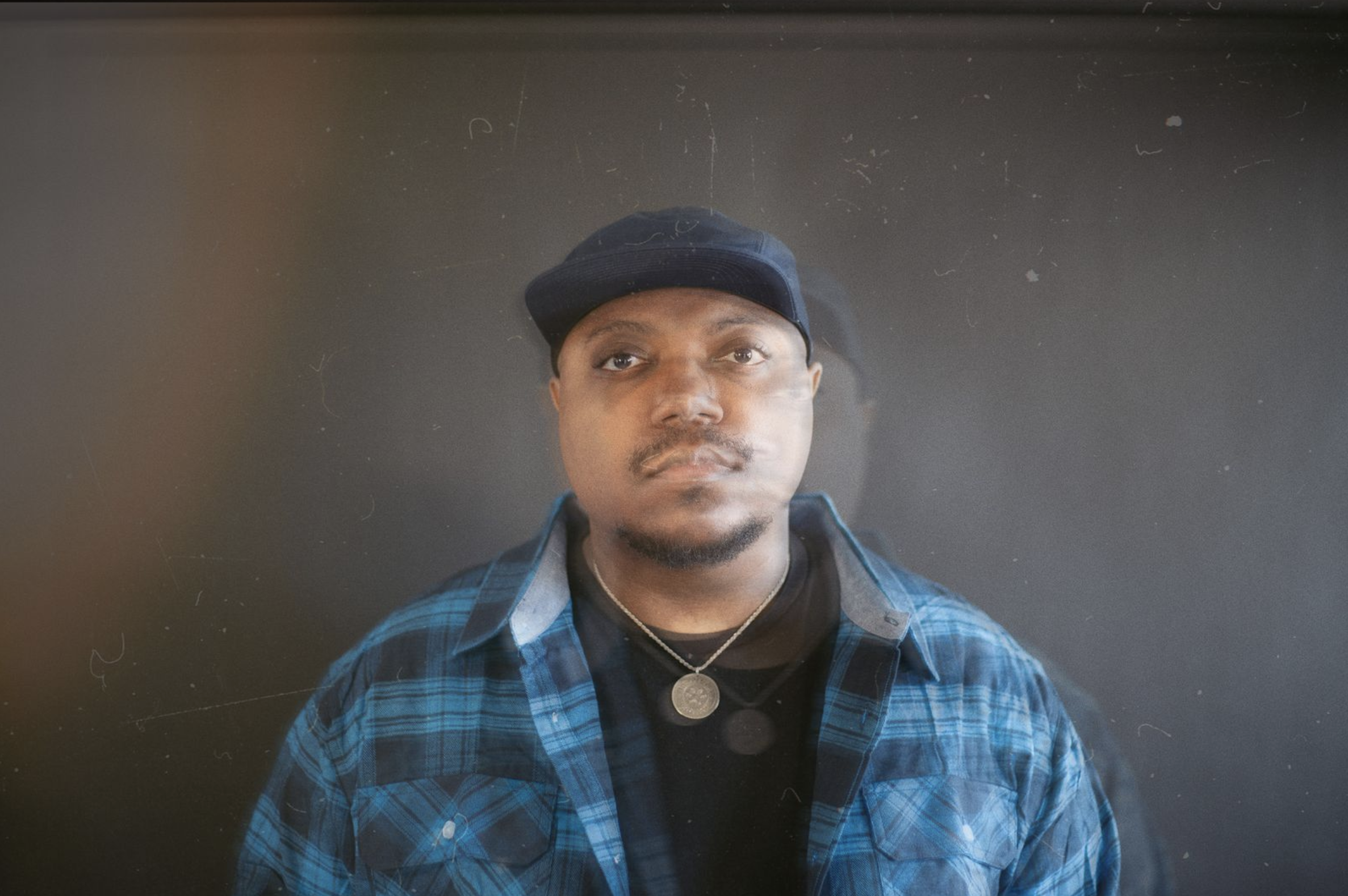
I discovered the music of Ray Curenton on GetMusic.fm. The song was “NFC,” and the blend of Curenton’s soulful voice and heartfelt lyrics inspired me to add it to the AMS Radio library immediately. The track description on GetMusic notes it’s part of a forthcoming album. The description further explains that “NFC” stands for “Need for Closure.” The song is about a childhood friend who was significant in Ray’s early life, including being the first boy he ever kissed. The track is part of the forthcoming album’s first act focusing on pre-adolescence, and it delves into Ray’s memories and the need to find closure around that early relationship. Ray describes it as a way of having a conversation he never got to have with this person, using the song to process and understand those formative connections. To find out more, I dropped Ray a line…
Your Bandcamp bio describes your music as a both a songwriter and a cultural worker. I’m curious about that description. What does it mean to be a cultural worker?
I’m going to link to an essay by writer and podcaster Musa Springer, who defines the phrase beautifully. Musa’s piece talks a bit about writers and poets who fit that framework—Nikki Giovanni, Amiri Baraka, Audre Lorde—and I think the term extends to music artists as well: acts like The Weavers, the Freedom Singers, Pete Seeger, Nina Simone, Arlo Guthrie. These are all artists who spoke to the times, channelled the spirit of what was going on culturally and politically into their songs, and acted as witnesses or keepers of the greater cultural story. I’m not an activist, nor a frontline organizer in a boots-on-the-ground kind of way, but I do recognize that music has always had the capability of being an organizing medium—an effective tool to promote expression, resistance, and action. We’ve seen it in all aspects of struggle: from work songs, spirituals, and call-and-response in the Black church to pro-union/industrial labor songs during the labor movement, protest chants during the civil rights and Black Power movements, 60s peace movement anthems, women’s music, and political hip-hop.
Even thinking about it less radically, I believe that music has the power to affect us emotionally and creatively. If we let it, the right song can inspire and uplift, it can comfort and encourage, it can illuminate, it can spark conversation, it can drive us to make change. There have always been singers and songwriters who have helped people use their voices and move that energy through their bodies in song. While my music isn’t always overtly political, there’s an ever-present undercurrent of responsibility there for me. For my songs to be of service in some way.
The bio also describes your music as a little bit folk and a little bit R&B. How do you see those two genres informing each other in your music?
On one hand, R&B has always been “me.” Most of my earliest inspirations are R&B (Brandy, Stevie Wonder, Musiq Soulchild), and my existing discography is predominantly R&B and pop music. Those R&B components are where a lot of my harmonies come from. The textures in my voice and how I deliver songs come through those inspirations. Folk came a bit later as an inspiration, in my teens and in college, where I fell in love with artists like Simon & Garfunkel, Joni Mitchell, and Nick Drake. When my husband and I first got together, he showed me a documentary called Radical Harmonies, which is all about women’s music, a cultural movement that took place within the lesbian feminist community during the second wave of feminism. The film introduced me to folk artists like Meg Christian, Holly Near, and Cris Williamson, and something about the way all three of these artists combined political messaging, love songs, personal storytelling, and spirituality shifted the trajectory of what I wanted to do with my art. I’ve been folding those elements into my songwriting bit by bit for a while now (I released the song “Stars” to act as a breadcrumb for where I knew I was headed next), and the music I’m releasing now is the most outright manifestation of that effort. It’s taken me a while now, but I’m finally figuring out how to do it authentically.
Do you think there’s also a connection between the two more broadly?
Absolutely. Part of my introduction to folk was, funny enough, seeing a TV ad for a Time Life compilation called Flower Power: it brought together a cross-blend of pop music that was informed by the counterculture of the 60s—folk rock, psychedelic rock, sunshine pop, R&B/soul—and something about hearing the sounds and messaging of artists like Marvin Gaye and The Impressions in concert with Joan Baez and Bob Dylan was illuminating to me. I think both genres are deeply soulful and designed to invite the listener in. They can both be universal or very intimate and personal. And there have always been artists who live where the two genres overlap: Odetta, Richie Havens, Leon Russell, Mavis Staples. I’m also really impressed with some of these young indie artists like Lizzy McAlpine, Tiny Habits, and Jasmine Jethwa who are doing this folksy acoustic thing but you can hear the R&B influences in their vocals. When I found Jasmine’s music in particular, I knew that I could step into what I’m doing now and that it could find an audience.
You’ve been releasing music for over a decade. How has your approach to writing and recording changed over the years?
My first two albums were recorded while I was still in college, and my writing and production were very much informed by what was happening in mainstream pop and R&B at the time. Back then, I was driven to make the most catchy music I could make, while still trying to “say” something. After I graduated, the reality of adulthood really set in, and finding the time to be creative got hard for a while. There’s a 9-year gap between my second and third albums (Backslider and Believer), and Believer was actually a really challenging album to write. I hadn’t exercised any of those muscles for so long that I truly had to relearn how to write songs. And the process looked different: many of those songs were completed over days and weeks as opposed to hours.
Since I wrapped production on Believer, I’ve been on a journey to write and record more organically: to rely less on samples and virtual instruments and connect with the process of composing in a more tactile way. So part of that journey was picking up an acoustic guitar for the first time at 29 years old. I’ve been learning how to play in earnest for almost three years now, and it has been one of the most fulfilling, frustrating, yet magical things I’ve ever done. I had predominantly been a head writer before (melodies and chord progressions usually just come to me), and this upcoming album is the first one I’ve written with a guitar in my hand, which felt so incredibly natural. I wasn’t sure if my playing was good enough to “make the record” but my producer, Brandon Adams, is such a visionary. He took the demo sessions (which in most cases were just glorified worktapes with some rudimentary chord blocking and my vocals) and used them as a foundation for most of the songs. All the really skilled guitar work that you hear on these songs is him, but it’s very special to me that he left my strumming in as a time capsule for this journey that I’m still very much on.
Speaking of Brandon, this album is also the first time I didn’t steer the ship, so to speak, as a producer. I passed all of these songs over and asked him to direct the sound of the whole project. The running theme was “less is more”— the lyrics were able to communicate a lot without being longwinded or overly straight forward, and whereas in the past I’ve valued maximalism and making really splashy and grand productions, I wanted this project to stay minimalist and understated. To breathe. A real departure for me.
You live in Nashville, a legendary musical city. Has that influenced your music?
I think it has. I went to college here and then came back to live permanently in 2019, specifically because I wanted to reconnect with music. And I feel at home here. I’ve lived a number of places, and I’m much more inspired as a writer being here than I’ve been anywhere else I’ve lived. Perhaps it’s something about being surrounded by so many other music makers…or perhaps it is that legacy you mention: knowing just how much great music has come through this city decade after decade.

Your recent song, “NFC,” really caught my ear both for its lyrical intimacy and your clear, fluid singing. Have you taken singing lessons, or are you just a natural?
I don’t think of myself as a great singer so I am always so flattered when people call out my voice as something worth mentioning. I studied voice very, very briefly in school, but I think the main “lessons” really came from growing up in a family of singers and singing in church as a kid. My mom is one of my greatest inspirations—she sings from such a pure and meek place. And when you mention clarity, that’s my sister all the way. They are both such tasteful singers and I’m grateful to have come up under them.
I’m struck by the difference, lyrically anyway, between “NFC,” which came out in May, and your more recent single, “Ground Zero,” which came out in June, and is incredibly spare in its approach to painting a mental picture. What’s your approach to songwriting, and how does it change from song to song?
Roger’s quote from One Hundred and One Dalmatians replays in my head: “Melody first, my dear, and then the lyrics.” And that’s truly how 95% of my songwriting happens. Melodies, when they come to me, have a way of telling me what they’re about. They often lend themselves to certain words or vowel sounds and I find that the more I sit with them, the more the story they’re supposed to communicate takes shape. And even though I made the transition from writing in my head to writing with a guitar this time around, I found that aspect of the process to still be the case: the chords led me to the melody, which then led me to the stories and lyrics.
What I didn’t expect, though, was for the lyrics to start pouring out of me so quickly, especially after what I went through with Believer. I wrote “NFC” first, which took a while, and then I wrote “Once Familiar Friend” (the next single) a couple of months later. Then in the middle of September last year, the most incredible thing happened to me: the rest of the lyrics just started compelling me to write them. I’m telling you, they would not leave me alone until I got them done. It was as if I was channeling the songs more than writing them. Eight of the songs were written consecutively in just as many days; that’s probably not a big deal to a lot of pro writers, but I’ve personally never experienced a creative flow so concentrated before.
I also get the sense that the songs are connected in some way, and I know they’re both going to be on your forthcoming album. Are they part of a larger story?
They are. My story, in fact. The album is titled Ripples of the Past, and most of the songs on this album are reflections on various people or experiences that I’ve been carrying around with me for a long time, which probably explains why when the dam broke, it really broke. Formative experiences that have shaped my understanding of myself: heartbreaks, embarrassments, losses, and epiphanies. The album has three acts: Age of Minority (pre-adolescence), Age of Maturity (adolescence), and Age of Majority (adulthood). “NFC” and “Ground Zero” are a part of that first act. “Ground Zero,” in particular, is describing one of my earliest memories and my recall is admittedly not the clearest, so I leaned into that and opted to just describe what I could. The mystery is intentional.
The cover art for both singles is interesting. Each includes a faint image that looks like a Rorschach blot. Am I seeing that right? How does that image comment on the music or signal significant themes on the album?
Great eye! Yes, one of the potential album titles that ended up on the chopping block was Therapy Sessions. “NFC” is named after a term in social psychology that stands for “need for closure,” and I found as each of these songs revealed what they would be about that I was really going to be processing some heavy stuff. It really connected for me more than any other project I’ve done how much music and music-making can offer the opportunity for therapy. So I jumped into the deep end and let myself feel everything I needed to feel while writing these songs, things I’d been reluctant to feel for a long time. I let myself cry. I let myself hurt. I let myself grieve. I let myself feel shame and remorse. I went through my typical editing process, but I didn’t stand in the way of myself, if that makes sense. Free association, followed by inquiry, much like the Rorschach test. It was incredibly cathartic. And when the last song wrote itself and all of the fragments came together I found that I had actually gained so much clarity and perspective on my life that I was missing. I’ve found that I’m not carrying around as much regret. I have a much greater grounding in who I am, and before when I would say “I wish I could have had xyz” or “If only my life would have gone this way, I’d be better off,” I instead now have so much more gratitude and appreciation for the journey itself. I am making more and more sense of my life as I continue to live it, which has been very empowering in a time when the world doesn’t make a whole lot of sense. I owe a great deal to this album.
And the album is due in September. How’s it coming along?
I’m so excited to release this one, and if I could just drop the whole thing tomorrow I would. But I also understand I need to give my pre-existing audience some time to catch up to the new sound, and give the songs a chance to help me connect with indie, folk, and singer-songwriter fans who have never heard of me before, so I’m letting this waterfall release run its course and I’m very grateful for the response I’ve been getting so far. The songs are finding their audience and the feedback has been so affirming to me that this transition was the right one to make.
What’s next after the album comes out? Do you have any plans to take the songs on the road?
I would love to take these songs on the road. I would love to take all of my music on the road. I’ve had a number of people ask me through the years why I don’t perform more. There are a number of reasons and I think the biggest one is that I see live performance as a totally different animal to conquer from studio work. It requires a level of rehearsal and stamina and investment of time and energy and strategic management to do really well. I’ve found a real rhythm and comfort level with my recording process and I want to be able to bring that same level of quality to the stage. Learning how to play guitar has also added a new complication: I, of course, want to play for myself on stage but that means getting myself to the same level of confidence and instinct with playing that I have with singing, which may take a little bit of time yet.
In the meantime, I have a new R&B album coming soon as well: a collaborative project with Spice:Garden and EverSōl, who I worked with on the song “Ember” back in 2023. The Spice:Garden guys are so fearless and prioritize play and curiosity over everything else, so pooling all of our ideas together and building our own little world of songs for that project was very freeing and super fun. We just wrapped the vocal sessions on that a couple months ago, and I’m already like, “so are we going to do a part two?” And I am also already conceptualizing my next solo project: more complex composition on the guitar and getting even more conceptual as a storyteller (perhaps with a companion literary component?). I’m always seeking to challenge myself and I never do the same exact thing twice.
5 responses to “When the Dam Broke, It Really Broke: A Conversation with Ray Curenton”
Wow, excellent conversation! Very thoughtful and insightful.
Glad you enjoyed it!
I know I’m sounding like a broken record, as I’ve said this often, but your thoughtful questions always elicit such deeply thoughtful responses, and Ray’s are possibly the most intelligent and thoughtful yet. He’s a gifted musician and songwriter, and his songs are quite varied and eclectic in sound and styling.
I agree that Ray’s responses are thoughtful and intelligent… He’s an interesting musician, and I’m looking forward to hearing his album!
Congrats, Marc, another great interview! Ray Curenton comes across as a very thoughtful artist. He also seems to be very moderate about his great vocals.