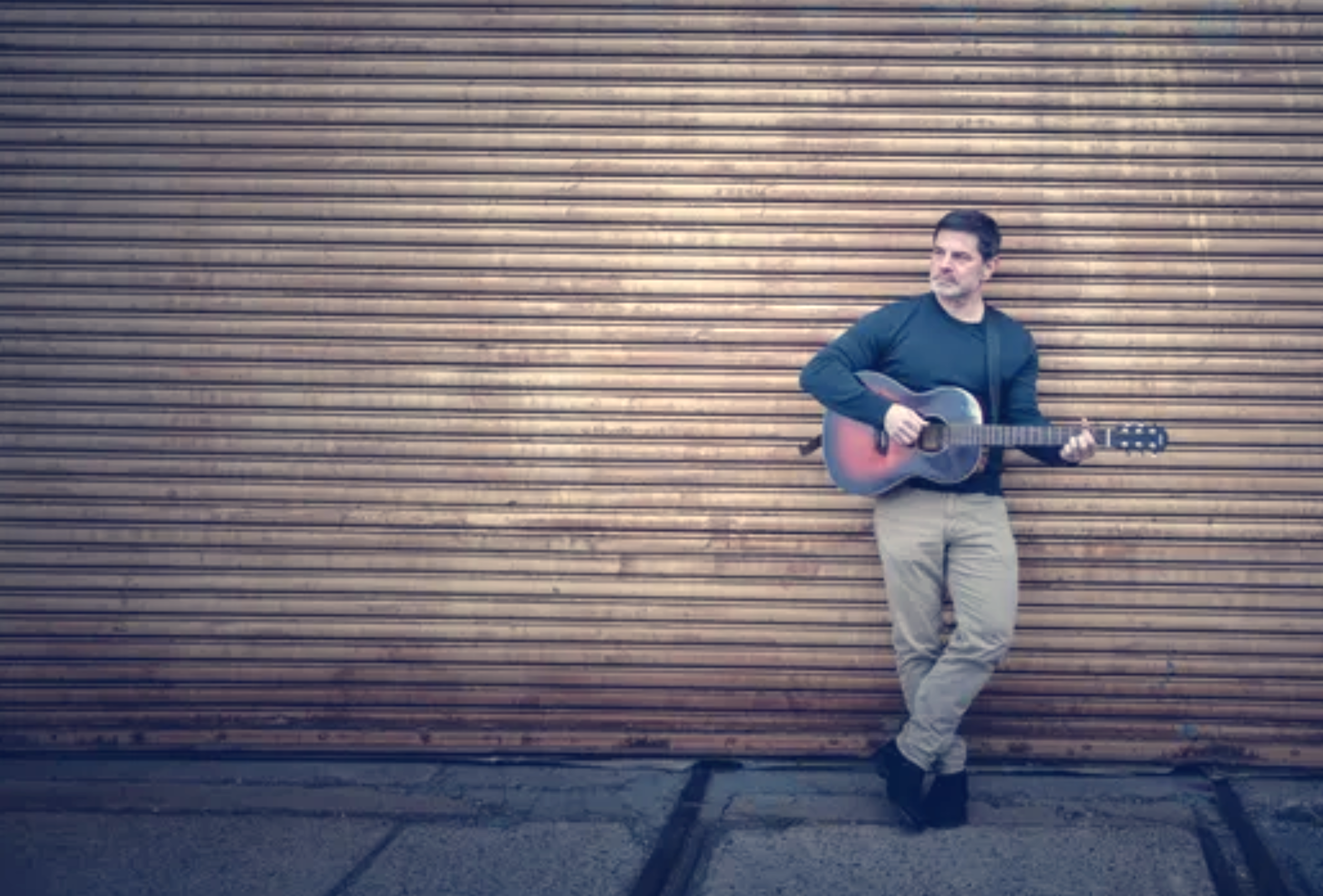
How’s this for an interesting turn of events? John Huggart, who’s based in Australia, interviewed me a little while back on his Indie Over Fifty YouTube channel, then Paul Hashemi saw the interview and dropped me a line about some of the good work he’s doing to promote indie music right in my own backyard of Philadelphia, Pennsylvania! Small world! In addition to recording music and playing live with his band Faint Halos, Paul also maintains a website called Bird vs. Skyscraper where he curates a Spotify playlist to spread the word about indie bands who are playing in Philadelphia.
Your press materials mention that you left your music career fifteen years ago to focus on providing for your family. What did your music career look like at that time, and how did it feel for you to give it up? Did you at least get to fiddle around with music, as it were, in the intervening years?
Honestly, I didn’t really know that’s what I was doing at the time. I had just left a band, but was writing and playing myself and looking for a new one; but then the 2008 market collapse happened, I lost my job, and suddenly we were in a financial emergency that it took us years to dig out of. I literally didn’t even think about music for a while. By the time things settled down, my kids were old enough to need me to coach sports, help with homework, and do all the other normal “dad” things, so years just went by where music and really anything else that wasn’t work or parenting just fell completely by the wayside.
What brought you back?
On March 11th, 2020, we were out to dinner celebrating my daughter’s birthday, and we got the message that my office would be closed the next day. It quickly became evident that we were going to be home for a while – I was really lucky that my job could be done remotely. It was also evident that we’d all have a lot of time on our hands.
The first thing I did was buy an XBox – I hadn’t played video games in years – and I played all the way through a Star Wars game over a few days. And then I was like, “well, this is a colossal waste of time!”
So the second thing I did was buy a new laptop (I didn’t own a personal one), and buy a copy of Ableton Live, and start messing around with writing and recording songs. And it started to click. I spent the next year, basically, absorbing production videos on Youtube and working on my writing, and building up my studio to the point where I could make quality music. The first EP for Faint Halos came out in August 2021.
As you returned to music, you set up a home studio. Did you have any gear leftover from your previous life as a musician, or did you build it from the ground up?
I had a really nice Martin that my wife got me as a gift a few years ago, and an electric guitar and amp in a closet from my old life; no more than that. It’s funny, both of those items – a DeArmond Starfire from the late 90s and a ‘63 Fender Vibroverb reissue from the early 90s – are like “vintage” now on Reverb, but they were really just the best things I could afford in my 20s.
What’s your setup? Is there any gear that you find particularly — or surprisingly — helpful? Personally, I’m always amazed at how important mundane things like cables and mic stands can be!
You’re not wrong – I just had to replace some of my pedalboard cables and it all sounds so good now!
One luxury of building from scratch, and doing so as an older guy with a little more money than I used to have, is that you can do things “right”. My 25-year-old self who bootstrapped every piece of gear I ever had would be super jealous of me now. But basically, in my home studio, I have a Mac Studio running Ableton Live; an Apollo interface; and three secret weapons, a Kemper Profiler guitar amp modeler, a Townsend Sphere mic, and an Arturia AstroLab keyboard (coupled with their Analog Lab software).
The Profiler can basically sound like any amp, just about perfectly; it’s also a great preamp for acoustic guitar direct signals, bass guitars, and so forth. The Sphere kind of does the same with mics – you can record with it sounding like a U87, or an SM57, or anything in between. I am sure there are purists out there who aren’t down with digital modeling, but all this music ends up getting played on digital media anyway. I can’t honestly tell the difference and it is just SO much easier to sit down and create when you have these tools available. And the Arturia software can basically mimic any synth or keys sound you want. I don’t know how anybody could afford a huge collection of real synths – it wouldn’t make sense for my music anyway – but this puts everything I do need at my fingertips.
I did expand my guitar collection a little bit too, and these days I’m kind of in love with a new-ish Jazzmaster for distorted rhythm playing, alongside a nice full-sounding Telecaster for cleaner tones, and my good old Starfire for more jangly stuff.

Early on, your music placed an emphasis on synth sounds and atmospherics, but you’ve shifted over time to a more organic sound. How and why did that shift occur?
That shift happened for two reasons: First, as I mentioned, when I started playing again, I was really learning how to use all the tools, so sometimes it was just a fun technical challenge. “Arcade” from the first EP has a full orchestral arrangement on the outro; the version of “Impostor” from the second EP has a string quartet; some of the other songs have a variety of synth sounds, horns, drum machines, etc. because I was just having fun with it. That was great and I love to have those brushes in the palette, but as I focused more on just writing good songs, my more traditional rock band side has come out.
The second reason is that I really started itching to play live again, and a lot of that stuff would be impossible to mimic. So the album last year was written with the express intention of being something that could be performed by a 4- or 5-piece band. It needed to feel like something you could go see performed in a room, because that’s what we were going to do.
Your daughter added harmony vocals to some of the tracks on your album I Can See a Million Lights. What was it like to record with her?
My daughter is a truly spectacular singer. I’m a decent singer, but it’s fair to say that on a record, it requires a bit of editing and polish to get it sounding good.
Cate had agreed to sing on the acoustic version of “Something to Lose” and we did a few takes, and then I asked if she could give “Impostor” a shot as well. She was literally on her way out the door to catch a train to head back to college, but she was like, OK, I’ll try it. We got one take and then she had to leave… and that’s what’s on the record. It’s basically flawless, I barely had to EQ it.
You’ve mentioned an urgency to share your music and noted that your songs have messages that people need to hear now more than ever. What are those messages, and why are they so relevant today?
At the risk of sounding cheesy, when I was younger, I wasn’t much of a writer because I hadn’t really lived. It was all fiction, and my reference points didn’t always feel authentic. I would try to be intentionally obtuse like REM, or grandiose and serious like U2, and it never really felt like me. Now don’t get me wrong, it’s entirely possible for a young person to be an amazing songwriter, just look at Olivia Rodrigo – but for me, at least, I was too self-conscious to write well at that age.
What I found now is that my songs really come from the heart. I’ve gotten more comfortable with who I am, and I’ve also seen that most of the mistakes in my life can be chalked up to staying silent out of fear of embarrassment. Like, any time I’m asking, “am I the only one who feels this way?” the answer is no.
In our current post-pandemic world, in the current political and media climate, everything is trying to shock you, to violently grab your attention, and I think a lot of people are just exhausted and bewildered and want to withdraw. Our times are increasingly lonely, and most of my songs end up being about connection and wanting to feel less alone. So that’s why it feels urgent.
You also curate a playlist called Philly Indie Now on the Bird vs. Skyscraper website. Can you talk a little bit about this project?
Sure. In promoting our first couple of shows, I got to thinking, “why don’t more people come out to see live music?” One school of thought is that they just don’t know that gigs are happening, and there are a bunch of people in the Philly scene trying to address that in creative ways – look at FOSH.com or StageDivePhilly for example.
My thinking is a little different – I think most people basically don’t like to see live original music that they don’t already know. A lot of times, the fun of a live show is in singing along, in hearing that magical moment from the record in person, from hearing the band subvert your expectations by doing something different than the record.
So I thought, “There must be a web site or playlist where I could hear some really good bands with shows coming up?” I searched and searched and didn’t find anything like this. The venue web sites sometimes have links to web sites or videos, but it requires you to proactively go check them out and hop across platforms; there are some “Philly” playlists on Spotify, but they end up being uncurated, with thousands of songs from bands that are now defunct in a wild array of genres, and predictably, I don’t think anybody listens to these playlists. I can’t imagine why anybody would!
So what I’m trying is: I’ll curate a tight list of music I think is really good with a consistent vibe, like 10-15 songs at a time, and tell you where you can go see these bands in the near future. It’s updated every month and in a place you already listen to music (Spotify). If you like my taste, you’ll easily discover some bands that you can go see, and you can look forward to new stuff coming out every month. Over time I can see expanding across DSPs (Apple Music, YouTube Music, maybe even Bandcamp) and across genres (I’m in the adult-ish indie rock lane, but there’s no reason there couldn’t be additional playlists for hip-hop, punk, metal, and so forth).
I’ve taken a little crap from people because it’s on Spotify – like literally people comment on the ad, “I only listen to vinyl” or “What about Deezer?” That seems ludicrous to me – this is free promotion for the bands and hopefully a valuable service to the fans, so the fact that it doesn’t make the bands any money seems beside the point. You need to fish where the fish are, and the bands will sure as hell be happy about it if more people come to their shows.
The last thing I’ll say is this. A club staging original rock shows in 2025 is doing God’s work. It would be a much better business decision to book a nonstop parade of Dead tribute bands and 80s cover bands and DJ nights. They are doing what they do out of love, and when you get booked, they are taking a chance on you, and you should move heaven and earth to make it worthwhile for them. That’s how all of this started for me – thinking about how I could pay back the venues that booked my band and put “butts in seats”. I’m excited about taking it into the future.
What’s on the horizon for you?
I’m trying to increase the pace of my writing. I just got notified that two of my songs were in the top 50 “Longlist” of the Talent is Timeless international songwriting competition, out of like 3,500 songs, and so even if they don’t make the shortlist, that’s gratifying and just that small external recognition makes me feel like it’s worthwhile. (I entered the WXPN 24-Hour Song Contest this year as well; that unfortunately did not fare as well.)
But what’s even more exciting is that I’ve finally gotten just the right mix of guys – Miguel, Bill, and Matt – and we are turning this initial “home studio” version of Faint Halos into a real band. I’m still the main writer and singer, but we’re going to be recording things as a band, fleshing out arrangements, and most importantly, playing some great shows.
There’s nothing better than being in a packed house with a tight band and having the audience sing along. That’s why I took Faint Halos out of the studio and into reality, and everything we’re doing now is about setting those experiences up.
9 responses to “My Songs Really Come from the Heart: An Interview with Paul Hashemi of Faint Halos”
Great interview, and how cool to meet yet another musician from Philadelphia, which appears to be a hotbed for indie music! I like his songs.
Thanks, Jeff! Yeah, it’s a hopping little scene we have going. With any luck, DelCobras might get to share a bill with Faint Halos sometime soon!
Very relatable article , I stepped away from music after college but came back to it with experience and a different attitude.
I’ve experienced similar things to the negative feedback Paul received on his Spotify in trying to uplift other local bands, but definitely try to not let the occasional negative reaction get to me.
It’s funny about Spotify. I don’t love the platform myself, but my music is on there and I appreciate when anyone adds something I’ve worked on to a playlist.
Same here, most of us don’t have the luxury of jettisoning it yet. I really don’t like it, but even a random person that you talk to will use it to check out your work, usually as the first stop.
Definitely! Everyone knows Spotify, so if your goal is for people to find your music, it only makes sense to put it there.
I’d like to second Jeff here – great interview! And how remarkable you found Paul via Australia!
I’m glad Paul was able to resume music and reassemble a band. It sounds like the years leading up to it were not an easy road. Also, kudos to Paul for promoting music by other Philly area artists via his curated playlist. Last but not least, I also sampled some of the tracks from what appears to be his most recent Faint Halos album, “I can see a million lights,” and like what I heard!
Crazy, isn’t it? An interview recorded on the other side of the planed introduces me to musician in my own backyard! Also, Paul was interviewed recently on the Rock n LOL podcast, and the interview was recorded at the Gem in Spring City! https://rocknlolpodcast.podbean.com/e/s1e26-faint-halos/
Wow, that’s cool!