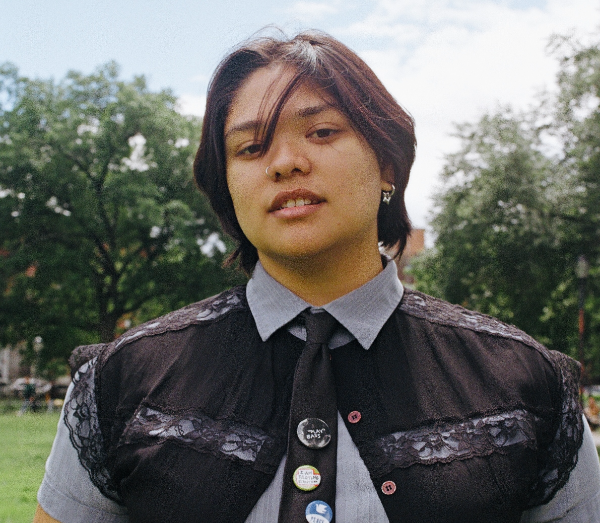
Debuting in 2021 at the age of 17, Leilani Patao showcased their rich, aching voice and youthful willingness to show vulnerability through a raw lyrical honesty across a series of DIY self-releases. 2024’s ‘But What If?’ earned them their greatest exposure to date when they were featured on The Tonight Show with Jimmy Fallon. Now, Leilani is releasing an album called daisy, which the artist describes as a “pure experiment” in both sound and distribution. Leilani’s ambitious production requires the listener to find the emotion within the cracks, as their range, biting words, and ear for melody push through the wash of sound in fragments. Leilani also made the decision to remove themselves from the algorithm by withholding these songs from streaming. To find out more, I dropped Leilani a line…
You’re Brooklyn-based via Los Angeles. What drew you across the continent?
I grew up in LA, born and raised in the Atwater area, but I always wanted to move to New York, even as a little kid. I had plans to pursue a career in musical theatre, and had originally come out here to go to theatre school. But I discovered an amazing music scene here, changed my major, and I really started putting roots down. Plus, I’m a pretty bad driver. I’m horribly nervous behind the wheel, so the trains in New York are much more my speed.
And you’ve chosen to withhold your work from streaming. Can you talk a little bit about that decision?
In the past year, I’d written and produced so much music. It was all stuff I was really proud of, but I was really discouraged by all the steps that I’d been taught I had to do by the music industry. I had to be on streaming, I had to submit for playlists, I had to make constant posts on social media in a certain format. I had to make nice with systems that I think don’t treat musicians fair and don’t care for anything but profit. And though I could do all the steps, I could pray to the algorithm gods, it could still just be another release people don’t get recommended. And I believed in this music so much. And I knew that if I was feeling this way, there must be others who feel this way too. So even before I signed with Audio Antihero, I’d decided I wouldn’t make a single post online that I didn’t feel excited to share, and I wouldn’t put my music on streaming. And Audio Antihero heard me out, and believed in me enough to support my decision, and is doing all they can do to help me out, which has really meant so much. I chose to do this because I think there’s better out there. We don’t have to accept the way things are, there’s always something we can do. And even though I’m just one person doing this, I feel better about the work I’m doing. And that’s all I wanted. Now I just hope that people will keep listening 🙂
On top of that, you also take an experimental approach to your sound and production. What kinds of sonic experiments can listeners expect to hear in your music?
My voice in these songs is definitely the biggest difference between my last album, But What If?, and this project. I’ve been a singer and a vocalist for almost my entire life, and I’d always felt like my voice was the most impressive part of my music. So for a long time, I always had a vocal first mindset: it’ll be the loudest in the mix, and it’ll be perfectly on pitch, and my emotion will convey the meaning of the song. But with this project, I wanted to think about the production first. I wanted to see if I could make my voice just one of the elements telling the story. So on daisy, my voice is chopped up, it has autotune on it. It has overdrive and chorus effects, and sometimes it doesn’t sound like me. I think the listeners can expect odd and bizarre sounds that come together in a kind of lovely way.
What informs your experimentation? Are there any other musicians or artists who inspire you?
I think I was definitely listening to other artists who were doing super cool things that I wanted to try. I’d started just exploring the depths of Ableton, and I started figuring out how I could recreate sounds that I liked. I always had a pretty eclectic music taste but in recent years, the music I was listening to and the music I made were quite different. And so I wanted to experiment with what it would be like to meet in the middle somewhere. I was raised on Daft Punk, so I knew I wanted to toy with the soft electronic sound they had on Random Access Memories. And I’m a big MUNA fan, and I’d been listening to a lot of “Toro” by Remi Wolf, so I tried to play with silliness in my lyrics and big vocal moments that play out. But then I got really into wacky production, with unpredictable turns and bizarre strange sounds. Artists like Feeble Little Horse, Grumpy, and Le Tigre. And I think that was when my sound started to take shape.
Why is experimentation important to you?
I think trying new things and seeing what you like is extremely important. Even outside of music, I think checking in with myself and asking where I want to go next is something I really try to do. I think I get tied up to the momentum of what I’m doing, that I don’t even realize what each day feels like. I get really into a job or making a song or going to the same restaurants, or whatever, that I just forget that I even can do something else. So lately, I’ve been trying to check in with things, see how I’ve been doing them, and finding what I could change, just to try. And this EP is the first music where I really tried new things.
Your forthcoming EP is called daisy. What’s behind that title?
Daisy was my childhood dog who sadly passed away almost a year and a half ago. When she passed, I knew I wanted to name a project after her, just so I could process it all and to get to share as many memories I could of her. And I used to have a whole EP of dog songs, all the songs were about a dog or about being a dog. But then I kept getting lost in life, and afraid to show this music to anyone, and then the one year anniversary of her passing came and went. And I kept going, and new songs started replacing the old ones, but the EP was always named ‘daisy.’ I knew that no matter what songs were on here, they would be for her.
Is that Daisy on the album cover?
The cover is Daisy running sometime in the first year or so we had her. Once when I was at my parents house snooping around, I came across an SD card that must have been in my mom’s camera the first year we got Daisy. There were only a handful of pictures on there, but I found the one that would become this EP cover. Daisy was such a runner, especially when she was a puppy. If she wasn’t asleep or being actively held in someone’s arms like a baby, she was running around. And I just fell in love with this picture as soon as I found it. This is how I remember her, this is the Daisy that shows up in my dreams sometimes. She’s in her cute little pink harness, and she’s just a blur, she’s so fast.
You’ve mentioned that the debut single, “Cut,” is about being bad at breakups. Is the song based on personal experience?
I’ve gotten in trouble with people in my life for writing songs about situations and then releasing them, so I’m going to tell this story with caution lol. I was dating someone, and for the last few weeks we were together, I was completely out of it. I was disassociated, it was like I was an inch away from my skull, and I was stumbling through the fog. I was saying the wrong things, nothing I did helped clear my head and it would just dig me in further. And I just wanted to say something that would make it better, I kept trying to predict what they wanted, but instead, I just did everything they expected me to. I would run when they lashed out, I would sting back, we’d argue in whisper screams late at night, and I just couldn’t decide what to do about anything. And I couldn’t stop listening to Caroline Polachek’s Desire, I Want To Turn Into You to comfort myself, which is a little funny. “Cut” is about not being able to let go, but knowing you’re losing the person. It’s about being the last person holding on, and but the one in the wrong.
Does writing and singing about difficult topics help you work through them or give you closure?
I think writing music is definitely the way I process things. I allow myself to sit in the feelings when I write a song, I let whatever comes out get said. And things can be serious, and devastating, and have long metaphors and break my heart all over again, and some of my emotions can hide a bit more. Things can be terribly funny or silly or worded in odd ways that I only know they’re about. I feel better most of the time. The other times, real feelings start to peek out in my songs, things I didn’t want to feel. But then I know, and I can go from there. Music really helps me know what I actually want.
I think the trouble comes from when I’m ready to show these songs to people, and I have to start explaining myself. Then I gotta start thinking about these things again and tell people about them. But I think that’s a little fun. I like sharing my secrets in the most cryptic ways.
What’s on the horizon for you?
We’ve got an EP release in the works, so stay tuned! And I’m making some physical copies of this EP, mostly CDs and tapes. I want this music to exist in the real world, and not just on the internet. So there hopefully will be plenty of opportunities to experience this music in different ways! And I’m excited to start sharing this music with people, I’m excited to hear what everyone thinks!
4 responses to “The Way I Process Things: A Conversation with Leilani Patao”
I really appreciate artists that keep challenging themselves, and I sure got that impression in this interview.
I agree… It can be tempting to fall back on a formula (especially a successful one) but trying new approaches keeps the music fresh and fun.
To my ears, Leilani’s vocals and music style are somewhat like a female version of Sufjan Stevens and Bon Iver.
Ooh… I hadn’t made that connection… It’s a good comparison!