I’ve been a fan of Graham Parker for years — ever since my high-school friend, Dan Barry, gave me a copy of his album The Mona Lisa’s Sister. Since then, I’ve had the good fortune to see Parker perform live a number of times and have been incredibly influenced and informed by the lyrical wit and musicianship of his music. So when Jay Nachman told me he’d written a book about Parker’s first album, I couldn’t resist asking him about it. And when Jay offered to forward a few questions to the man himself, there was no way to say no!
Jay Nachman
Your new book, Graham Parker’s Howlin’ Wind, tells the story of Parker’s first album. What first attracted you to his music?
The first time I heard his music, the album Heat Treatment, I was driving in a car with friends, and I didn’t particularly like it. But I really wasn’t paying attention.
At college, a group of us would gather in the room of a dormmate and play records, including Howlin’ Wind, and I was really taken by Graham’s music. I like Nick Lowe and Elvis Costello (both in the book), and have a lot of their albums, along with others of his contemporaries, but his music resonated more powerfully with me in a way that the other musicians didn’t. Why that was, I can’t answer. It just happens that way sometimes, right?
And why focus on that album specifically?
I was curious about Graham’s background, and I knew focusing on that album would, selfishly, allow me to learn about how he was raised and his musical influences. But also things like whether he ever had music lessons. And I knew that his bandmates in The Rumour had interesting stories and influences of their own.
So, I thought that by writing about Howlin’ Wind, I could explore the various scenes that he and the musicians in The Rumour were a part of, as well as their influences.
Plus, it’s a great album.
In your press materials, you mention that in his liner notes to Parker’s 2001 album, That’s When You Know: The Acoustic Demos & Live at Marble Arch, writer Nigel Williamson claimed, “Graham Parker and The Rumour had revitalized British music with their debut album Howlin’ Wind.” Why did British music need revitalizing in the mid-1970s?
I wasn’t there, of course, but glam and prog rock dominated the charts at that time. For example, Yes’s Tales from Topographic Oceans spent two weeks at number one in the last week of December 1973. Queen’s Sheer Heart Attack spent twelve weeks in the top ten. Genesis’s The Lamb Lies Down on Broadway spent six weeks on the charts, peaking at number ten in December 1974.
And in the states, soft rock and singer-songwriters were topping the charts with acts like Carole King, America and John Denver.
So, both countries were ready for something with a little more edge, which really was demonstrated with the advent of punk.

The book includes some interesting photos. I love the shot of Parker with his childhood band, the Black Rockers! How did you acquire these photos for the book?
The photo of Graham with the Black Rockers was scanned, and he sent it to me. I knew that it existed because it was shown in a documentary about him, Don’t Ask Me Questions: The Unsung Life of Graham Parker and The Rumour. Funnily enough, he was in the midst of moving while I was interviewing him and writing the book which ended up tossed in a box. I think he ended up finding it in a storage shelter.
How did you meet Graham Parker?
At one time I had a now-mostly-defunct blog and I interviewed him a time or two. So, I was a bit of a known quantity with some credibility. He agreed to the book with almost no hesitation.
I’ve always thought of him as somewhat gruff, but that impression is based entirely on his lyrics. What’s he really like?
That’s his reputation in some unthinking circles, but nothing could be further from the truth. Graham has a great sense of humor. He enjoys a good laugh and is quick with a humorous take on things. His songs have a lot of humor, too. Check out “Lady Doctor” on Howlin’ Wind.
Did anything surprise you as you were researching the book?
In the book, I write, “In the Parker home, a big radio sat above the drinks cabinet.
‘What I would hear on there would be Bing Crosby, Perry Como, Danny Kaye,’” Parker said. “I loved Danny Kaye. ‘Inchworm’ was one of my favorite songs. Beautiful, lovely melody. You heard all that stuff, pre-Beatles and pre-Little Richard.”
“Unlikely as it may seem, those singers influenced Parker’s music to a degree. ‘Everything resides when you have a musical bent,’” he said. “’It’s there in the brain. The melody of ‘Inchworm,’ the beauty of it and the way it goes, it’s probably been an influence on me ever since.’”
I thought that was pretty interesting, something I would never have considered. I thought I had a scoop. Then, while doing research, I discovered Graham had mentioned it in another interview. Oh, well.
At some point, I came across an interview with Nick Lowe and he, too, mentioned how much he loved “Inchworm.”
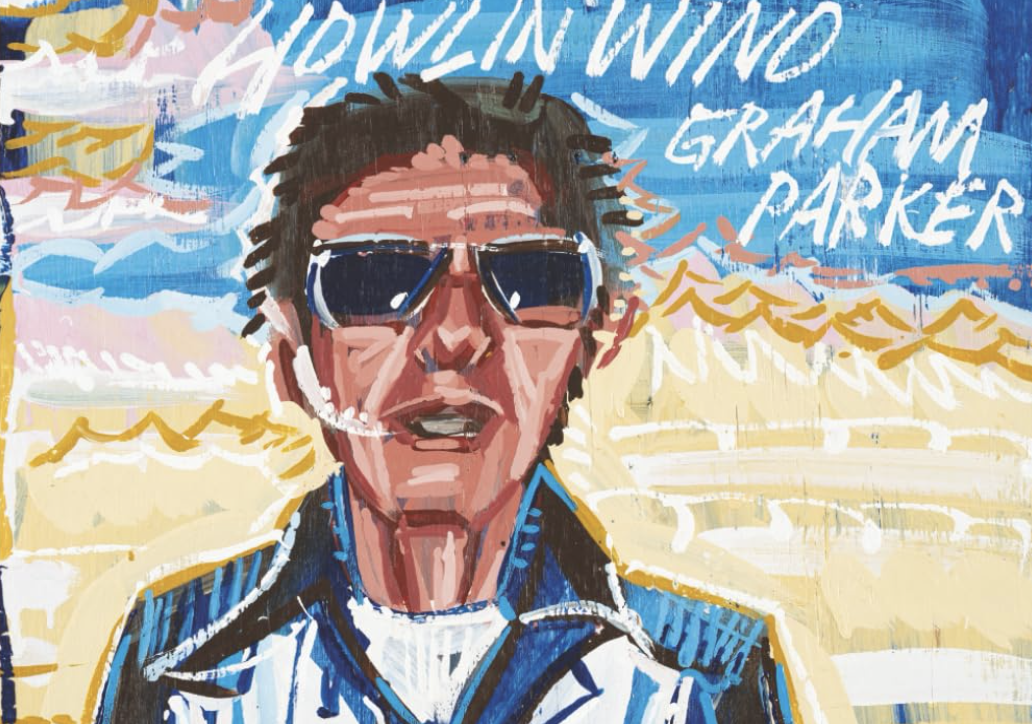
The image on the cover of your book is a painting of the original album cover. Whose idea was that, and who painted it?
The artist is Steve Keene, whose work I admire tremendously. He has painted his take on album cover art in his unique style, which I like very much. I found contact information for him, emailed him, and he said yes without any hesitation. Graham, too, hardly hesitated when I asked him about writing a book. One lesson I learned: It never hurts to ask.
Do you have any plans for a follow-up?
There is another musician I’d like to write about. I’ll let you know if it happens.
Graham Parker
It’s been almost fifty years since the release of Howlin’ Wind. How much do you still have in common with the man you were back then?
He was a complicated character, that earlier me. I could easily have gone the other way and ignored my small amount of talent and fell into a less challenging way of life, but when I hit the strong vein of songwriting that led towards Howlin’ Wind, a drive developed in me that was unstoppable. I’ll never feel that again. In fact, two guitars are sitting in front of me on their stands right now, but World Championship Athletics from Tokyo is on TV, so they’ll just have to wait, won’t they?
It’s an understatement to say that the music industry has changed a lot since then. What do you think of these changes? How have you adapted to them?
There wasn’t much to adapt to—gradually the digital age crept in and before long everyone suddenly had to have an internet presence, and I just drifted into it like everyone else. Record sales are largely a thing of the past for the majority of us who create the material, but it’s been better for gigs because no one has to rely on the local paper to know when an act is playing in their town anymore.
You played a comical version of yourself in Judd Apatow’s This Is 40. How did that come about, and what was the experience like for you?
I had just got hold of all The Rumour members who agreed enthusiastically that they were excited about doing a reunion album. This was sometime in 2010. It was no more than a week, maybe two, when my publishing administration company, Primary Wave, which also ended up releasing the album, informed me that Judd Apatow was looking for me, asking if I’d have a word with him. He knew nothing of the planned reunion album. I met up with Judd in New York where he outlined the possible part for me in a new movie he was about to make. He couldn’t believe it when at some point in our discussion I told him, “Guess what, I’ve just got back with The Rumour, we’re going to do an album, you should put them in your movie, too.” And he did!
Do you still wear sock ’n’ sandals?
Only when I’m a long way from anyone I know.
2 responses to “A Little More Edge: Q&A with Jay Nachman and Graham Parker”
Awesome, Marc! Glad to read this on the blog, quite a coup!
Yeah, I’m glad to have gotten the chance to ask GP a couple questions!