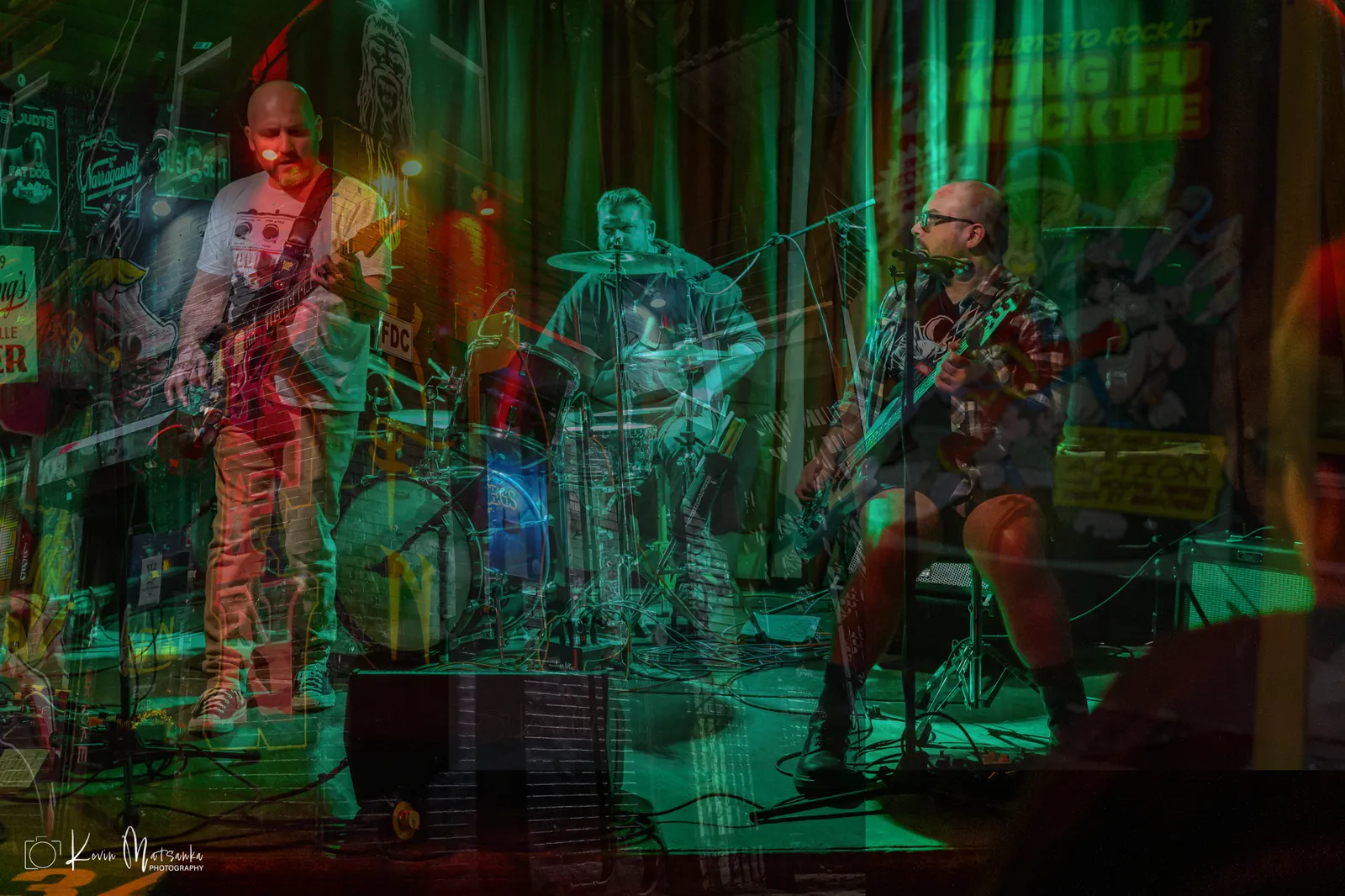
Turns out I’ve been somewhat remiss. I’ve enjoyed the music of Unlucky Mammals for so long that I just assumed I’d interviewed them when, in reality, I hadn’t. And reality—and humanity’s frequent refusal to accept it—is what the band is all about. Their music draws attention to the folly of humanity in our postmodern, hyper-real age: “Welcome to the Age of Information/Where no one bothers with the annotations,” guitarist Greg Kane sings in “Socratic Meathead.” Similar sentiments abound throughout their catalog, with wide-ranging lyrics alluding to America’s sordid past, out sketchy present, and potentially bleak future. And that’s just in the five songs they’ve released so far!
Your press release says that Unlucky Mammals got together at the outset of the pandemic. How did that happen? Did you all know each other beforehand?
We didn’t! I’d started writing songs before the pandemic even began, largely out of frustration over how misinformation and propaganda was dividing people both here and abroad. Imagine fearing the effect of Internet rabbit holes and echo chambers PRIOR to the isolation of the pandemic shutdown! I recorded some demos and decided to seek out some like-minded musicians once it felt safe to share a rehearsal space again in the summer of 2021. I threw my demos out on Craigslist and, thankfully, found Tim (Christopher, bass) and, eventually, Jay (Moriarty, drums).
Did the pandemic—and the heated rhetoric surrounding it—inform the project?
To an extent. Like I said previously, the rot had been there for a while. The pandemic is just when the house really started to fall apart. People have become increasingly polarized in the last few decades, first by partisan cable news networks, then social media feedback loops that barrage users with biased and often untrue “news” that reinforces their new beliefs. It’s so blatant and obvious, yet millions have allowed themselves to become radicalized. A lot of our music tries to highlight this phenomenon and its consequences.

I love that line in “Socratic Meathead” about failing to provide annotations. Where did that come from? Why do annotations matter?
Misinformation has zero power if anyone bothers to check the primary sources. Which, of course, nobody does.
You’re a teacher, is that right?
I’m a high school science teacher. I’ve worked as an English teacher and a journalist as well.
Do you think there’s a connection between teaching and songwriting? Or performing, for that matter?
There’s definitely a connection between performance and teaching. In the classroom, you’ve got to command the attention of 14, 15 and 16-year-olds who have already dealt with more distraction than any other generation in the history of humanity. They have phones, laptops and earbuds on top of the two dozen peers on whom their still-developing brains are telling them to focus. I think out a setlist just as I would a lesson: How does it flow? Are there lulls? Will we lose the audience?
The band is pretty upfront about political issues. Why do you think that’s important?
I swear I’m not one of those people who will corner you at a party and deliver a filibuster on the differences between socialism and social democracy. (Although I’m always happy to discuss it!) I often wonder whether we should chill out a little and write a song about anything else. Sometimes we do that. But music is a great way to get a listener’s attention, and while you have it, you should say something important, right? What is happening is very real. The onslaught of rhetoric is so constant and massive that it’s impossible to see the forest for the trees. I hope people who listen to our music at least pause to consider how informed their beliefs truly are.
One thing I love about your music is that it sounds alive—like old-school punk. What’s your approach to recording?
It’s definitely a DIY approach. We’ve never set foot in a proper studio. I think it lends a bit of a lo-fi quality to our recordings, and as a huge Guided By Voices fan I absolutely love that. We’ve discussed trying the studio approach with the next album (although Tim’s a hell of an engineer and gets the most of our modest recording equipment), but for now we’re more than satisfied with the quality of our releases.
I understand that the singles you’ve released so far are part of an album. How’s it coming along?
Recording is done. We’re still pretty new on the scene and building an audience, so we didn’t think it made sense to drop an entire album with just a few singles and expect people to seek it out. Instead, we’re releasing it a single at a time, so we can promote each song and find an audience in smaller doses. The entire album will be out in mid-October though!
I was chatting with Unlucky Mammals’ drummer Jason Moriarty at a recent show, and he mentioned that Greg has written a book. Can you talk a little bit about that?
It’s called Mississippi in Manhattan. It’s a historical fiction novel set in New York during the 1920 baseball season, which was Babe Ruth’s first with the Yankees. I’d describe it as part history and part mystery, with a twist that baseball aficionados might find interesting. It’s available on Amazon if anyone wants to check it out. I’ve also published a fair amount of short fiction here and there!
What separates the unlucky mammals from the lucky ones?
Ha! Well, the name comes from the late, great Kurt Vonnegut’s Slaughterhouse-Five, in which he describes two soldiers who are about to be killed during World War II as “unlucky mammals.” So through that lens, it would be whether you’ve been fortunate to avoid one of our endless wars?
What’s on the horizon?
Well, for one thing, we’re planning to introduce a fourth member and second guitarist in the coming weeks! We’re dropping what we’re labeling a “flash punk” track in July. It’s going to be part of an upcoming compilation of 30-second songs called Short Songs for Even Shorter Attention Spans that’s being curated by Mike Huff from the great Philly band BEES! We’ve also got some still-unannounced shows lined up for August and September in Philly and Jersey. And, the full album Fiddling in the Undertow will be available to all in October.
Very cool–plenty to look forward to! Thanks for taking the time to answer my questions!
Anytime! Thanks for all you do for the indie music scene!
4 responses to “Definitely a DIY Approach: A Conversation with Greg Kane of Unlucky Mammals”
I love UM’s songs and songwriting. Did not realize he was a science teacher too, neat fact. Lots of good lines in “Socratic Meathead,” my personal fav is the “welcome to the age of information, where every charlatan gets validation.” You and I must be having a Mandela effect going on, I could have swore you’ve previously wrote about them too. This is like the third one that’s happen to me this week, I’m starting to think the paradox is contagious
Maybe in an alternate universe I wrote about them in Rolling Stone!
Great interview, and I love that Greg’s a science teacher too. I think being a teacher is a plus for being a musician, and you’re a living testament to that Marc! Unlucky Mammals write some of the best lyrics out there.
Love the weltanshauung…and about how, as a teacher: “I think out a setlist just as I would a lesson: How does it flow? Are there lulls? Will we lose the audience?” Wow. So, that’s a thing now.
Anyway, great interview and love the sound!