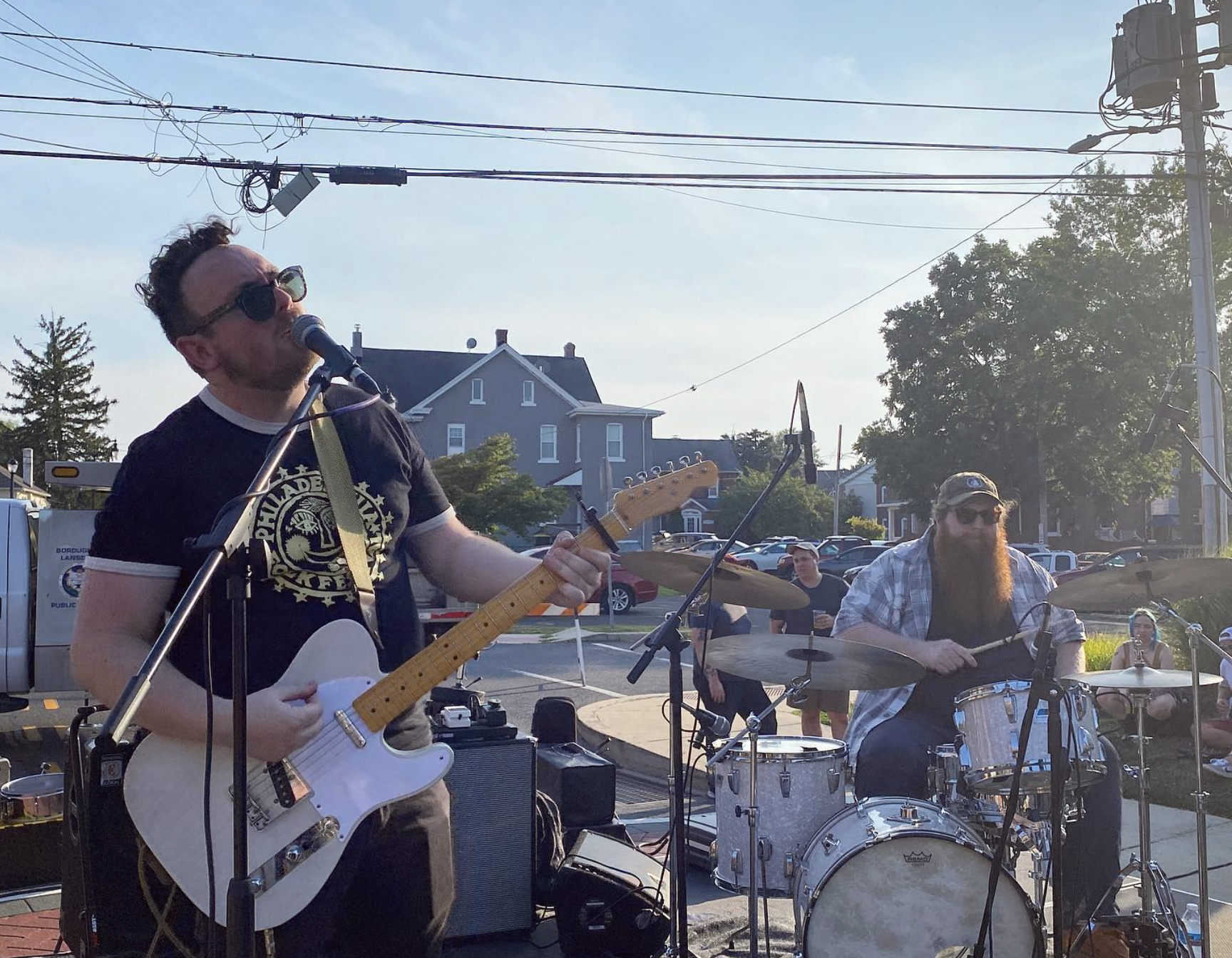
I had the good fortune of meeting Jesse Gimbel at the Rusty Nail in Ardmore, Pennsylvania, a few weeks ago. We were both there for a show that included Sacred Monsters, BEES!, Diet Lite, and Jima. Towards the end of the Sacred Monsters set, singer and bassist Kathleen Poliski gave a shout-out to Jesse for mixing and mastering their latest EP, Confessions of a Sad Girl and said she couldn’t imagine handing her music over to anyone else. Given that level of praise, I figured it would be remiss of me, as an intrepid music blogger, to pass up an opportunity to chat with the guy, so we struck up a conversation. Turns out, he’s a musician as well—not to mention an exceptionally talented singer-songwriter!
Kathleen Poliski of Sacred Monsters really gushed over your mixing and mastering skills – and appropriately so! I was listening to Confessions of a Sad Girl, and the mix really threads the needle between what I think of as slick production and live energy. How did you get into mixing and mastering? What did your journey look like?
I had a late start in music. My parents had both retired from being in touch with music well before I was born, so I had no exposure to music outside of what I’d hear quietly on the radio in the car. When I was 14 or 15 I wanted to try playing guitar, and as soon as I knew a few chords I started writing songs. I started recording my songs on a little 4-track very shortly after, and as I dove deeper into songwriting and recording, it naturally left me with recordings that needed to be mixed. Around the same time I started downloading music from any band whose name sounded mildly familiar and tried to connect with and understand everything I could about the evolution of music through the decades, different genres, and what things sounded like. I didn’t know it at the time but this was an education for me in song structure, lyrics, and the huge world of things you can do in mixing and mastering. I worked on my own recordings, expanded out into recording friends and mixing their recordings, then eventually started looking for musicians to work with on Craigslist, and I’ve been working with artists ever since.
I’m guessing every project is different, but I’m also wondering if you have an over-arching philosophy of what a mixing and/or mastering engineer should do. What’s your approach?
I want to serve the song, and make it sound how it feels in the artist’s head, even if they don’t know how to express it. Sometimes my job is to figure out the direction and how best to present the song and make sure it has the right energy to connect with a listener. I worked for quite a few years learning to get all the elements in a mix to sound balanced appropriately and make sure nothing is getting lost. Lately I’ve been moving toward trying to really make the listener feel something, even if it means the balance needs to shift to something that might feel technically wrong.
Do you ever listen to music and think you’d have mixed it differently?
Yes and no. I’ve definitely heard songs that had an element that felt really distracting to me – a snare ringing that sticks out too much, an important beat that felt less impacting than I should because the timing isn’t great, or in one case I can think of a long-held note from a singer in a very popular song that just feels too flat to keep in. But I also know a huge bounty of music that has drums that are muddy, vocals that are clipping, guitars that sound like they’re coming through a tiny radio speaker, or bass guitar that’s way too loud, that are a huge part of the feel of the song. Evenly balanced is a great baseline and covers a lot of bases, but many times the emotion and effectiveness of a song are tied directly to the honesty of everything not feeling slick.
A lot of people mix and master music entirely on laptops, but a good number of professional mixers use outboard gear. Where are you on the spectrum?
I’m using a hybrid setup. I generally record digitally, and I’ve got no problem using plugins, but I use outboard gear as much as I can. I’ve got a rack full of preamps, compressors, EQs, and saturation that I use all the time, as well as modulation like a Space Echo for reverb/delay, and I reamp tracks a lot, either for different guitar/bass tones, or adding something extra to vocals or drum room mics. I try to bring things into the nonlinearities of real-world circuitry or spaces as much as I can. I rely on digital mostly for two reasons – ease of editing, and recall. It’s not uncommon for me to get a call a year after I’ve mixed something that an instrumental version is needed, or a drum-less track for a drum play-through video or something like that. Especially with opportunities for TV/streaming placements, being able to recall a mix exactly later and only change what’s needed is important. Of course, variations can be printed at the time of mixing but you never know what will come up down the road.
Do you have any go-to pieces of outboard gear?
I’m a big fan of 1176s, I’ve got four that I’ve built from DIY kits. They’re known for smashing drum room mics and vocals, but they’re actually really versatile and can help reign in exaggerated dynamics with finesse. I’ve got a few kits waiting to be built that I’ve bought to have an analog version of plugins I use constantly. I’m obsessed with Pultecs, and I’ve got everything to build a pair later this year. I also love SSL bus compressors for some mix or drum buses, and I’ve got a DIYRE G Bus waiting for that. I’m especially excited about that because I got to help design it.
Any advice for people looking to make a living at mixing and mastering?
Always push to be better. There are many victories where you feel like you finally understand how to get a certain sound, but it’s always worth continuing learning and finding new sounds and ways to control them. It is very easy in this business to get to a point you consider good enough and stay there. I’ve had more than a few artists come to me to redo recordings or mixes they had done by someone who’s been micing drums the same way in every session since the early 90s, or who refused to mic a bass amp that’s an important piece of their tone because the engineer found a DI more convenient. The job isn’t to press a button and apply your method to every artist without consideration. There is way too much trust involved in handling people’s music to not treat it with care, and it deserves spending your time and energy making it what it can be.

You’re also an incredibly talented singer-songwriter. I was listening to Decathect and there’s an open-endedness to the lyrics. I might describe them as impressionistic. There’s a story in each tune and the album has a narrative arc, but a lot of the gravity comes from what’s not said, if that makes sense. I also looked up the word “decathect” and saw that it involves detaching oneself from someone or something. What’s the story there?
I was writing the songs on Decathect while I was exiting a relationship I had been in for almost a decade. It was challenging to easily describe what was wrong because we rarely argued, and everything was on this automatic path. Looking back, neither of us were happy or fulfilled; our relationship existed on familiarity, comfort of things not changing. I was spending almost no time doing things that felt like an important part of myself interfacing with the world like writing songs, and the path was leading very quickly toward marriage and kids. I didn’t know at the time if I wanted these things, but I knew I wasn’t ready for them and the permanent changes they require when you’re someone who wants to put your whole self into what you’re doing. It’s not an easy choice to pull the plug and know someone will be hurt, both of your lives will completely change, but those moments are often the most necessary and important ones. I came across the word “decathect” at the time and it couldn’t have been a more perfect fit – disconnecting from a person or situation in anticipation of a future loss.
Proceeds from your more recent single “By Grace” go to Campaign Zero and the ACLU of Pennyslvania. What’s Campaign Zero, and why are those two organizations important to you?
I released “By Grace” in June 2020, during the protests against police brutality following the murders of George Floyd, Breonna Taylor, Manuel Ellis, and countless other unarmed African Americans that have been needlessly killed by police. My voice as a white male isn’t what needed to be amplified above others, but trying to draw attention of members of my audience to important causes felt worth doing. Campaign Zero is an organization working toward ending police brutality, and the proceeds originally also went to the Philadelphia Bail Fund to release protestors who were kettled by police with tear gas onto 676 in order to create a reason to say the protestors could be arrested, since we have a legal right to protest. Donations to the Philadelphia Bail Fund went through the roof and the organization eventually directed donations to instead go to the ACLU of Pennsylvania, who aim to protect the rights were are supposed to be given as citizens by the Constitution.
Previous to “By Grace,” you released a track called “Minds on Fire” along with an animated video. What was involved in making that video? What program did you use to make it? Had you done any animation prior to that? How did you learn?
That video was quite a process. I storyboarded the whole thing drawing by hand, and then I used Adobe Illustrator and Photoshop for graphics, and After Effects for animation. I scanned and photographed handmade papers for the rock and water textures in the video, construction paper for a lot of the flat planes. Like with audio I like to use real world pieces to take the edge off digital things when I can. I’ve loved hand drawn animation and claymation since I was a kid, and started messing with it as soon as I had my first digital camera. I’ve experimented with claymation, stop motion, hand drawn animation, and digital animation, and I wish I could spend more of my time doing that.
You recently played a set for the West Philadelphia Porch Festival. How did that go?
This was probably our 4th or 5th time playing West Philly Porchfest and it’s always fun. It’s amazing how much its grown. I’m still in touch with all of my previous porch hosts, and it always seems like there’s a chance for honest connection at events like this that don’t happen at your average venue or bar gig. After playing West Philly Porchfest I’ve started playing in a handful of other porchfests, and since 2020 they’ve been some of the only in-person events I’ve done.
What’s on the horizon?
Rebuilding post pandemic destruction. I’ve parted ways with some of the musicians I was playing with, and I’m looking for some new folks to grow with, but it can be a slow process. I’ve got a bunch of songs I’ve had in my back pocket to record, they’re actually maybe my favorite I’ve ever written, but playing live such an important part of making music to me, so I’ve been waiting until I can rebuild that component to release new music. If any musician happens to be reading who wants to put on impactful shows and go on the road, get in touch!
Thanks for taking the time to talk to me!
Thanks for reaching out, Marc! It was a pleasure to meet you at the Rusty Nail. There are amazing nights of music happening everywhere and I truly believe that making them last and reach more people by writing and sharing music like you’re doing it what the world needs.
3 responses to “I Want to Serve the Song: An Interview with Jesse Gimbel”
Really like the philosophy of “serving the song” it’s an homage to other musicians I’ve read about who have said similar things in the vain of not over playing their particular parts. Very compositional thinking
Once again Marc, I must make note of what a great interviewer you are! As I’ve also previously stated, your also being a musician yourself enables you to ask some particularly insightful questions about music techniques and practices that someone like me would have no clue about. Jesse’s responses indicate a really thoughtful and talented guy.
Thanks, Jeff! And, yes, Jesse is indeed a talented guy!