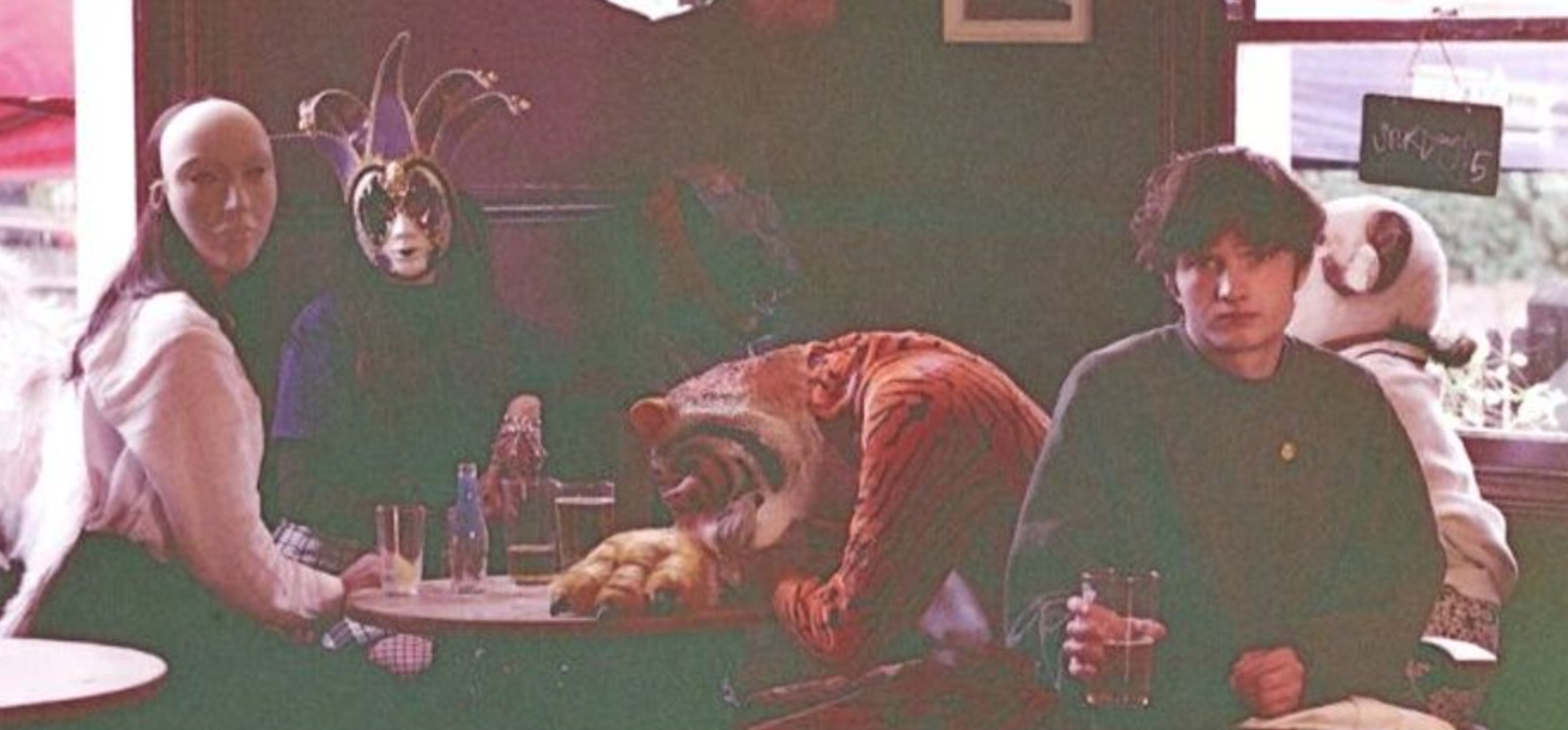
Max Blansjaar was born in Amsterdam, raised in Oxford, and recorded this début album in Brooklyn. He appeared on the Oxford scene in 2018, aged 15, promoting shows in all-ages venues and performing his playfully sincere lo-fi indie pop songs. Since then he has released two EPs of laptop recordings and become a fixture of the local scene, packing out pub back rooms and festival tents. Curious about his latest efforts, I dropped him a line.
Since most of my readers are American, how should they pronounce your surname?
It’s a weird one, because it’s a Dutch spelling of a French surname. But it’s ‘Blan-zhar’, which is to say, ‘Blan-shar’ but with a softer ‘sh’ sound. If you’re saying it in Dutch, it’s more like ‘Blun-sha-ir’, but let’s not even go there.
You were born in Amsterdam, raised in Oxford, and recorded False Comforts in Brooklyn. Where is home for you, and how has all of your traveling influenced your music?
I don’t really have an answer to this. I’ve lived in England the longest, but I would never say I’m from there. I find it kind of offensive when anyone suggests that I am. I would say I’m from Amsterdam, but I didn’t grow up there and I barely remember living there at all, so it seems strange to call that home, too. I think the ambiguity is something that influences my songwriting — I don’t feel like I’m operating within one particular tradition or anything. In fact, I probably feel closest to the stuff that’s come out of New York, weirdly. I guess the power of music transcends borders after all.
Before False Comforts, you recorded two EPs on a laptop, but you worked with a producer on the album. What was behind that decision?
Self-producing for a long time can get you locked into a certain way of doing things. Which isn’t necessarily bad, I mean, I definitely developed my own production style over time — but there were things that I did in a certain way just because I no longer considered doing them differently. Partly that’s because of the equipment you have, but also it’s just your approach and your workflow.
Breaking that pattern can get you interesting results, and that was why I wanted to work with a producer this time round. I had a collection of songs which I could’ve produced myself, but I wanted to see how we could stretch the material beyond as far as I could personally see. Katie and Nate heard certain things and thought ‘oh, we could do this and this with it’, and it’d be stuff that never occurred to me. Vocal sound was a big thing that they recorded cleaner than I would’ve ever dared to. Guitars, too. ‘Song Against Love’ used to be a very four-on-the-floor kind of song, it was Nate who suggested we put a bunch of weird gaps and stops in it.
Listening to False Comforts next to your EPs, what would you say is the difference?
Well, the songwriting is obviously different, just because I was younger when I wrote the EPs, and in a very different stage of life. It’s more considered, I think, more deliberate and less naïve. I say that totally value-neutrally, by the way. The album is definitely more polished than anything I’ve done before. The instruments on it are nicer, the recording equipment is nicer, the playing is technically better, and all of that really shows. It’s the first thing I’ve ever put out that features people other than me performing on it. Which means it’s more difficult than the EPs, just in the sense of how hard it is to play, because the people playing on it are actually really good at their instruments, ha. So it feels less impulsive because of that. Or more multifarious, really.
You read a report titled “Who Is Gen Z, Really?” around the time you started writing the songs for False Comforts. How did that report inform your writing, and how does your music respond to—or complicate—the question?
Oh yeah, that was a report that Spotify’s advertising department wrote for companies looking to understand Gen Z consumers better so they could improve their marketing strategies. A horrible document, but kind of interesting. The idea that members of a single generation have some kind of fundamental commonality is very powerful, but I think it’s a lot less true than people imagine it is, and it’s the kind of thing that becomes more true the more you say it. I’m very interested in this idea of how we find our place within the collective. I didn’t actually think the Spotify report would contain the answer, obviously, but something I explore on the album is what happens when you give up trying to ask the question. I mean, it’s literally a question for marketing departments and corporate execs.
That said, I do think there’s such a thing as the Zoomer sensibility. But it’s not about how you mime being on the phone or what acronyms you use over text or anything. That’s stupid.
That was in 2020. Did COVID factor into your writing as well?
Only in the sense that I really struggled to write anything during the lockdown. Nothing was happening — and it wasn’t even that nothing was happening in a sort of slow down and contemplate life type way. Nothing was happening relentlessly, distressingly. It felt like nothing was moving. I was still in school at the time, so I was preparing for my exams and stuff, but all my classes were online, most of my daily interactions were over video call…I really gain inspiration from being around people, and of course video calls are nothing like actually speaking to people in real life. So it was hard. I’m not sure anything I wrote during any of the lockdowns actually made it onto the album.

I’m curious about the title. Why False Comforts?
It’s a reflection of what the songs are to me, I think. Obviously the kind of songs that I write are sort of vaguely confessional, at least notionally, but I don’t want to give the impression that I’m writing them in order to feel better, or that they serve a therapeutic function. They’re ways of trying to capture a feeling, of trying to pin down a sense of betweenness, but strictly for its own sake. They’re not trying to resolve anything.
The image on the cover is amusing but also creepy. It depicts you seated on the lap of someone dressed like a tiger and surrounded by other people dressed as animals and clowns. Who came up with that idea, and what was the thinking behind it?
Ha, amused but also creeped is a good response. Léa, who does all the graphic design for my music, once sent me a picture of this little girl in a sort of school photo setting with five really creepy masked figures, and was like, ‘this should be your album cover!’. But I didn’t have an album at that point. So about four years later, when I had an album, it came to actually making the album cover, and I was like: we should recreate this picture. But then I couldn’t find it anywhere. I was frantically googling, and I did find a similar one of this kid standing on his bed in the dark surrounded by the Teletubbies all with big black holes for eyes, so I took that picture to Siobhán Cox, who does all the photography for my music, and I told her I wanted to do something like that. So we talked about it and then we ordered in a bunch of masks and costumes, plus that blue seventies school photo background. I think it’s fun because it seems like they’re my friends, but they also seem shifty, like you probably can’t trust them.
And how does it reflect the music on the album?
I mean, the really blunt answer would be that they are false comforts. In the sense that they’re surrounding me, and I’m sitting on their lap or whatever, but they clearly aren’t actually comforting. I guess there’s also a kind of children’s party vibe, a kind of school photo vibe…something carnivalesque and slightly nostalgic, too, which seems like it reflects the musical material in some ways.
What are you working on now?
Well, at the moment I’m preparing for the UK album tour. That kicks off towards the end of June, and it’ll take us through to the start of July. Apart from that I’m trying to get back into writing music, which I haven’t done for a little while because I just haven’t had the time. Summer is coming and new things are growing. Apparently it’s gonna be one of the wettest summers ever recorded here in the UK. I say bring it on.
One response to “Amused but Also Creeped: A Conversation with Max Blansjaar”
Max appears to be an intelligent, thoughtful and articulate young man with both talent and a healthy and realistic outlook on the music industry. I’m liking his new album!