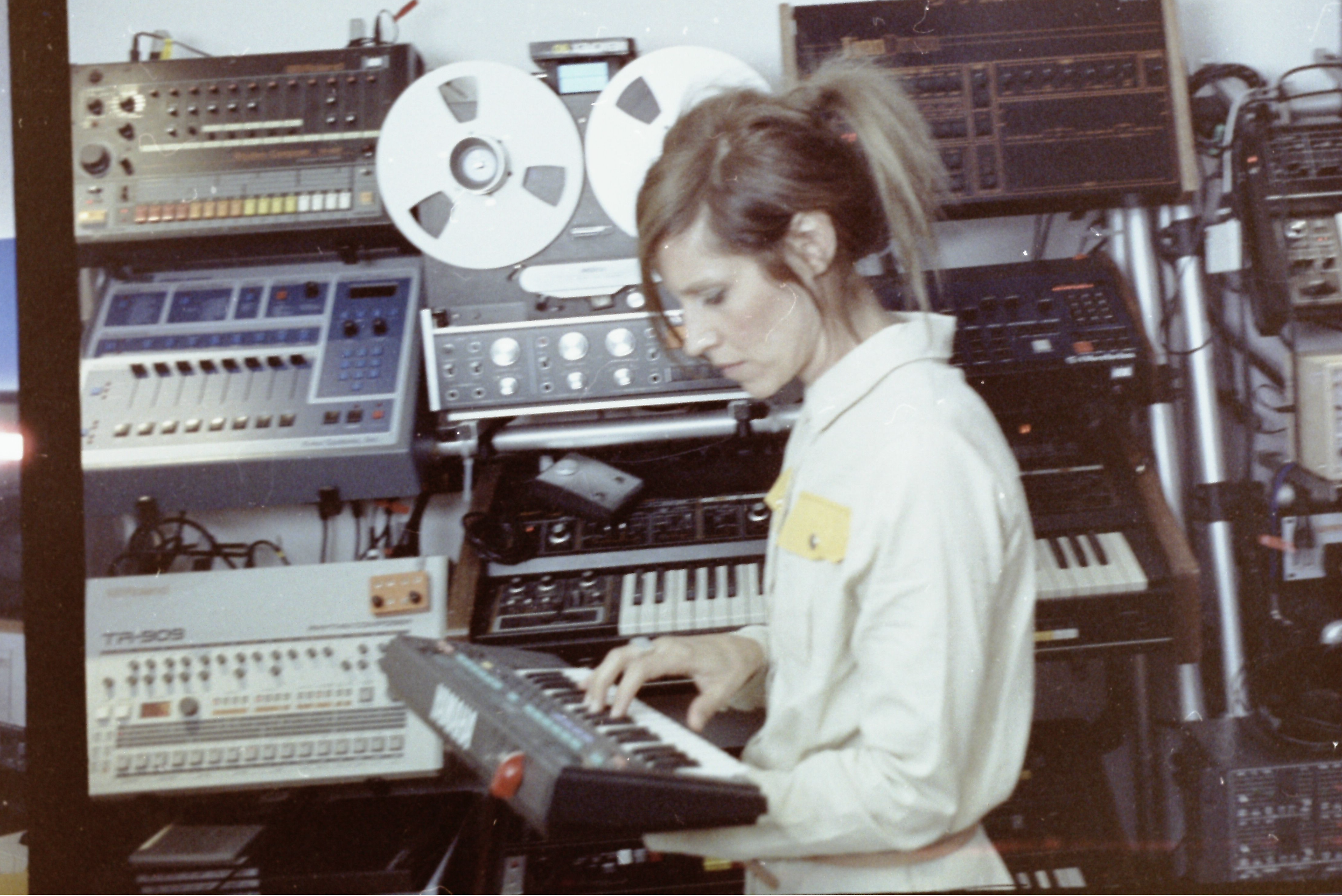
Throughout her music career, Anglo-French avant-garde electronic artist Julia-Sophie has repeatedly burnt everything down to the ground. Each time, she has risen from the embers transformed, forging new paths, her past casting a silhouette onto her ever-evolving creative endeavors. forgive too slow, her deeply personal debut album is testament to her ability to yet again transform adversity into raw beauty, combining her traditional songwriting roots with her own take on experimental electronica. It features Julia-Sophie’s intimate voice backed by warm and precise electronic sounds whose free spirited explorations give body to the carefully written personal songs. The introspective confessional lyrics explore how her experiences of trying to be true to herself have burned and thrilled but eventually broken her.
You’ve played in the rock band LittleFish and the dreampop collective CandySays. What inspired you to strikeout on your own for your first solo album?
I think I reached a point in my life where I no longer wanted to dilute how I expressed myself. I had a lot of emotions that I needed and wanted to confront personally and making music alone felt like the only way that I could do that.
With LittleFish, you toured with artists like Blondie, Courtney Love, and Juliette Lewis. Do any memories from those tours stand out to you?
I remember one night Courtney Love was looking everywhere for her lost glitter. She looked pale, faint, almost like a shell of herself. It was Mother’s Day, and there had been loads of stuff in the papers about her broken relationship with her daughter. I just remember looking at her and feeling sad, wondering to myself whether fame was worth it.
Okay, so yeah, I did get flown in a helicopter to Las Vegas and given a bag full of money to gamble away in the slot machines. That’s what you really wanted to hear, right?
Wow… To both stories! Regarding your music industry experience with LittleFish, you’ve remarked, “I didn’t care enough about being famous to survive all the shit that was being thrown at me.” Can you elaborate on that? What was the shit? And, more important, what was it about music that you continued to care about and that has kept you in the game?
I don’t think you can equate being in the music industry with being a musician or an artist. I’ve always made music simply because I enjoy it, because it feels good, and because it helps me process and express myself in ways I couldn’t otherwise. I entered the music industry thinking it might allow me to keep doing what I love. Unfortunately, I met some bad people who really messed me up personally and broke my career. It’s taken me years to recover, and it has been extremely difficult for me. I’m very cautious now about who I work with, which is probably why I prefer to work alone. I still make music for me, not to achieve status or be part of something. I guess I’m just lucky that some people like what I do and feel a connection.
Your work with CandySays involved recording film scores. How does recording a film score differ from recording music that’s meant to stand on its own? Do you have any thoughts on what a film score should do — or what it shouldn’t?
Recording a film score differs significantly from creating standalone music. While standalone music is crafted to capture attention and convey emotions independently, I believe a film score is designed to complement and enhance the film’s narrative and support the on-screen action and emotions, often requiring a more subtle, adaptive approach.
I believe that a film score should seamlessly integrate with the film, enhancing the story without overpowering it, guiding the audience’s emotions and highlighting the narrative’s nuances and shouldn’t distract from the action or dialogue. I enjoyed working on film music, as it allowed me to access different parts of me that allowed me to create cohesive, immersive cinematic experiences, where the music and visuals work in harmony.

Your press materials describe you as an avant-garde electronic artist. What would you say marks your music as avant-garde?
If I have to describe what makes my music avant-garde, I’d say it’s because, for me, it’s all about pushing boundaries and defying expectations. I experiment with unconventional sounds, structures, and production techniques to create something unique and unexpected. My music isn’t designed to fit neatly into any genre or formula; it’s about exploring new sonic landscapes and challenging listeners to experience music in a different way. It’s less about what it is and more about what it can provoke or inspire in the listener.
Those materials also describe you as Anglo-French. Do those two cultural elements inform your musicality? Do they compete in any way?
Absolutely, my Anglo-French background deeply informs my music. Growing up with both English and French cultural influences has given me a unique perspective and a rich palette to draw from.
These cultural elements don’t compete, instead, they complement each other and help me create a dynamic interplay in my work. The fusion allows me to explore a broader range of themes and sounds, blending the sophistication of French chanson with the edgy innovation of British music scenes. It means my music can be both introspective and avant-garde, traditional yet contemporary. This duality is a core part of my identity and is reflected in the stories I tell and the soundscapes I create.
Youralbum is called forgive too slow. How does that title reflect the contents of the album?
The title forgive too slow was an attempt for me to encapsulate the essence of the album. Each song explores the emotional weight of holding onto past hurts, and the difficulty of letting go. The struggle of being stuck in these cycles, with electronic beats and melodies evoking a sense of repetition and entrapment.
I hope that the album also hints at the possibility of breaking free. If we learn to forgive more easily, then maybe we can move past these old patterns and open ourselves up to new, healthier relationships. forgive too slow is a journey through these emotions, capturing the pain of the past and the hope for a more liberated future.
Can you comment on the nature of forgiveness? What does it mean to you? Why is it important?
Forgiveness is about breaking free from the past and the hurt that traps us. It means letting go of the pain and allowing ourselves to move forward. For me, it’s essential because it’s the key to healing and finding peace. Without forgiveness, we stay stuck in old wounds, unable to fully experience the present in all its potential and beauty, or build healthy relationships. Forgiveness is difficult but, I believe, a necessary step towards freedom and growth.
I’m also curious about the importance of forgiving oneself—and the idea that even the most forgiving people tend to be less forgiving of themselves. Is that an element of youralbum as well?
Absolutely, many of the songs on the album stem from my search for forgiveness from others, intertwined with my struggle to forgive myself. I’ve struggled a lot with self-forgiveness, constantly feeling guilty and beating myself up, which really impacted my self-confidence and identity. Living this really impacted my ability to live fully, interact with people, and maintain friendships. I just felt like a bad human. It’s much harder to be happy when you’re always carrying that weight. The album reflects this struggle and the journey towards self-forgiveness, showing how crucial it is for personal healing and happiness.
What’s on the horizon for you?
On the horizon for me is a deep dive into the field of gestalt psychotherapy, I’ve come to realise that my passion lies beyond just music, and I’m eager to explore ways to make a meaningful impact in people’s lives in other ways. While music will always be a part of me, and I am sure that I will keep writing and recording, I’m also excited to broaden my horizons and pursue other interests concurrently.
One response to “Breaking Free from the Past: An Interview with Julia Sophie”
<3