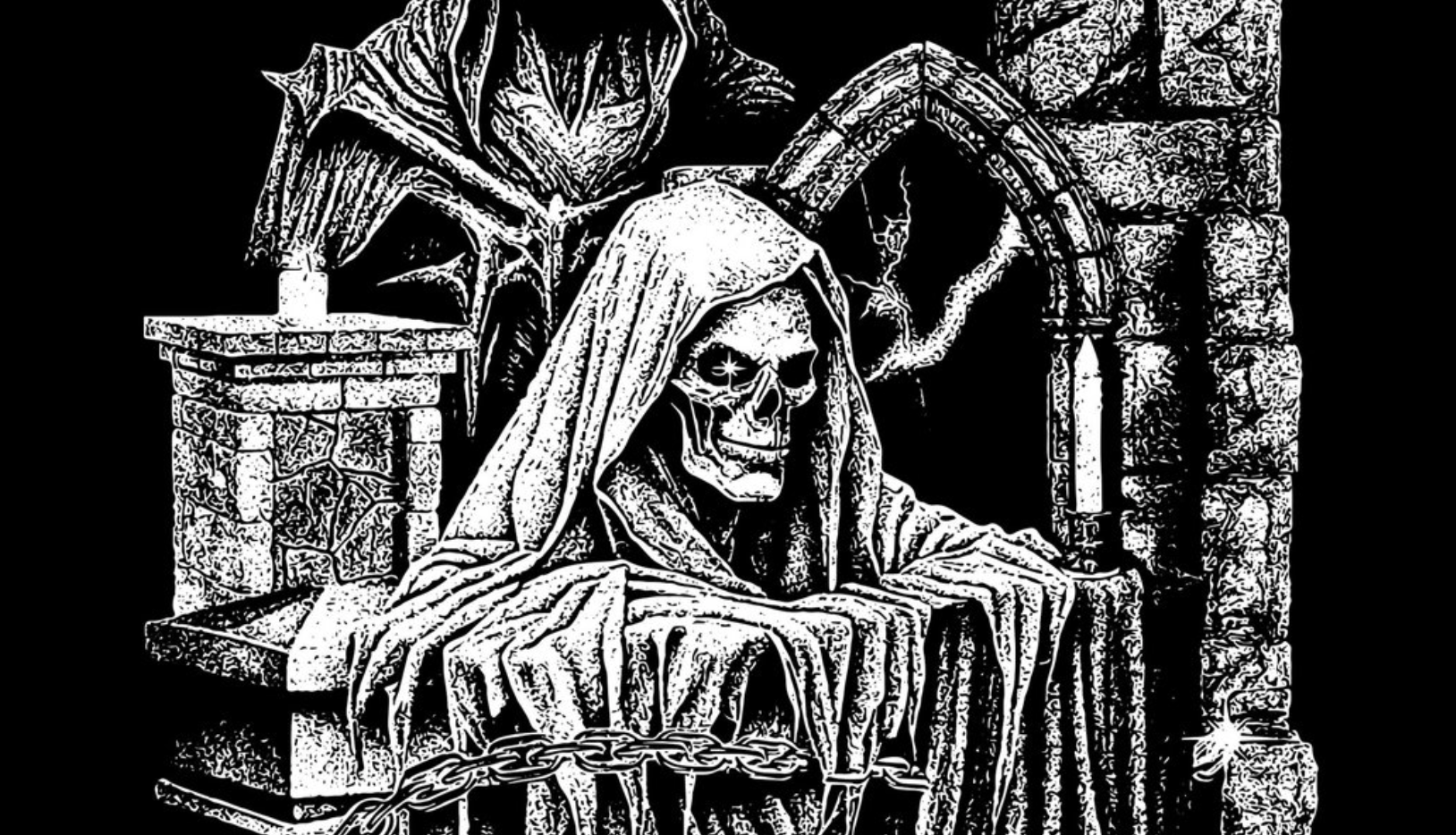
Hailing from Chicago, Lost Legion describes their music as “a weird mix of old Midwestern hardcore (Effigies, Negative Approach) with uglier, melodic UK punk, and post punk. Some of our favorite bands are the Gun Club, the Replacements (Bob Stinson era), and the Go-Go’s… burly and gloomy and kinda lo-fi, with lyrics about mental health and psychedelic experiences.” Their new album, Behind the Concrete Veil, came out in February.
I love the name Lost Legion! For me, it conjures something epic like an old-school comic book. What does the name mean to you?
Thanks! I don’t think we really thought super hard about it at first, and the name just gave off the vibe we wanted. Originally, we were writing songs about these little military factions that existed during certain wars, like anti Nazi resistance fighters in Poland and Spanish anarchists, so they were the “Lost Legions”. Griff, who started the band with us, was a big history buff and I think wanted the band to go that route.
I started to think of it differently when some of the subject matter changed. There’s this book called The Lesser Key of Solomon, which is a medieval register of demons. In one of the printed versions you can get, there’s a theory that the “demons” are metaphors for parts of the brain, and when they’re described in the book it says that the demons command however-many “legions” beneath them, which feels a lot like they’re describing cells in your body. So “Lost Legion” became a reference to parts of myself I hadn’t really acknowledged, or was actively working to change. Kinda dumb, but that’s how my brain works.
Your band claims an interesting range of influences like the Gun Club, the Replacements, and the Go-Go’s. How do they all come together in your music? I’m particularly curious about the Go-Go’s!
We describe the band as “whatever we want to do”. That’s sorta what the Replacements were doing, right? Our influences are bands I think came from a similar mindset. Gun Club comes out in the guitar leads and some of the lyrics. They had a great, “dusty” sound, but still sounded tough and even kinda heavy sometimes.
When I think about my definition of “punk rock” or whatever, a lot of it has to do with the idea that it was a catalyst that got disparate groups of people to take ownership over their surroundings in a specific way. But they also all have a sense of humor. We aren’t a super serious band, despite most of the subject matter. We like bands that didn’t take themselves too seriously.
The Go-Go’s were totally a punk band. Their first recordings could have been comped on Killed By Death or Bloodstains… They were playing the Whiskey in LA with all the early punk bands, and toured the UK with The Specials. The song “Tonite”, that we covered, is like an early UK punk song dressed up as a pop song, which is how I feel about their whole first record. Have you ever heard the original version of “Lust to Love”? That shoulda come out as a single on Dangerhouse!
And your songs cover a range of topics as well, focusing largely on mental health and psychedelic experiences. What draws you to these topics?
I’ve struggled with my mental health my whole life. I think most people in my family have. A few years ago I wound up hospitalized and then shuffled through a state run psychiatric program. I went in trying to get help and came out much worse.
Psychedelics were suggested to me and had a much better effect on my long term mental health than anything else.
How are they related to each other?
I feel like a lot of mental health issues are the result of someone not being able to reconcile their internal, lived experiences with the expectations of our consensus reality. Psychedelics basically reframe your worldview and perception of self. A lot of times it means letting go of those external expectations. It can be a confrontational, scary experience, but it fundamentally changes the way you think and view the world, which you don’t get from SSRI’s or anti anxiety meds.
Now we have all this research about the physical process that takes place in our brains while it’s on psychedelics, so hopefully it becomes something that’s regularly accessible for people who need it.
I’m also curious about the epigram on your Bandcamp page: Don’t question authority, question reality. Can you comment on this?
Punk has always been anti authority, but that falls short of actually addressing the issue of authority in the first place. l know that sounds insane, haha. But just think about how systems of oppression and authoritative control are perpetuated in your own communities, social groups, work environments, or even yourself. The point is that you have to see things as sort of universally egalitarian and remove yourself from the equation. The problem isn’t the authority figure, it’s the duality the gives what perceive as authority the ability to control you. A reality based on duality is an incomplete experience.
I also mean, literally, question reality. Do you believe our physical bodies and material existence are the sum total of our experience? Because that can be a very depressing worldview. It makes more sense to think that our empirical senses are possibly lacking.
But, in the end, it’s a really funny sounding axiom. As much as I can ramble on about all this stuff, it is very funny to me. A lot of it is tongue in cheek, with the aesthetic references and everything. I’m not trying to tell anyone what to think. We do all this for ourselves, because it’s fun and, in a personal level, it helps me get to know myself.
In a more productive sense, I guess if you want to present something that helps people unlearn, or at least question, a lot of the thinking that comes with the dominant culture of Abrahamic religion, presenting it like we do is a lot more productive than, like, songs about satan.
Your Bandcamp page also lists two members, Dave and Ian. Is that the full lineup?
The LP was just us. Our friend Kyle played bass on a couple EPs, and we’ve had some other collaborators on recordings, but all the writing and production has just been the two of us since 2021 when we got more active.
We put together a live line up last year and it’s been fun doing shows. We’re feeling out how to write and record with a full band, and will be releasing some records with our current line up. Some of the guys in the band now want to contribute, so we want to make sure the band is there for them to work ideas out with as well. But there will always be recordings that are just the two of us because we like working together like that.
How did the band come together?
Our friend Griff and I decided to start a very part time band to write a couple songs that were kind of like early Templars, a band from NYC we love. He introduced me to Dave and we recorded the first demo the day we met. We just posted the songs on YouTube and didn’t think much of it. We did another demo and then got busy with other stuff until COVID lockdowns had me playing guitar all day with no real outlet for it, so we decided to start working on new songs. Since then it’s been its own thing and grown.
You mentioned a while back that the youngest member of the band is 35 and the oldest is 50. What does the age difference mean to you? How does it play out in your music or in terms of band dynamics?
What’s funny is that I don’t think it really plays into our dynamic much because we all knew each other for a long time from just from going to punk shows in Chicago. Bryan, our guitarist, is 50. I’ve known him since I was in my early 20s. Our other guitarist, Dylan, is the youngest at 33 (I made a mistake when I wrote 35, sorry!) and I’ve known him since he was probably 21. Obviously we have different stories and interests, but we’re all punk rock “lifers”, which ends up feeling like we’re all in the same boat.
The best thing about being in a band that skews a little older is there’s just so much less drama. Everybody here is just into playing music and having a good time.
You also do a good amount of touring. What’s that experience like for you?
We’ve really only done one real tour, and haven’t left the Midwest yet. We got really lucky and got to do a few shows with Soft Kill and GUMM when our LP came out, which got us in front of a bunch of people who otherwise never would’ve heard of us.
It was funny to play after dark wave bands a couple times and feel like we brought the vibe down, but most of the shows were crazy fun, and playing mixed bills brought diverse crowds. We played in St Paul to a ton of people, and then the next day we did an in-store in Extreme Noise in Minneapolis to like 12 people, and both were the same amount of fun.
What’s on the horizon?
We’re gonna do a few shows out East in the fall. I’m not really sure how the reaction will be or if people on the east coast even know who we are.
We’re also finishing four songs that will be released on two split 7”s, and we’re working on another group of songs for an LP. After that, who knows. I have a ton of ideas and things I want to do, but I need to focus on one at a time or nothing gets done, haha. We’re hoping to play Europe next year and do another stint of shows in the US.
3 responses to “Whatever We Want to Do: A Conversation with Lost Legion”
Well-done, Marc & Lost Legion!
I like their raw, frantic sound that’s a riotous mix of punk, garage-rock and thrash.
interesting conversation! Really cool artwork too