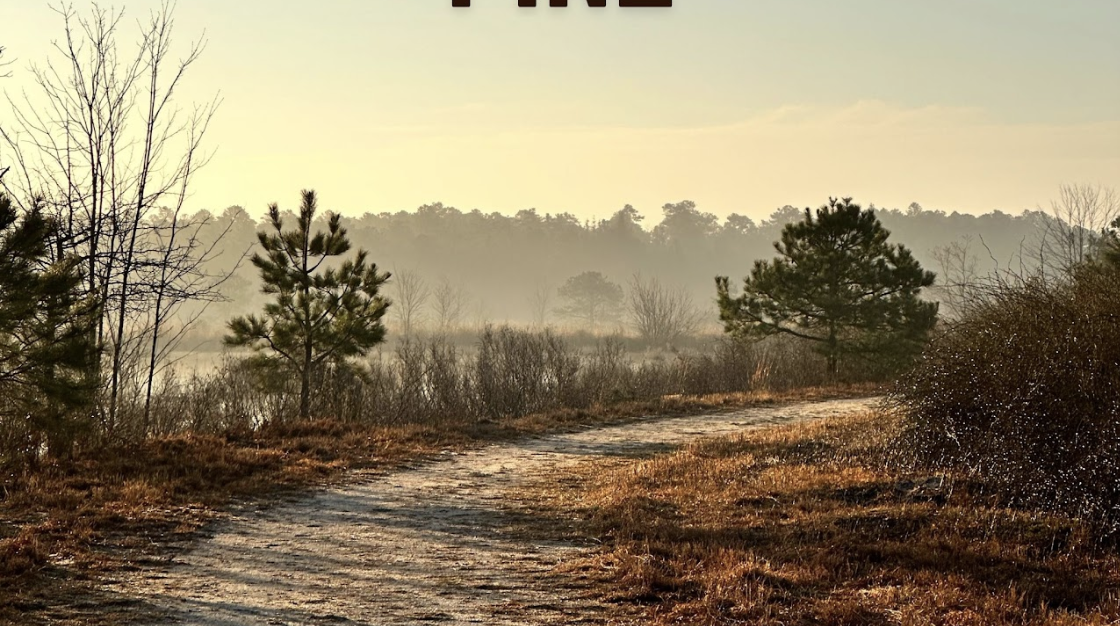
Songwriter Dylan Gallimore conceived The Lower Aetna began at the height of the COVID-19 pandemic when his previous project, Honeyjar, decided to take an indefinite break. Consisting of Gallimore and his former Honeyjar bandmate Kayla Rae Molocznik, The Lower Aetna provided him with what de describes as “a permanent place for retreat, escape, and shameless, uninhibited creative exploration.” Their first album, 2022’s Waiting for God to Turn out the Lights, explored the ways in which online conspiracy theories infiltrate our lives, and their latest, Pine, draws on the songwriter’s experiences as a queer man who grew up in South Jersey’s sprawling Pine Barrens.
I’m curious about your name. What does The Lower Aetna refer to, and how does it reflect the nature of your music?
The band is named after a lake in my hometown. I grew up in this tiny woodland village so charming that you’d barely believe it exists. It’s right on the edge of the Pine Barrens, and it’s very small, but has something like 21 lakes.
Lower Aetna Lake was right down the street from me, and it essentially served as the setting of my most formative years. To me, the term “the lower aetna” represents a sense of safety, wonder, and non-judgment—that period of life before adolescence, when you’re young and small enough that just a single lake in a single town can feel like the entire universe, and it’s all for you to love and explore and call home. Naming the band The Lower Aetna is my way of preserving that feeling and carrying it with me.
The project started at the height of COVID-19. How did that experience influence the music you were writing at the time?
When The Lower Aetna started, I was alone in my apartment, in the middle of winter, sick with COVID-19 for the second time, and my other band Honejyar had just recently gone on an indefinite hiatus. Everything in that moment just felt so bleak. I needed an outlet.
The Lower Aetna and specifically our first record, Waiting For God To Turn On The Lights, gave me an opportunity to feel inspired, uninhibited, and free, exactly when I needed it. Now I just try to keep that feeling alive as best I can.
Your website describes The Lower Aetna as an ever-evolving experiment in genre and storytelling. Why is it important for you to continually experiment with genre?
I think that life is too long and my attention span is too short for me to lock into a single genre. My influences make no sense on paper. I love stadium rock, but I also love alt-country…and regular country, and heartland rock, and quiet singer-songwriter-type stuff. I love pedal steel guitars and ploinky resonators, but I also love synthesizers and screaming Jazzmasters and ‘80s drum machines. I love writers like Jason Isbell who can break your heart to pieces in under three minutes, but I also love showmen like Brandon Flowers who can blow your mind with the sheer power of their performance.
In my music, I just want to explore and love all of that stuff, all at once, across as many records as I can.

And storytelling?
Our first record, Waiting For God To Turn On The Lights, is a concept album that tells one story from start to finish, from the perspectives of multiple different characters. Our new record, Pine, puts more of a focus on individual songs. They have shared themes, but they’re all standalone stories, each from a standalone character’s perspective.
Making a record is a ton of work. I respect the hell out of songwriters who can write 25 songs, whittle it down to ten or so, and say, “Cool, that’s my next record.” I think that’s awesome, and have no idea how they do it. For me, it’s more like, “If I’m going to undertake all this work, what’s it all in service of? What’s the big idea I want to communicate? What makes it all worth doing?” And then I try to grow the record out of that. In terms of both songs and records, I like to have some sort of larger concept in mind because it helps me believe that I’m contributing something unique, something that hasn’t been done yet. Something that justifies doing it all.
I also just really love writing about complicated, broken, misunderstood, or marginalized characters. A nonbinary artist who hates their hometown, yet refuses to leave until they finish some “magnum opus” they know they’ll never actually complete? That’s interesting to me. Or a middle-aged empty nester who fills the hole in her heart with conspiracy theories? That too. Those characters feel real to me. I can see people I know and love in them. They have shadows, just like we all do. To me, that’s worth exploring—not in spite of the fact that it’s maybe a little uncomfortable, but because of it.
The Lower Aetna’s first album, Waiting for God to Turn on the Lights, examines the threat that online conspiracies pose to families. What inspired you to focus on that topic, and did making the album lead to any epiphanies regarding the subject on your end?
Waiting For God To Turn On The Lights talks about the dangers of online conspiracy theories, but it isn’t really about them. It’s about family.
Online radicalization is a very new phenomenon. The past ten years or so have made it clear that the internet can be a very dangerous place for the human mind.
And yet…it seems like nothing is being done to address it, or even start a dialogue about it. What’s a kid supposed to do when they realize their parents have become obsessed with deranged nonsense? Thousands of people stormed the U.S. Capitol on January 6, 2021, all based on a lie. A bunch of them have spouses, siblings, or children. What are those people supposed to do? How are they supposed to feel? How do you respond to someone you love embracing and acting on something that’s so obviously deranged and so clearly bad for their psyche? We don’t really talk about it as a society and I wish we would, because to me, those are hugely important questions. I don’t have the answers. But it’s a little wild to me that we don’t really even talk about it much.
Why do you think online conspiracy theories—or even conspiracy theories more broadly—are so attractive to so many people?
I think there are a lot of factors. But the one that I’m most interested in is this idea that people turn to conspiracy theories for a sense of meaning, purpose, and understanding, when they can no longer get that from the things in their daily life.
For example, on Waiting For God To Turn On The Lights, the main character is a suburban mom who falls down the conspiracy theory rabbit hole after her kids move out of the house. For so long, there was this thing that gave her a deep sense of personal fulfillment—being a mom. But when her daily life no longer requires that of her, she becomes desperate to find meaning and purpose in something else. For one person, it might be taking up a new hobby. For another, it might be getting red-pilled online. (What makes one person go one way and another person go the other? I have no idea.)
Growing up in America means internalizing a lot of myths, well before you even have the vocabulary to really understand them. Life is long and life in America for most people is something of a tightrope walk; eventually, there’s bound to be a moment when some foundational myth you believed, consciously or subconsciously, unravels in the blink of an eye.
When that happens, some people can shrug and move past it without even remarking on it, if they even notice it. But some people don’t, and they start looking for other explanations. What else isn’t true? Who’s REALLY in charge? What’s REALLY going on in this country? And there’s an entire online ecosystem of conspiratorial bullshit out there ready and waiting to take advantage of people who start going down that road.
Your new album, Pine, draws on your own experiences as a queer man who grew up in South Jersey’s Pine Barrens. How do the two topics—your identity as a queer man and growing up in the Pine Barrens—intersect or complement each other?
I came out in late 2013, about a year and a half before the Obergefell ruling. Back then, “gay” very much felt like a pre-packaged, media-approved lifestyle label. Oh, you’re gay? Here’s how you talk now. Here are the kinds of clothes you need to wear now. Here are the kind of people you need to hang out with now. Here are the movies and tv shows you watch now.
It didn’t resonate with me at all. It all just felt too clean, too cut-and-dry, too sanitized. Gay men aren’t just fit, white, perfect-smiling twenty-somethings. They’re also janitors, farmworkers, fishermen, carnies. There are people who come out in their 80s. There are people who live their entire lives in the closet—who die in the closet, as tragic as that is. I think queerness is so much more than a lifestyle brand; it’s a deeper connection to humanity, and especially when I was coming out, it felt like there basically no recognition of that in the media.
So I wanted to write songs about those people because I see myself and a lot of my queer friends in them. And the Pine Barrens just felt like the perfect place to do it, because it fits that vibe—it’s different from other places, but in ways that are a little rough around the edges, a little resistant to the outside world. Culturally, it defies categorization, and it seemed like the right place to put these characters.
I love the title, by the way—great double-entendre! What accounts for the theme of “pining” in the album?
If I had to sum up the theme of Pine in two words, it’d be “queer loneliness.” Nearly every character on Pine is desperate for something or someone. These characters are living quiet lives somewhere out there in the forest, hoping things will be better tomorrow.
Can you talk a little bit about the recording of the new album? How was your experience with recording Pine different from that of recording Waiting for God to Turn on the Lights?
Making Waiting For God To Turn On The Lights was an education. I’d been a part of making records before, but had never produced one myself. There was so much I didn’t know, and a lot of people helped me learn it and lent their talent to the music, which was humbling and really rewarding and led to some great new friendships. But mostly, I felt like I was just flying blind for most of the process.
Pine was totally different. As I wrote the songs, I looped in Rich Strab from Steady Hands and Darla, and he joined me in co-producing the record. Rich is responsible for pretty much all my favorite parts of the record; getting to collaborate with him on it and learn from him really elevated the entire experience and made a significantly better record than I ever could’ve made by myself. We also worked with a wider network of musicians than the first record, which added more depth and collaboration.
What’s next for The Lower Aetna?
We recently played Pine from start to finish at the World Cafe Live Lounge for our release show on August 15. We’ll be booking shows to promote the record around Philadelphia, and then it’s onto the next record.
One response to “Life is Too Long and My Attention Span is Too Short: A Conversation with Dylan Gallimore of The Lower Aetna”
Dylan’s an interesting and thoughtful guy and musician. His lyrics are particularly compelling and poetic.