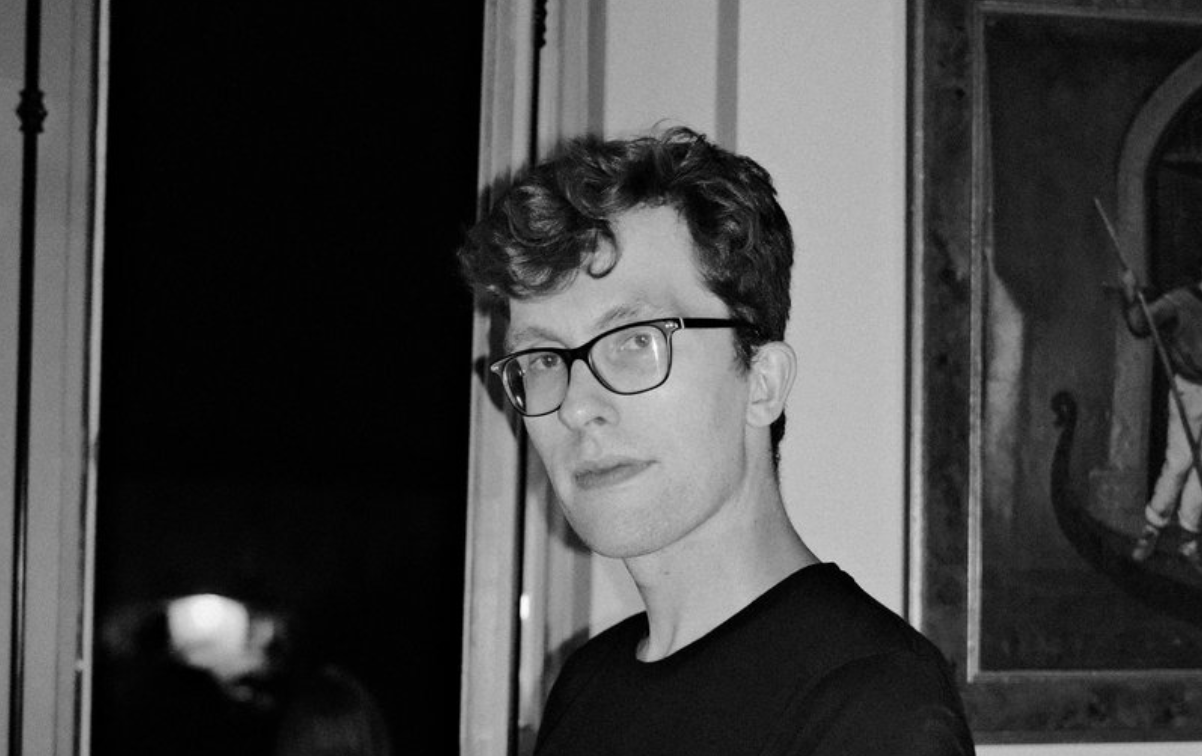
In the press materials promoting his latest album, Squash, Alex Hudson – AKA Rec Centre – explains that the title does not refer to gourds but squash “as in the racquet sport, and also in the sense of getting completely flattened by life.” Hudson further explains that he started working on the album – his sixth – following the passing of someone close to him, adding, “Forgive me if I don’t go into any more details about that in a band bio. But it made me revisit and reconsider lots of strange and painful memories, and I initially thought that I’d be writing a sad album about death.” The result is an excellent collection of retro-sounds reminiscent of Kraftwerk and early Human League.
Your new album is called Squash, and you’ve mentioned that it’s not a reference to gourds but to both the racquet sport and the sense of being flattened by life. How do those meanings of the word relate to the music on the album?
The material on this album came in two distinct phases: I started with some emotionally fraught songs following the death of someone whoI used to be very close with, and then I started writing very detail-oriented songs about specific things in my life. One was about reckoning with the loss of life, the other was about celebrating the day-to-day moments that make life worth living.
The word “squash” tied those two ideas together. In one meaning, it was about the emotional weight of intense loss. In the other, it’s about a memory of playing racquet sports in March 2020, on the same day that they shut down the NBA.
It’s not about gourds, even though they’re delicious.
Squash is your sixth album (or eighth, if you count your EP and instrumental album). How has your music evolved from one project to the next?
With every album, I try to set up some sort of limitation to guide how it sounds, both to challenge myself and to create an overall aesthetic for the album. My last album (Maxed Out!) was made entirely with guitar, bass and drums, which was a reaction to the previous one (Pep Talk) being based in synths and drum machines. This time around, I was more focused on the words. Every word of every line was intended be as direct as possible, full of proper nouns and specific references to real-life things. If a line felt vague, or simply a placeholder for a melody, I worked on it until it felt like it had a meaning that added to the song. “Polly and Andy,” which is about the couple that runs the corner store near my house, was a very rare instance where I wrote the lyrics first. It’s my favourite song on the album, maybe my favourite song I’ve ever written, so I’ve started doing that more.
Your videos for the songs “Polly and Andy” and “Undying” are fun slice-of-life visual collages. How did you film them?
There was an era of indie music , about 15 years ago, when bands were really into Polaroids and VHS music videos. I love that aesthetic, but I wanted to update it slightly — so I got my hands on a couple of point-and-shoot cameras for a crunchy, low-res look. I find it captures the same nostalgia and innocence that VHS used to evoke, but now evoking the 2000s rather than the ’80s. Thanks to my friend Allie for lending them to me!
I filmed “Polly and Andy” in my neighbourhood, in and around the store that I sing about in the song. “Undying” was filmed on a trip to South Korea with a couple of friends earlier this year. In both cases, I just filmed random things that caught my eye, and then tried to assemble them into some sort of narrative.
Your sound balances lush arrangements with a DIY sound. How do you strike a balance between the two, and why is the DIY ethos important to you?
I am trying to make my recordings sound as good as I possibly can, with the huge caveat that I’m recording in a basement that isn’t acoustically treated, using a preamp that only has one input. Luckily, I enjoy hearing the quirks of mid-fi recordings, so I’m happy to accept the limitations.
My first-ever band recorded an EP that I wasn’t proud of, but we had recorded it properly in a nice studio, so I felt obligated to release it. We pressed 1,000 CDs, then broke up after selling like 50 of them. I carted around boxes of CDs for years after, moving with them from house to house, and eventually just threw them all in the trash. It was a lesson to never do that again, and to remain fully in control of what I make and how I release it.
Do you have any DIY heroes?
Jay Arner has been an encouraging and empowering part of every single Rec Centre release. She has a ton of knowledge and makes things sound great, but at the same time isn’t overly precious about insisting that things are “perfect” or “correct.” She always reminds me that, if something sounds good and it feels good, then it’s good!
Phil Elverum is also a huge inspiration. He does everything — writing, performing, engineering, producing, mixing, creating the visuals and even releasing through his own label. He has such a distinctive and consistent vision, and he has created a whole universe by himself. Even choices like redoing the same songs across different albums, or reusing the same lyrical motifs, make his whole catalogue feel like a single piece of evolving art. That’s the dream.

Do you have a fixed approach to writing and recording, or does each song evolve on its own terms?
I try to mix it up. Sometimes I start with a bass part, sometimes with a lyrical idea, sometimes by strumming chords on an acoustic guitar and singing gibberish. But the consistent thing is that songs tend to take me a while, and I rarely write a verse and a chorus and a bridge all the same sitting. I dip in and out, and come back later with a fresh perspective. I tinker.
Something I’ve done on the past couple albums is to have an email songwriting club with friends. We call it “Song Game.” Someone in the group suggests a song title, and then everyone has two weeks to write and record a song with that title. At the end of the two-week period, we all send each other what we made, and then someone else picks a title and the process starts over. It’s a great way to impose a deadline and force myself to take the first step in writing a song, which is always the hardest part. A bunch of songs on Squash came from the Song Game: “Reclaimed by Nature,” “The Slow Wonder,” “Squishy,” “Trillions of Trilliums” and “Squash.” That last one was a title suggested by me, because I knew I wanted my album to be called Squash and I thought it would be good to have a title track.
What does your recording space look like? Do you have any pieces of gear that you’re particularly fond of?
I’m not a gearhead! Almost everything on this album was recorded with a single microphone, a Beyerdynamic M88. I mostly try to have one decent version of each thing I need: one good preamp, one good bass, one good guitar, one good microphone, and so on. When making this album, I got a Fender Jazzmaster, which is my first new guitar since the Strat I bought when I was first learning guitar as a teenager. Having a whammy bar that doesn’t throw the guitar way out of tune is revelation, and a huge influence on the sound of this album. I love anything that’s artfully out of tune.
My favourite thing is the recording space itself. It’s an unfinished basement, which I wouldn’t call “nice,” but the room sounds pretty good to me, and it’s the first time I’ve had a dedicated recording zone that doesn’t double as an office or a bedroom or anything like that. My wife once referred to it as “Alex’s Masturbatorium,” and the name unfortunately stuck.
Your longtime collaborator Jay Arner produced the songs. How did your collaboration work? Who did what?
I write and record the songs and work on them until I think they’re completely finished. Once I finish an entire album, I send all the tracks to Jay and she mixes them. When she sends the mixes back to me, she has often added new instruments to them. All of the 12-string acoustic guitars on the album were added by her, and she’s much better than me at both synthesizers and percussion. I think the biggest change was that she added an arpeggiator to “Trilliums of Trilliums,” which totally transformed the song.
I know you don’t plan to play the songs on Squash live, but do you have other ways of being part of a music scene?
I play bass in a band called Weak Hands. We play live, so that keeps me connected to other indie musicians here in Toronto. Just last weekend we played a rooftop house show for an extremely underground festival called Greenwoodstock and I think it was our best show ever. The audience was a super cool scene of young punks, and it made me feel like the world is gonna be okay.
What’s on the horizon for you?
Weak Hands have been a band since well before the pandemic, but we haven’t ever made any proper recordings. That is finally changing, since we have an eight-song album recorded. It’s being mixed by our friend Kieran Douglas, who plays in a great local band called Paste. I’m guessing we’re looking at an early 2026 release.
As for Rec Centre, I’m already working on the next album. I have a bunch of new songs written, and I’m also chipping away at finally making recordings for a bunch of the earliest songs I ever wrote. I’m not sure if I’ll ever release the latter, or if I’m just assembling them for posterity, like a photo album of slightly embarrassing teenage memories.
My big focus is learning how to mix. Kieran and Jay are giving me amazing guidance, and I’m excited to keep getting closer to translating the sound of my brain into a WAV file.
6 responses to “I Try to Mix It Up: A Conversation with Rec Centre”
I like his mellow, melodic style and vocals. And deciding to finally toss all those old CDs into the trash had to hurt!
I can imagine! I’ve gotten rid of a few old CDs over the years, and each one felt like a major decision!
Cool interview! I agree about the recording space – it really helps.
Definitely! How’s your new rehearsal space coming along?
My downstairs home recording space is back in business. Three of us are getting together this weekend to regroup.
Pat’s space is basically done. I’ll send you a couple pics. Should be back to work in there after he and Adrienne return from vacation after next week.
Nice!