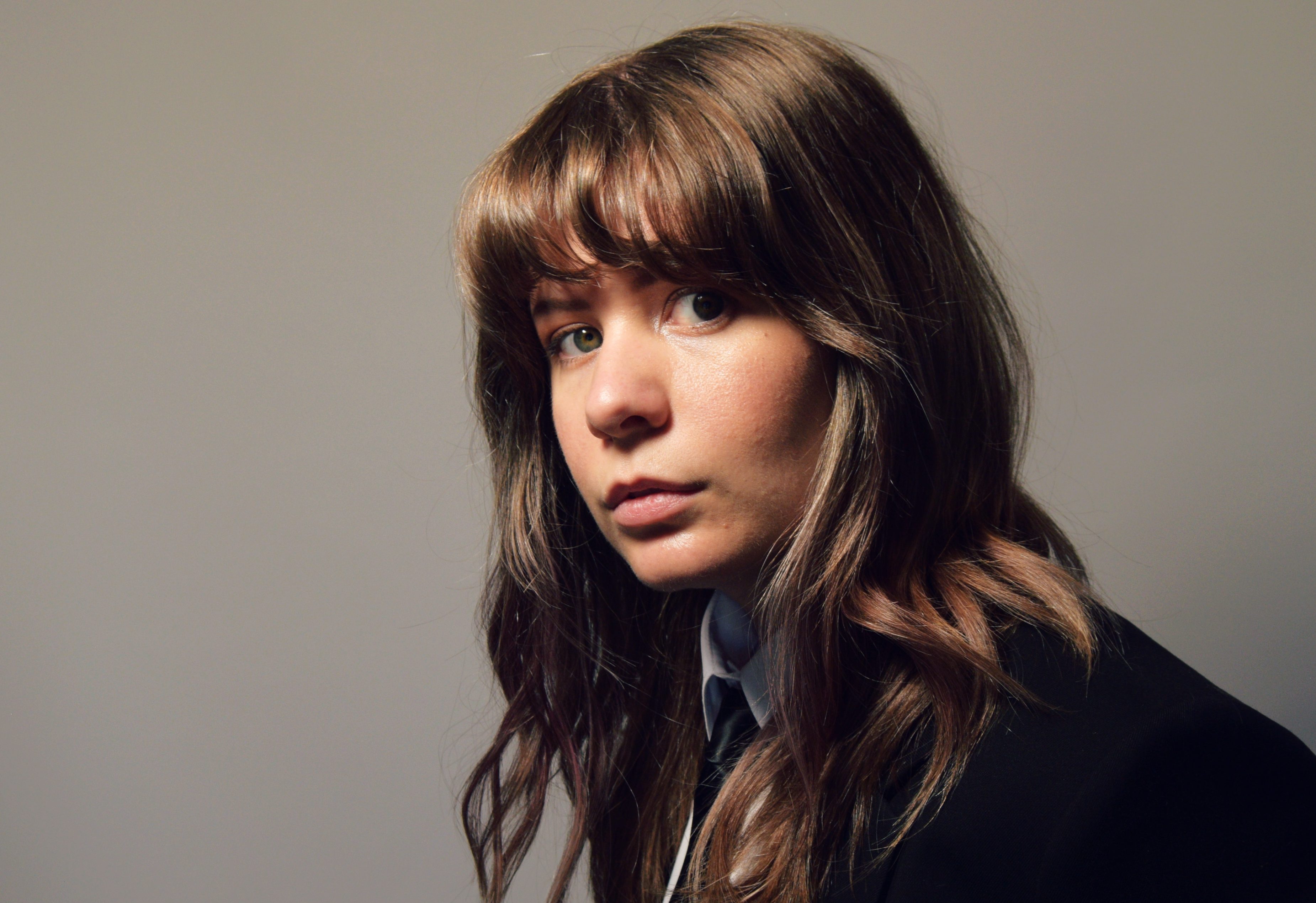
When I last spoke with Kerrin Connolly, they had just released “Cut,” a song inspired by Severance. It’s an excellent tune, so I was very excited when Kerrin emailed with news of their latest album, Simpleton. The album explores the classic themes of a hero’s journey within the context of the creative process, grief, mental illness, and trying to exist simply in the modern world, but it’s also a love letter to some of Kerrin’s favorite sounds and styles from the 80’s, 90’s, and 2000’s.
Do you mind if we start with the cover art? I love it! Simple but evocative: a rat curled into a ball with its tail in its teeth. Who’s the artist, and how did you arrive at that image?
Horror artist and friend of mine John Green (@jrgdrawing) brought the vision to life! At some point while writing the album, I knew I wanted the cover to be pretty simple, as you say, and this captured much of what the album explores. An Ouroboros is just such a classic and effective symbol to me.
And how does that image speak to the contents of the album?
A lot of these songs are about cycles – of anger, grief, life and rebirth, trying and failing and trying again, destruction and rebuilding, and otherwise just telling the same story over and over again. There’s also something to be said about the repetitive nature of compulsions in OCD, which is explored a bit. The flowers on the cover are also representative of grief, sympathy, and congratulation, and how sometimes I can’t really tell the difference. The rodent imagery throughout the album is a nod to some of my favourite mouse references in literature and movies – Flowers for Algernon, Dune, Stuart Little, An American Tail, etc. – small guys with big significance.
You’ve mentioned that the album explores the classic themes of a hero’s journey within the context of the creative process. How might being creative be a heroic gesture in today’s world?
What I keep coming back to is duty – there is an obligation, self-imposed or otherwise, to keep creating. It’s political, it’s a means to community, it’s something we all need and thrive on, and even if they aren’t, the stakes always feel so high. Every time I make an album it kills me, but it’s what I need to do. But to be clear, as a person making music in their home office for a very small audience, I’m under no illusion I’m anyone’s savior but my own 😉
The album also touches on themes of grief, mental illness, and trying to exist simply in the modern world. How do these themes relate to creativity?
For me there is intense grief in creation – in killing your darlings and in using a song as a means to process your feelings and move on from the chapter of your life they bloomed in. There is rumination and anxiety and fear and expectations and pressure! There’s living in the potential of something too long that once you finally complete it and let it out into the world, it can’t compete with what you were waiting for it to be. Mix in now having to also compete with AI slop, algorithms, and political devastation, the game has changed so many times many of us are becoming disenchanted, and others are just too busy surviving to have the time or energy to make their art. It’s uphill all the time, and it’s difficult to come to terms with that when you were promised something much different as a kid.
I’m particularly struck by the idea of trying to exist simply. What gets in the way? Why is it so hard to live a simple life these days?
I think this deserves a more nuanced and topical answer than I can really provide, given the current state of affairs. The reality is that many of us live in a world that seeks to destroy us where we are expected to consume, rage, and despair. I can’t speak to how we attempt to live simply in the midst of all of this when living at all is challenging. But I can say that some of our problems are only complicated because we make them that way, and we have some power to zoom out and see things simply if we want to. And then those simple problems have simple solutions. So much easier said than done, and certainly not applicable to everything, but it helps. Am I really feeling a hundred different feelings about a hundred different things, or am I just hungry? Does everyone hate me or do I just need to go for a walk? Sometimes it just boils down to basic needs being met, and everything around us is seemingly designed to prevent that.
“Simpleton” is usually an insult, but in this case, I’m wondering if there’s value in being a simpleton. Any thoughts?
Definitely. In the context of this story, the narrator starts out considering it an insult – their perception is that they’re a fool, inexperienced, even an imposter in a pool of people who really know what they’re doing. Some of my deepest insecurities are rooted in other people thinking I’m stupid. But by the end, they’re coming to terms with how complicated they have actually become, and how the grief and frustration they’re feeling is coming from the sort of burden of knowledge and hyper-awareness they have. There’s a lesson in how not to overwhelm yourself in there somewhere – I’m still learning it, and learning to let go of thoughts that don’t serve me.
You’ve also described the album as a love letter to your favorite sounds and styles of the 80s, 90s, and 2000s. Do any touchstones from each of those decades stand out to you?
I had a sizable playlist of reference tracks while working on this album, and a few of the tracks that got the most mileage were “Can’t Fight This Feeling” by REO Speedwagon, “You’re the Inspiration” by Chicago, and the Pokémon theme song. Some of the songs on this album are genres I hadn’t really tackled before so there was much studying involved – but I also borrowed a lot from more modern acts who lean toward earlier decades as well, like Ghost and Sabrina Carpenter. I think you can hear pretty heavy influence from Phantom Planet, Jack’s Mannequin, Jonathan Coulton, and The Shins in a lot of these tracks though.
Is there a common thread that runs through them?
I think it’s nostalgia if anything, and that plays a part in the overall themes of the album, too. Everything cycles and recycles, and I’m one of those 30-somethings that has trouble breaking from the stereotype of never listening to anything new. But if nostalgia is death, then rebirth will be in these new songs. But really, these are all just sounds I love with my whole heart and music I’ve always wanted to make inspired by them. I drew from really powerful and emotional songs and hope that people see the same traits in mine.
Do you have any plans to play the songs on Simpleton live?Yes! I’m playing the release show for the album on February 21st at The Burren in Somerville, MA.
What’s on the horizon?
Nothing major written in stone yet, but I’m excited for whatever is next. Simpleton was 6 years or so in the making, so it’s going to be really nice to be free of it and to explore something new.
4 responses to “An Obligation to Keep Creating: An Interview with Kerrin Connolly”
love the simple talk. Been my life lately. Getting down to bare bones. Efficiency. Sweat. Love it.
Interesting interview with who appears to be a very thoughtful, deep-thinking artist. I sampled each of the forthcoming album’s three tracks that are already out and like the music. I think my favorite is “Big Amygdala” – great sound and chorus!
And great title, too!
Once again, I have to agree! 🙂