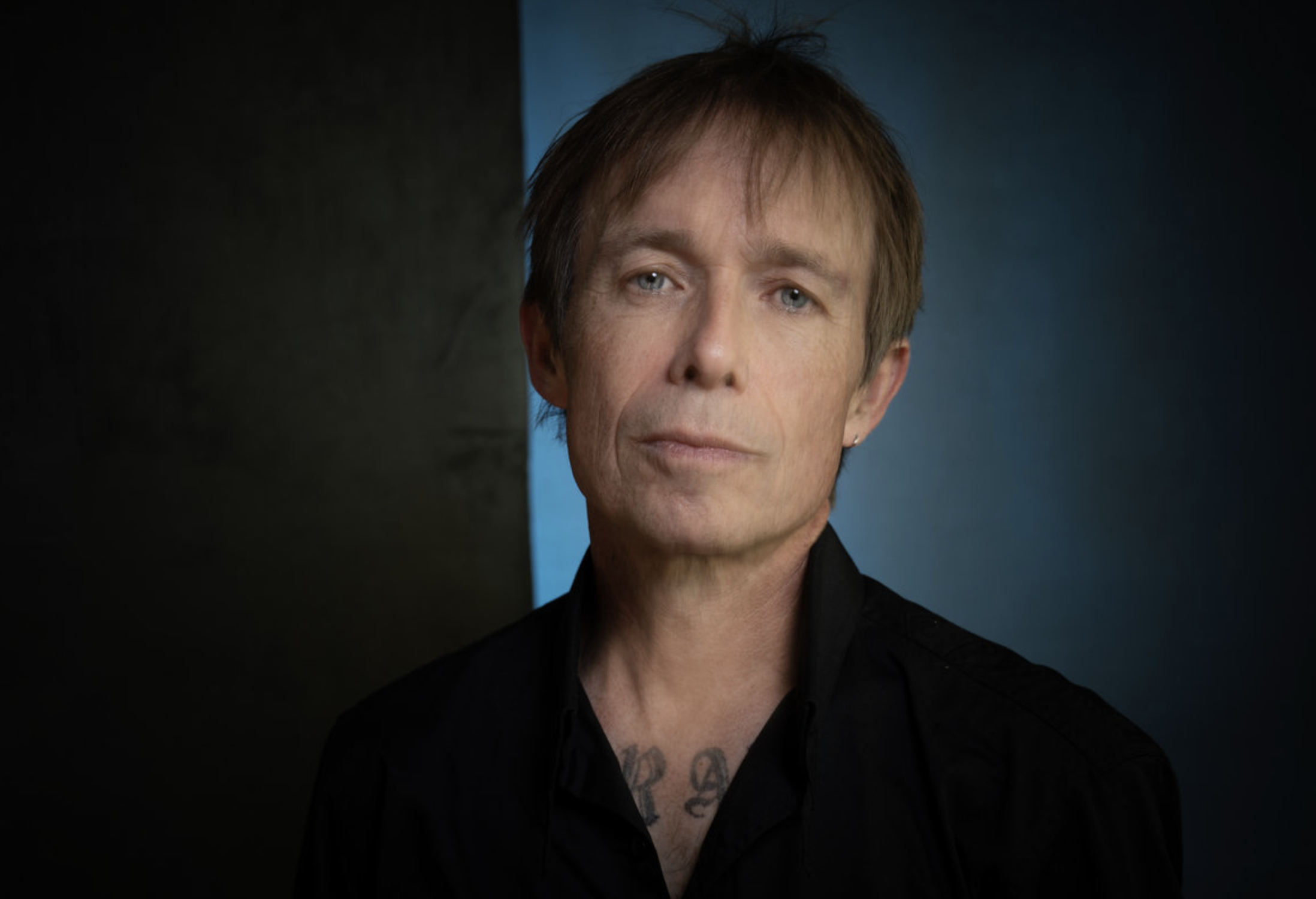
Sunday Morning’s “Carry the Sky” is a sweeping tribute to love, loss, and the weight of memory that never fully lifts. The project, led by frontman Bruce Wilson, has long navigated a space between poetic storytelling and cathartic art rock, drawing comparisons to David Bowie, Nick Cave, and Iggy Pop, yet this track brings a newfound immediacy and accessibility to Wilson’s singular voice. To find out more, I dropped him a line…
I’m curious about the name Sunday Morning and whether there’s any wordplay involved with the word “morning.” Does “mourning” fit into your vision of the project?
That’s a really interesting observation and it’s not something I’ve consciously considered, but it’s certainly applicable with the new single. Probably a lot of other Sunday Morning songs, too—this project was started as a way to reconcile with my sketchy past and maybe make up for a lot of time I lost while nodding out on a couch somewhere. It seems strange to mourn lost time. I mean, what determines that time is “lost,” and did it even exist in the first place? It’s so easy to get lost in our stories of what was and what could’ve been when none of it really matters.
Your single “Carry the Sky” has a beautifully uplifting yet elegiac tone. How do you strike a balance between these extremes in your songwriting?
Those two ends of the emotional spectrum are at the core of what Sunday Morning is based on. The name itself is inherently about that dichotomy. Sunday morning can be a day of spiritual reflection or alternatively it can be waking up in a trap house with no shoes and no recollection of the night before. Marrying those extremes has always been an objective of this project.
You’re a regular of the Vancouver music scene, yet your sound has a distinct Brit Pop echo. How did the sound of Brit Pop become so indelibly intertwined with your own?
With this song in particular, I tried to channel a little of Jason Pierce (Spiritualized). I love his deep but simple approach to songwriting. He can basically sing one phrase over and over for four minutes and keep it interesting and engaging. I don’t have that kind of talent but that’s where the song started and I’ve always had great admiration for bands like Blur and The Verve so those influences are always going to be hanging around. There are also layered guitar tracks in the song where Kevin Rose did a pretty great job at emulating Kevin Shields from My Bloody Valentine—not Britpop, but certainly of the same era.
Before Sunday Morning, you cut your teeth, so to speak, in the 90s grunge-punk band Tankhog. How do you feel about the music you were making then, particularly in light of the music you’re making now?
Tankhog was very much a band in the sense that we jammed on riffs and came up with songs as a unit. Our influences ranged from Aerosmith to The Dead Boys and reflected that 90’s time period of loud, heavy guitar rock. I’m very proud of what Tankhog accomplished, but we were a beautiful, chaotic mess that wasn’t sustainable emotionally or physically.
I remember touring with Skinny Puppy and realizing that I could both love Motörhead and bands like Ministry and Front 242. With Sunday Morning, I gave myself permission to make whatever kind of music I wanted. Whatever supports the emotional tone of the song, and not worry too much about what genre the song fits into. This approach doesn’t gel that well with music algorithms and makes it difficult to answer the question, “What kind of music do you make?”, but I think it serves what the song is trying to convey and that takes priority.
You launched Sunday Morning nearly a decade ago. Has the sound of the project evolved since then?
When I started Sunday Morning I was basically musically illiterate. My place in bands had always just been to write lyrics, scream and be entertaining on stage. As Sunday Morning progressed, I learned more about musicality—how to sing and how to integrate a little music theory into what I wanted to make. When Covid hit I started recording demos at home and buying synthesizers. I think over the past couple years, Sunday Morning has started to sound more like me. My songwriting has gotten better and I have a better grasp of studio language so I can express in more detail how I’d like something to sound. It feels freeing.
I’m also curious about changes you’ve seen in the music industry over the years. How is being a recording artist different now than it was when you were getting your start?
Major labels still don’t care about making art, so nothing changed in that respect. I think they’ve become even more sophisticated at their exploitation of artists and devaluing music as an art form. Now AI platforms make it possible to release a new software-generated “song” on demand onto streaming platforms—it’s a fascinating apocalypse of creative thought. Don’t get me wrong, I’ve messed around with Suno, and it’s fun to play with, but I much prefer the tactile sensations of the weight of a key on a keyboard or the vibration of a guitar string. I even enjoy those painful periods of creative blockage and the joy of finding a way through them. For the time being, the human soul is still deeper and more nuanced than a computer chip.
Guys like Ian MacKaye (Minor Threat/Dischord Records) had the right idea 40 years ago: just do shit yourself and fuck the industry at large. I try to surround myself with talented, creatively driven people, and I love the community aspect of working on a project; in many ways, that’s equally as important as the finished product. I have to ask myself why I bother making music. It’s certainly not an attempt at achieving some form of immortality—or maybe it is? I think we’re all striving to give our limited lifespan some sort of meaning or validity. Making music just happens to be my discipline and something I care deeply about, so I keep writing songs without too much thought about the industry aspect.
Jamey Koch produced “Carry the Sky” at The Warehouse Studio in Vancouver. What attracted you to working with him, and what did he bring to the recording process?
I enjoyed working with Jamey immensely. We spent a lot of time talking about the song and how to present it properly. The song is about the death of our mutual friend Christian and my sister Juliet. The fact that we both knew Christian and that Jamey had also experienced recent familial loss made the process more intimate and personal. Loss is a universal touchstone, and he understood that the song needed to rise above the grief and have a spiritual element of joy and gratitude for the experience of connection between people on this mortal plane.
Jamey’s attention to detail was really evident in his mixing process, how he brought all the elements together and made the entire song shimmer. He was always fully invested and a master of his craft.
Are you doing any touring to support the new song?
I spent a lot of time on the road in my past. The tricky thing about Sunday Morning is that currently there’s no set band, and all the musicians I’m close to are incredibly busy with their own projects. That being said I’m not adverse to the idea of touring, I’d just have to do it in a way that’s manageable.
What’s on the horizon for you?
I should probably plan better or have some set career outline but my basic mode of operations is to always keep writing, and when I have enough money to record and release something properly I throw it out there. I have an album worth of songs demoed that I love and I hope to share at some point in the very near future.
2 responses to “Striving to Give our Limited Lifespan Some Sort of Meaning: A Conversation with Bruce Wilson of Sunday Morning”
“Carry the Sky” is gorgeous, with some spectacular guitar work! Bruce has a fine singing voice too.
And I love the 80s vibe!