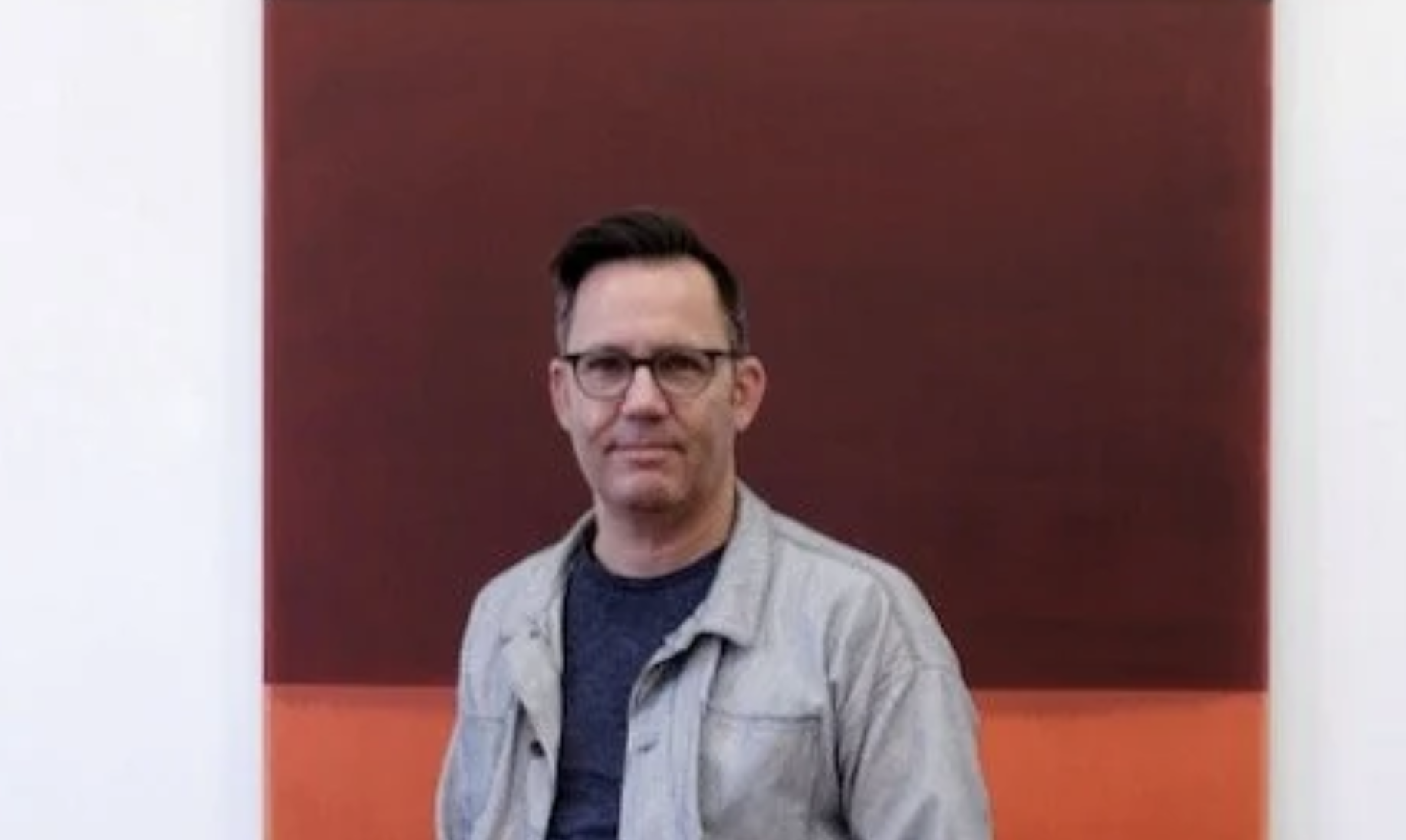
Life is full of surprises, chance encounters, and serendipitous discoveries. Case in point: I wanted to give away a bass amp a little while back, so I put it on Craigslist and almost immediately heard from an artist named Douglas Witmer. It turns out that he had just joined an REM cover band and needed the amp for practice. And though my intention was to give my amp away for free, Douglas said he’d give me one of his paintings for it. I tell you, my friends, a fairer trade was never struck, and the painting hangs proudly in my studio adjacent to a New Order poster…

In any case, I visited his website and checked out his music on Bandcamp and was impressed by both the work and the philosophy behind it. To find out more, I dropped him a line…
You’ve been a visual artist for decades. What were some of your first steps toward becoming an artist? Was there a particular moment when it hit you that you were, in fact, an artist, or was it more of a gradual realization?
I’ve been artistically and musically inclined since childhood. Music was very valued in my upbringing, particularly singing. It was less so the case for visual art. But I was lucky to have supportive teachers for both disciplines throughout elementary and high school. On a trip to the Philadelphia Museum of Art when I was 14 I saw the painting “Torches Mauve” by Franz Kline. I remember that as a “lightning strikes” kind of moment. I stood in front of that painting and knew right then I would become an abstract painter. I had a very clear sense of purpose after that. I never looked back.
Reading the “about” page on your website, I was struck by the idea that the subject of your work is presence or, in your words, “establishing a visual place that offers someone an open invitation for a personal experience of seeing and feeling.” It’s something I always think about when I visit an art museum and stand in front of a work of art, like, Wow, I’m standing in front of this object that the artist also stood in front of years or decades or centuries ago and spent who-knows-how-long pouring their passion into. There’s a sense of communion in that kind of experience that’s somewhat difficult to find in today’s world. What do you think gets in the way of the kind of presence you’re describing, and how might art counteract those forces?
Oof…where do I start to work on an answer to this? I mean, the overwhelming flood of digital imagery coming at us and the speed at which it comes is an easy thing to point to. But, maybe just as challenging is the idea that I think we often get in our own way. I think a lot of people believe they need to know something more than they actually do in order to experience a work of art. That’s a little bit the fault of the art world. With my own work because it’s abstract I often tell people to try to just look at it as if they were listening to music. I think that kind of helps them get into the present in front of my paintings.
Many years ago, I came to terms with the fact that even though my paintings are “art” to me, they may not be recognized the same way by someone else. And so I just simply surrendered to the idea that I put my work out into the aesthetic realm in absolute hope that someone else will connect with it and have an art experience with it. This is when I began to use the idea of presence…like the painting is just “there” and can become a place for a personal visual experience. And hopefully that visual experience feels like art to the person there.
Along similar lines, you’ve written that you want to believe that the relationship of painting values inquiry over conclusion. Why do you see that as an important distinction?
It’s all about staying curious. To look at or to watch what is happening right in front of you. I want my paintings to be catalysts for personal visual/emotional experiences. I want them to seem very open for you to take in for yourself versus trying to “tell you something.”
How has your approach to painting or the philosophy behind it evolved over time?
I think my philosophy about painting has been fairly consistent…trying to stay open to what happens in the process…keepin on trying to push color in ways that spark unique visual and emotional responses for me. Maybe the biggest “arc” of change in my work is that when I was young I was using a lot of color, then over many years I pared my paintings back to a focus on just one or two, and over the past 5-6 years I’ve been introducing a lot more color back into the paintings. Within the past 2-3 years I would say I’ve focused myself much more acutely on my own basic impulses…kind of the “first idea best idea” mindset. Keep things in the painting process at the moment of joy as much as possible and not overthink. It’s somewhat a response to feeling my middle-aged-ness, and also in response to the accumulating darkness in our world generally.
In addition to being a visual artist, you’re also a musician. Do the two pursuits inform each other?
Absolutely yes. These days I’m probably making as much music as I am art. I reach for one of my guitars just about everyday. I’ve come to find that I tend to make music in the morning and art in the afternoon. Over the years my visual artist self noticed and became a little jealous of my musician self because my musician self seemed to have much more of an ability to noodle around and explore things in a less critical way, whereas my artist self has a hard time not feeling like it has to “make actual art.” Noodling around on guitar feels like drawing to me… like how I drew in my sketchbook when I was young. Over the past couple of years, I re-engaged with the activity of drawing every day too just like playing guitar. I almost said “fostered the practice of drawing,” but practice suggests something too serious. The best results for me whether it’s making music or making art comes when it is simply an activity.

And within music, you also have multiple projects going. Your instrumental recordings under the name The Consolidated Hand Mouth and Ear Institute are incredibly calming and contemplative, offering the perfect complement to your painting. What inspired you to start that project?
Short answer: GarageBand. In 2003 or whenever it came standard on Mac, I went from having only an acoustic guitar, the little Yamaha Portasynth I got in like 1988, one cheap microphone and the most basic 4-track to suddenly having what felt like any music-making option I could think of…plus I could take it with me all the time. My first “album” is definitely a record of me learning how to use GarageBand…lots of stock loops, etc. I’ve evolved so much as a recording engineer since then. GarageBand on iPad is even better…at least for tracking. I love using my fingers on the touchscreen…feels more immediate than clicking around with a mouse.
Long answer: I live in Philadelphia near the universities. And in the vein of the idea of creative inquiry, I thought it would be kind of funny to come up with a very over-wrought “research center” kind of name for my music…that explains The Consolidated Hand, Mouth and Ear Institute…basically it’s “me.” But that name is also quite a mouthful isn’t it? What I like about it, similar to the artist statement I use, is that it applies to any kind of music I might make.
My high school art teacher is probably the person responsible for getting me into ambient music. She would play Wyndham Hill records releases while we worked on our projects…like Shadowfax and George Winston, etc. Back in the 80s they called it “New Age Music.” I really got into Andreas Vollenweider for a minute haha! I was also working at a Christian bookstore in the mall and back then the Christian music world had its own replica for almost every music genre. There was a label called Meadowlark that was their answer to Wyndham Hill. Looking back on it, it was pretty cool. Very audiophile pressings and really good deluxe packaging. And actually fantastic records! Aesthetically almost identical to the stuff coming out of the new age/ambient scene. I got really into this synth-based artist named Jeff Johnson. Some of his stuff was electronic singer/songwriter, and some of his records were instrumental and sound like stuff you’d expect on an ECM release. And because of being involved in church and religious music, of course I gravitated towards stuff like Gregorian chant and contemporary stuff like Taize, which is repetitive and contemplative. Soon enough I was getting into Philip Glass.
And parallel to this my friends and I were listening to new wave and “college rock” and excited about anything that seemed experimental. In the late 80s in Lancaster PA where I grew up, we had few bands getting signed to major labels and a really burgeoning creative scene. There were a couple decent places to see music if you were under age. Plus Philly was only 90 minutes away.
You’ve also recorded with singer-songwriter Christa Aikins under the name Oviette. How did that project come about?
Christa and I became friends through the church we attend and we discovered we had overlapping musical tastes. Christa is a remarkably gifted singer and songwriter. Our voices seem to work well together. We started collaborating around 2017. Christa would often send me voice memos with bare-bones chords and melodies…sometimes just her singing an idea while walking in the Wissahickon. I would then flesh it all out. It took a full five years to get a record finished because we were both juggling work, parenting our respective families, and the pandemic. It’s an indie-pop record with a lot of big feelings.
More recently, you’ve joined an REM tribute band. Can you talk a little bit about that?
I mindlessly scroll the Craigslist musicians ad for fun when I’m bored, never intending to respond. But in December last year I saw one looking for a guitarist/singer for an “all-acoustic early-albums REM” cover band. It was so specific! I’ve covered REM songs in this band or that my whole life and it sounded so fun. I sat on it for a month. The ad was still up in the new year and I couldn’t help myself. The person forming the band is a bassist who recently moved to the Philadelphia area from Asheville NC and used to have a version of this band there. The goal is to start playing live this summer.
You’ve lived in Philadelphia since 1995. What makes it a good city for artists—visual, musical, or otherwise?
Yeah I think Philadelphia is a pretty great city for artists and musicians. For years I’ve listened to my New York artist friends complain about their rents and watched as one-by-one eventually move out of the city (I think it’s funny they all go upstate…like they can’t bear the thought of “slumming it” down here). I was involved for a few years with the Tiger Strikes Asteroid artist collective and gallery. That scene was and is fantastic. The independent artist-run galleries are a great network here in Philadelphia. Philly has a DIY attitude generally which leads to cool things happening just because someone decided to do it. In the ambient music community, there’s a regular “ambient open mic” where the venue is someone’s real estate office on Passyunk Ave…they lend the space to the organizer. I think that’s amazing.
What’s on the horizon for you?
Later today I will go to my studio and work on finishing a new group of paintings to be exhibited in March at Galerie Biesenbach in Cologne, Germany. I have new works on paper in an exhibition here in Philadelphia at Bridgette Mayer Gallery that opens in March and runs for a few months. I also have work on view currently with Galerie Mathias Mayr in Innsbruck, Austria and I’ve recently started a new gallery relationship with Studio Light | Space in Tucson AZ. I’m currently working on my first-ever private commission which will be placed in a new home near Chadds Ford later this spring. On the music side of things, in addition to learning REM songs, I’ve been dipping my toe into Philadelphia’s ambient music scene which has been pretty fun. I’ve had a few collaborative sessions with people I’ve met in that community. There may be something in recorded form forthcoming.
4 responses to “All About Staying Curious: An Interview with Douglas Witmer”
I love it when artistry converges
Absolutely!
Great interview, Marc. Douglas appears to be a multi-talented guy like yourself whose works transcend the music and art worlds.
Truly a like-minded soul!