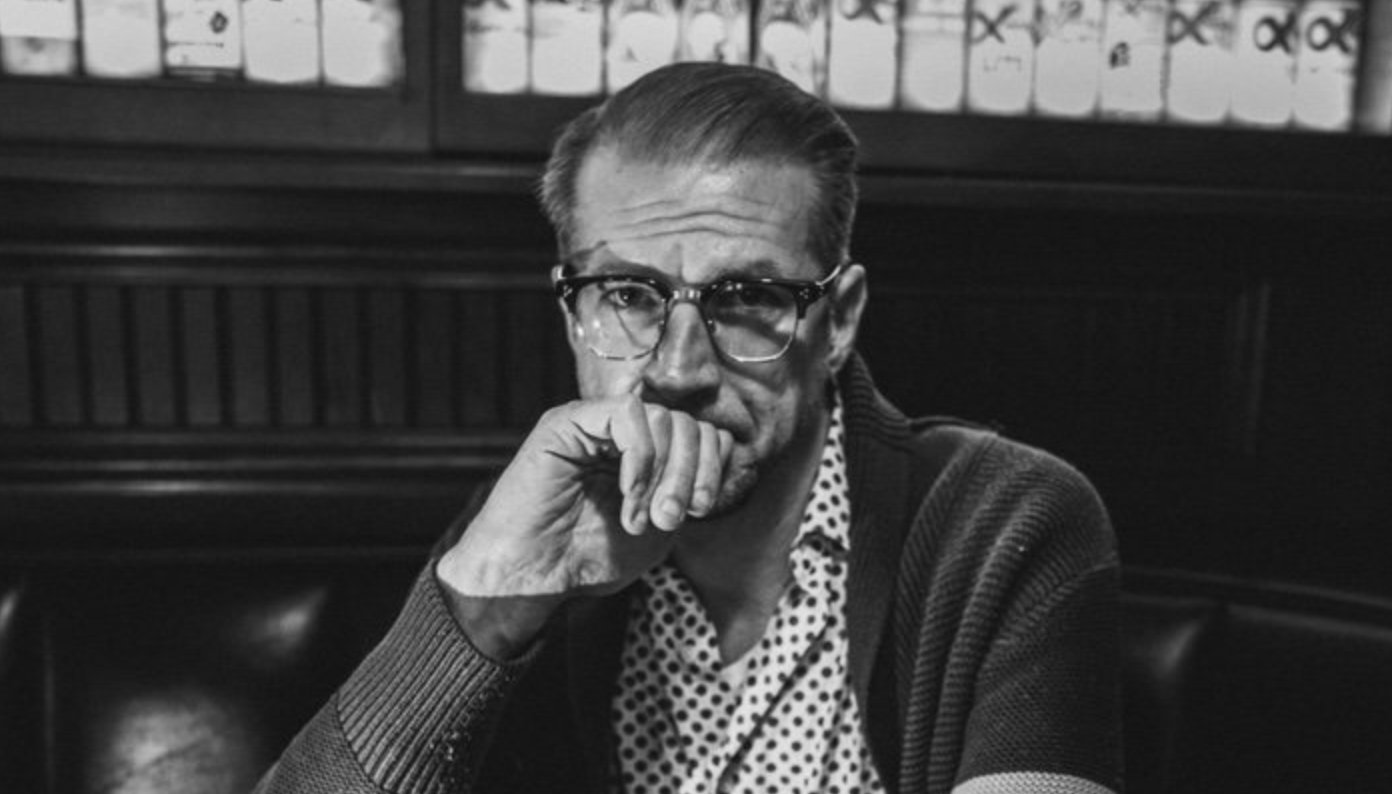
Kye Alfred Hillig’s The All-Night Costume Company came out on March 4. The Tacoma-based singer songwriter has spent more than two decades working the margins of the Puget Sound music scene, balancing songwriting with the realities of work, responsibility, and long stretches outside the spotlight. Since stepping fully into his solo work in 2012, he’s released a deep catalog of records defined by sharp hooks and lyrical candor. His songs often land where discomfort and dark humor overlap, more interested in honesty than resolution. Fans of Father John Misty, The Jayhawks, and early-era The Shins will recognize the instinct for narrative and melody, even as Hillig’s voice and perspective remain distinctly his own.
I love the title of your new album! What does The All Night Costume Company mean to you, and what does it reveal about the contents of the album?
The title came to me first when an old costume shop burned down here in Tacoma. I used to drive by it all the time and look at the dressed up mannequins in the window. Something about it stuck with me. It said something to me about people. It’s not just Halloween when people dress up. They’re doing it all the time in their everyday lives. For a while The All-Night Costume Company is what I wanted to call my band, as it’s been the same core guys for the most part the last decade or so, but ultimately landed on it as an album title. It’s a fear of essentially becoming an actor in your own life instead of living out of your essence. So on the record The All-Night Costume Company is a place that houses all these ideas of ourself, mostly for the worse.
The first single from the album is called “Ezekiel Bobbing for Apples.” Is the reference to Ezekiel Biblical?
Short answer, no, not specifically. It’s more about what that name means. The name Ezekiel means “strength of God” so the idea that Ezekiel would be bobbing for apples speaks to a blind grasping for hope, the belief that love will arrive and save you. It seemed funny to me to frame it that way, that even the “strength of god” must stumble about blindly groping for the light switch. It’s saying that despite all our efforts to seek out love and light in life that sometimes it just feels hopeless. So this song is an acknowledgement of that feeling. For instance, I know so many people who are on dating apps and in them I feel the toll of repeated failed attempts at connecting with others who ultimately crave cheap frivolity. So thus the refrain of the song.
I’m hearing an echo of Bruce Springsteen in your vocal delivery. Is he an influence?
In as much as anybody of a certain age making music would be, yes. The man casts a long shadow. That said, he wasn’t in mind for me. I am a huge fan as many of us are, but he’s not necessarily my guy. I draw more inspiration from people like Warren Zevon, John Prine, and David Berman (Silver Jews/Purple Mountains). All artists we now can only connect with through their recorded music or a Ouija board, unfortunately.
The backing vocals on that track are amazing! Who provided them and how did your collaboration come about?
Yes! Aren’t they marvelous? That’s Annie J. She’s a powerhouse. One of my favorite voices in the Seattle music scene. I’m so grateful for her contributions on this album. What happened was I was listening to the playbacks in the studio and just kept hearing a female singing voice in my head. I reached out to her with only a day or so notice. At the time the roof of her house was falling in or some godawful thing, but she still showed up, laid vocals down on half the songs on the record over about an hour and a half, and dipped out. Blew us all away.
Your PR material describe the single as “the sound of a songwriter stepping back into the frame with focus.” Had you left the frame or lost your sense of focus prior to recording the album?
I tried to quit music. That’s what happened. I’d been making records since I was twelve, putting out roughly an album a year, so I was at least in need of stepping away from it for a bit. That did not go well. My mental health plummeted. Super grateful for the guys in my band who essentially arrived at my door with pitchforks and torches and demanded music from me. None of this would have happened without them. Lesson learned. I’m now back in music full swing.
Your PR materials note that your music “sits between alternative-country and indie rock, carrying the tension and plainspoken urgency of a songwriter raised on punk rooms rather than polish.” What are some of the punk rooms of your youth, and how did they inform your development as a songwriter and musician?
Oh man, so many different spots around the Pacific Northwest: Hells Kitchen, The Black Lodge, The Kraken, Club Impact, GRN STRP Haus, and just tons of house shows and the like. Punk is a great musical education. It emphasizes all the right things for the creation of art. When implemented correctly, the punk ethos is absolute freedom. Its emphasis are less on being a musical virtuoso and more about the feeling. You’re not trying to become famous. You’re trying to express yourself, say something, and you don’t care if its a socially acceptable sentiment or not. In fact, all the better if it isn’t. Even though my musical arc might sound less in that “genre” now those mentalities live in me.
You’re also more interested in honesty than resolution. How do you see the two as being in tension with each other?
I think honesty is a more authentic take. Most of the questions in life don’t have easy answers and I don’t think an audience appreciates someone shoe-horning cheap platitudes into a pop song. I would rather just acknowledge a feeling or a difficulty and say “there there…me too”. That’s all I feel my job is. Meet me for five minutes and it’ll be clear I’m in no position to be providing life guidance. If I’ve discovered something to be true, sure I’ll share it, but you won’t catch me leading anyone up the mountain.
You’ve spent over two decades in the Puget Sound music scene. What’s that scene like?
It’s changed a lot. For me it’s almost more like three decades. In the 90s, in my teens, playing a show in the PNW was shooting fish in a barrel. People were super engaged with the music scene. They’d go to a show just because it was happening. 2000s it shifted to people being a bit more selective about what they saw, but we had some really interesting local bands: The Monks, Quiet After Nine, and Real Life Trauma. Then 2010s when I started performing solo there was a really healthy scene for singer-songwriters, so that lined up really well for what I was doing at the time. Now it’s hit or miss. Some shows are a full house and others you got five people blinking at you. It all depends what’s dropped on Netflix or whatever. It’s hard to pull people away from their simple pleasures.
Do you have any plans to take The All Night Costume Company on the road for live performances?
Absolutely! We’re in the planning stages of what that looks like now. I love touring. I’d love to take this thing we do all over the globe, but for most modern acts that reality has become harder and harder to manifest. Most certainly the band and myself will be performing a lot this year, so there will be many opportunities to see us.
What’s on the horizon for you?
Getting this record into as many ears as possible is my main focus over the next stretch of time. I’m super proud of this work of audible psychopathology, so I’d like to give it the attention it deserves. That said, I’m back in the studio working on another new album in February, so that’ll likely be coming out in the Summer sometime. Other than that, just stepping onto a lot of stages and howling at whoever shows up.
2 responses to “Honesty Is a More Authentic Take: A Conversation with Kye Alfred Hillig”
Another fine interview Marc, and I like how you always pull a quote for the titles of you posts. I like his music, and also agree with you that Kye’s vocals sound reminiscent of Springsteen at times.
Thank you, Jeff. Pulling titles from the interviews may be the funnest part of the job!