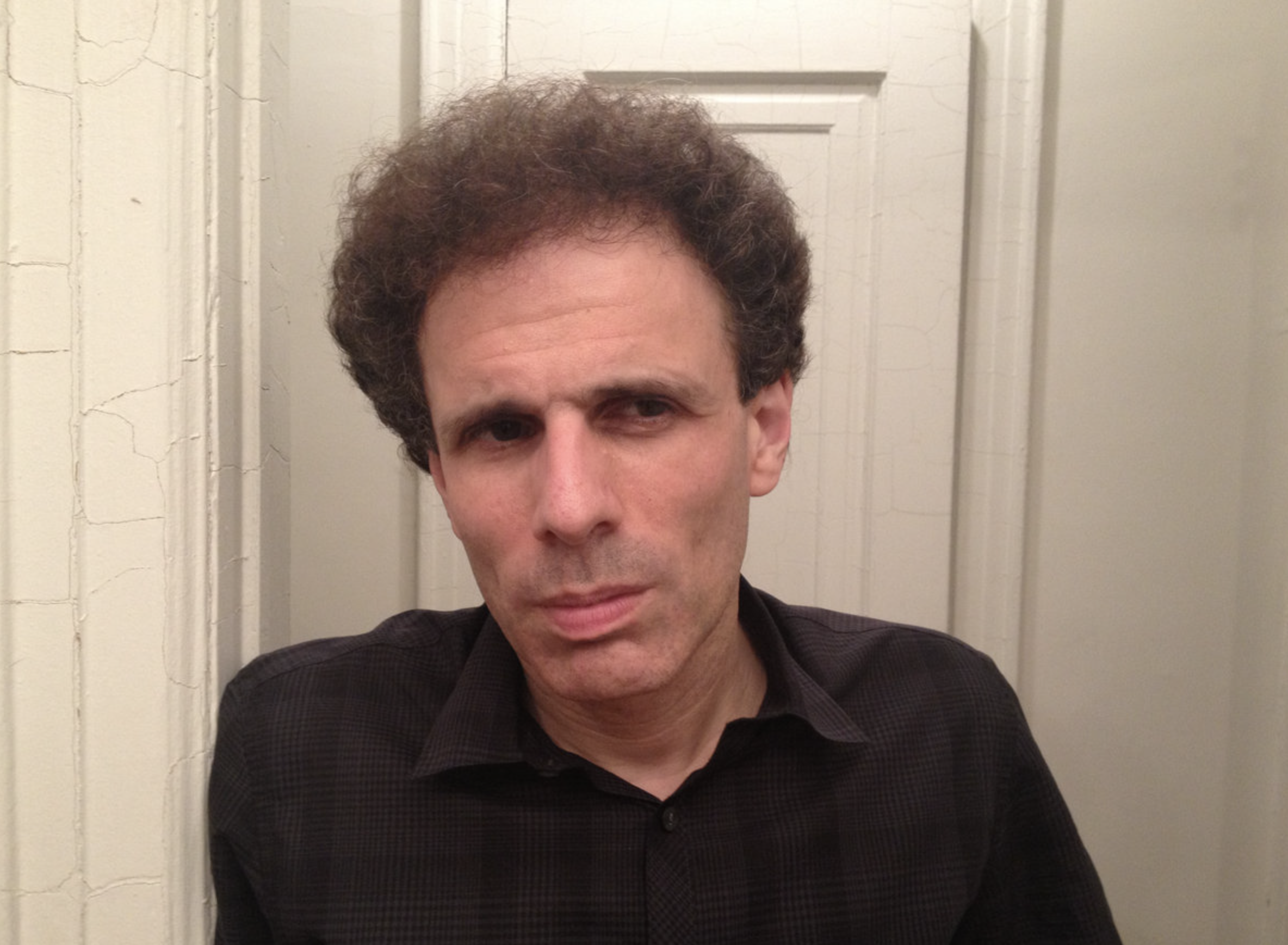
I had the excellent fortune of seeing Eytan Mirsky perform at the International Pop Overthrow festival when I performed there with DelCobras a little while back. The New Yorker’s sardonic sense of humor blends effortlessly with sharp lyrics and tight arrangements in a way that reminds me of some of my favorite British pub rock acts from the 1970s. Curious to learn more about the man and his music, I chatted with him briefly after his set and then dropped him a line with some questions…
Your Bandcamp bio mentions that listeners may be familiar with songs of yours that appear in the films Happiness, American Splendor, and The Tao of Steve. Which of your songs are in those movies, and how did their appearance on the soundtracks come about?
The song I had in the film “Happiness” was the title song “Happiness.” I went to grad film school at NYU with the director, Todd Solondz, and after graduation we had even written some film treatments together and also an entire script, which was a take-off on movies like “Die Hard.” He then had his first big success writing and directing “Welcome to the Dollhouse,” which won the Grand Jury Prize at Sundance in 1996. When he wrote the script for his next film, one of the main characters was Joy, an aspiring songwriter (eventually played by Jane Adams). I had put out my first album by then so Todd asked if I could write something for a scene in which Jane performs one of her songs. I gave him a few options and the one chosen was “Happiness.” Aside from the scene in which Jane sings it, the melody became her character’s motif in the score and was also performed by Michael Stipe and Rain Phoenix in a pop/rock version I produced for the tail credits.
Shortly after that, I was working as a sound editor — which is what I used to do — on a short film written and directed by Barry Strugatz, who wrote the script for “Married to the Mob.” I said to him that I could write a song and he would be free to use it or not. He ended up using the song, which was “(I Just Wanna Be) Your Steve McQueen” on the tail credits of his film (“The Transformation”), which was about a sad sack who kind of becomes possessed by the spirit of Steve McQueen and turns his life around. Amazingly, a few months later I was contacted by the producers of a film called “The Tao of Steve” whom I had given my music to. The film was about a guy who had a philosophy of picking up women by being a “Steve” — think the holy Trinity of Steve McQueen, Steve McGarrett and Steve Austin, the Six Million Dollar Man. They were looking for a song for the tail credits and had me watch the film — alongside another songwriter who was competing for the same gig. After the screening I told them, “You’re not going to believe this, but I have already written and recorded a song called “(I Just Wanna Be) Your Steve McQueen.” Initially the music supervisor didn’t have much of a reaction, but they ended up using my song at a crucial point in the body of the film. I then wrote another song called “The Tao of Steve (Isn’t It Time?),” which was used over the tail credits. Both of these songs were on the soundtrack album, which probably sold 10 copies before Milan Records went out of business!
As far as “American Splendor” goes, my friend Ann Goulder, who also cast “Happiness,” was the casting director and she called me to audition to play the lead role of Harvey Pekar. I read for the directors, who knew I had written songs for the other films. They asked me, “Are you an actor or a musician?” I said, “Whatever you got!” They asked if I could write a song for them, and even though I didn’t get the sense that they were really serious about it, I wrote one anyway and called it “American Splendor” (basing it on lines from the script). When the directors later explained that Paul Giamatti had beaten me out for the lead role (because HBO needed a “bigger name”) they added that they had decided to write me into the film singing my song on camera — if I could get myself to Cleveland (which I did).
Your songs strike a curious balance between humor and heartbreak. What makes those qualities travel well together, particularly in song?
A lot of my songs have a humorous take on things because that’s my outlook on life. I don’t think you can or should force something like that. I mean, if someone isn’t funny they probably shouldn’t try to be amusing in their songs. But I guess it’s like line in my song “Tell Me That You’re Foolin’: “…if I wasn’t busy laughing, I’d have to sit right down and cry.” Reviews have compared some of my songs to Larry David, Woody Allen, Seinfeld, etc. But really I like it if I can have a range of material. On my album “If Not Now…Later” I go directly from my song “Tithonus,” which was based on the Alfred Lord Tennyson interpretation of an ancient myth to the utter ridiculousness of “Lingerie Pillow Fight.”
I was listening to “I Bought Your Broken Teeth on Ebay” from your 1996 album Songs About Girls (And Other Painful Subjects) earlier, and I was struck by the way you rhymed “oral surgery” with “always count on me.” Are there elements of your songwriting that you pride yourself on—or maybe think of as unique to yourself and your worldview?
I gotta make something clear here before we give everybody the wrong impression. “Songs About Girls (And Other Painful Subjects)” was my first album. But I didn’t really know what I was doing then and got a lot better after that, both in the writing and the performing. So when I sold out all the cd’s I let that album go out of print. But if people insisted they had to have it, I would burn them a copy at home and photocopy the artwork, etc. In order to make it worthwhile I would load a bunch of extra unreleased stuff on there — even more than what is listed on Bandcamp. So I would give people 22 or so tracks instead of the original 10. The song you are asking about was just a goof. It was probably written around 2008 or so? I was doing a lot of musical guest slots on comedy shows and one of the hosts was Jena Friedman, who later made her name on The Daily Show, among other places. She had broken her teeth and sold them on eBay to pay for her oral surgery. So I bought them, wrote a song about it and performed it at her show. That’s one of the extra tracks I put on the homemade cd’s.
But to answer your question, I do think a lot of people appreciate my lyrics. And it’s not like I write flashy, overt lyrics, generally speaking. I write in a clear, conversational way, but with a degree of irony and deadpan humor. Whatever it is, people get a sense of my personality, which I don’t think is true of a lot of performers. The persona I create in my songs is pretty flexible, though. Sometimes it’s self-deprecating, sometimes pompous, self-deluding, etc.
How has your approach to making music changed since then?
I made my first album as an experiment really. I had wanted to write screenplays and make films. When I decided that that was unlikely to happen, I decided it was cheaper to make music. A friend of mine had a band and helped me record. That was a learning experience, and I could see I could make something a lot better. I could see what people liked about my songs and focused more on the lyrics. I also got some real top notch musicians involved, starting with guitarist Larry Saltzman, who went on to play with Paul Simon over the years. Larry also recommended Jon Gordon to me, and Jon (who was best known for playing lead guitar on Suzanne Vega’s “Luka”) ended up producing six of my albums before his death earlier this year. Jon was a great multi-instrumentalist, arranger, producer, etc.
Another song of yours that caught my ear was “Life of a Pretty Girl” from your 1999 album Get Ready for Eytan! That album has a strong power-pop feel that I associate with the 70s and 80s pub rock acts like Nick Lowe, Graham Parker, Elvis Costello, and Brinsley Schwarz. Who are some of your influences?
When I made “Get Ready for Eytan!” I was just barely even aware that there was such a thing called power pop, though after it was done I did get into that scene a made of bunch of fans and friends in that community. But you are definitely right that I probably fit in best with the pub rock acts you are describing, which I did listen to when I was a teenager. Another big influence for me was Jonathan Richman. I first saw him when I was 15 circa 1977 — yes, I know I look much younger, at least that’s what I hope you guys are saying! Also influential for me was Willy Deville from Mink Deville. So my song “My Dog Likes Your Dog” is the ultimate Eytan Mirsky song because it’s like a collaboration between Jonathan Richman and Willy Deville. But as the years have gone on I have gotten to incorporate a wide variety of influences: fifties and sixties rock and roll, soul, country, New Wave, even Tex-Mex.
Of course, the title of that album raises an important question: Is the world ready for Eytan?
I guess not! Unfortunately most people will never hear of me! But I can’t complain too much since I’ve had more exposure than most people in my situation get. I even had a guy recognize me in the street a few weeks back from my songs in “The Tao of Steve.” Sometimes people recognize my name from the film songs. And recently indie rock phenom MJ Lenderman also covered my song “Happiness” and I got to meet him backstage at his show in Brooklyn.
More recently, the ad-lib at the end of “Apologize in Advance” from your 2025 album All Over the Map is very funny. Did you make it up on the spot, or was that planned out?
Oh, great, glad you enjoyed that! On this most recent album I co-wrote a few songs, which is a new experience for me. So that song was written with my friend John Carbonara. As we were writing he suggested doing an outro like the one in “Pretty Woman” by Roy Orbison. I can’t remember exactly what he meant or how specific he got about it. But then I guess i just experimented with it. I guess I improvised until I found something we liked. I didn’t make it up the day of the final vocal recording though. The thing I like about it is that it’s like a reversal of “Pretty Woman.” In that case, the woman comes back to the protagonist; here she keeps on going…and going.
What keeps you going in terms of making music?
I really just keep going with it because I enjoy it. I really do entertain myself with what I do and I like feelling that I am improving at it. But it’s also kind of an addicdtion in a way because I feel like I have to keep doing it to prove that I’m still creative. Of course, I also have to admit that it is a good feeling when people tell me that they really love what I do.
What’s on the horizon for you?
Not sure — hopefully I get some more ideas. As I mentioned, my producer died earlier this year so it will be interesting to see what kind of new system of recording I can develop in the future.
8 responses to “That’s My Outlook on Life: A Conversation with Eytan Mirsky”
What an interesting and funny guy! He’s a great songwriter with quite an imagination and a pretty healthy outlook on life.
Definitely! I’m glad I got a chance to see him play live!
What a cool interview. eBay teeth, indie film, mentions of Willy Deville & Jonathan Richman – that’s pretty wide-ranging!
Right? All in one interview!
I’ve sampled some of the tracks on “All Over the Map” and love what I’ve heard thus far. I had never heard of Eytan Mirsky before. Intriguing artist!
Quite intriguing, indeed! Great songwriting skills, and an interesting career!
He’s prolific on YouTube with some great and unexpected covers as well.
Good to know!