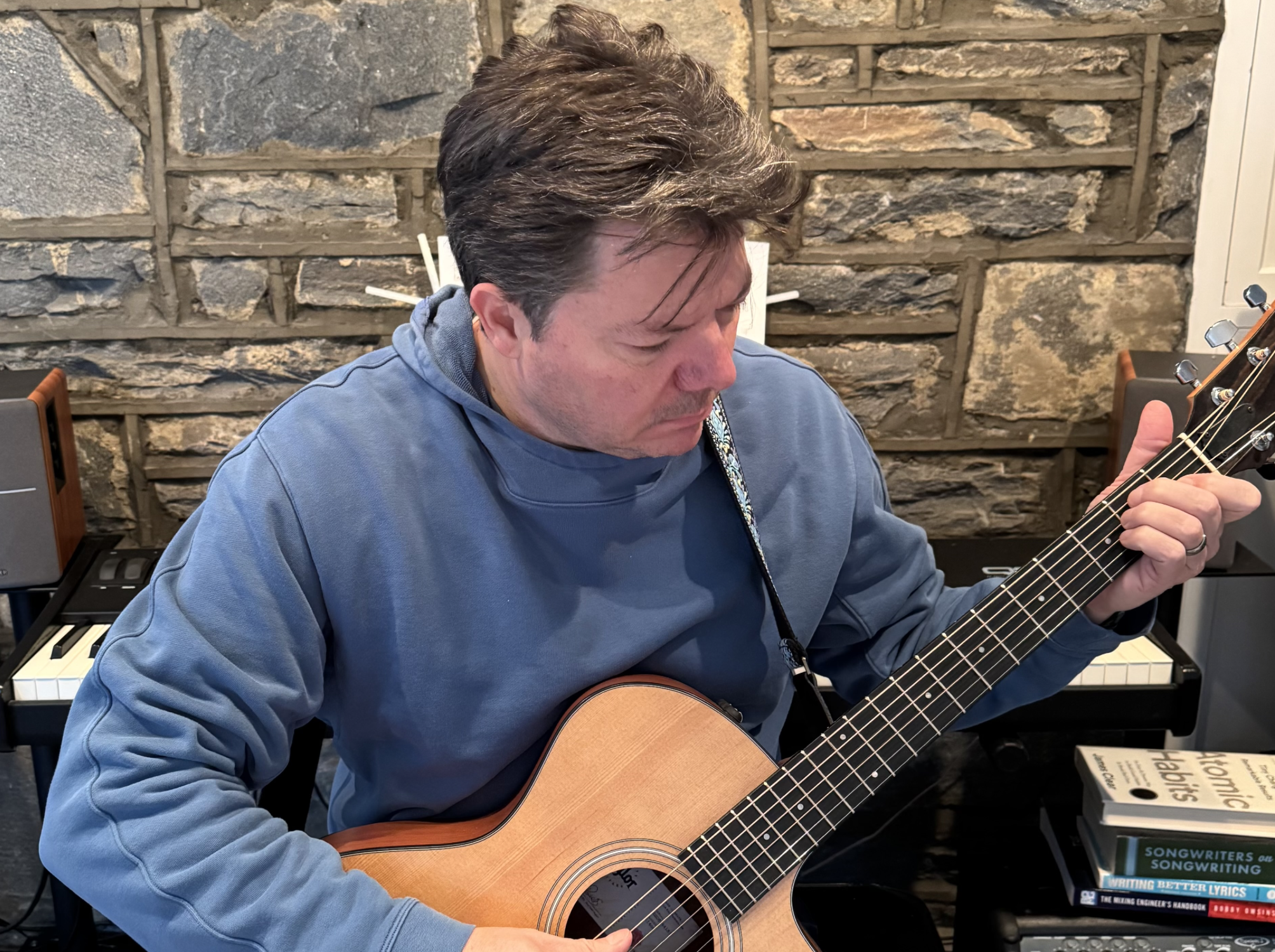
I met the artist known as Midwinter Mason a few weeks back when he introduced himself to me at a show featuring Faint Halos and The Brett Tobias Set. We chatted a bit about music and the local scene, and it turns out that he’s not only a fan of DelCobras (always a sign of good taste!), but he’s also a musician himself. Intrigued, I checked out his tunes online and was immediately impressed with his organic blend of folk and Americana that calls to mind The National, Phoebe Bridgers, Radiohead and Lana Del Rey. To find out more, I dropped him a line with a few questions…
I love the alliteration of Midwinter Mason. What does the name mean to you, and what does it say about your music?
I like the alliteration as well. I was getting ready to release my first song and I needed a name. My given name is a little too common, so I felt I needed something different. I went to one of these band name generation sites and all of the names were either horrible, or taken, or both but it did suggest Midwinter which I liked. I added Mason which appealed to me in that it could be a male first name but is also a tradesperson. I like the idea of crafting something, likely alone, in the cold of winter. Maybe we all just want to be Justin Vernon of Bon Iver in his cabin writing For Emma.
You and I met at a local show featuring the Bret Tobias Set, Faint Halos, and Koser, and the next night you were heading out to see Jesse Gimbel. Why do you think it’s important to see local indie acts in person?
So much of the work of making music, at least for me, is solitary and it’s easy to get lost in the details of writing, recording, and mixing. Seeing artists live reminds me of how music connects with people and the importance of that. I almost always come away inspired after seeing a live show. A part of that is that I have a deep appreciation for anyone else writing, releasing, and performing their own stuff. It is hard and I want to support as many people as I can.
When we met, I think you mentioned that you were retired from a career in the tech industry. I’m struck by the fact that your music runs in the opposite direction in that it’s very earthy and organic. Was that a conscious decision?
I worked managing software teams for over a decade and was between tech jobs about 4 years ago and when I started to work on music more seriously after dabbling for a long time. When I started working on software again, all I wanted to do was go back to music, so when that consulting engagement ended, I decided to do music full time. I would say my sound is more a reflection of my own taste than a response to working in tech. My father and my daughter both really like America’s Ventura Highway so I hear the Folk-Americana sound as being kind of timeless and having a place across generations. I try to release songs together that support a cohesive sound and Nebraska was the one song I knew would be on this release when I started planning it. It really set the tone for what else was included and how it was produced.
I’m listening to your song “Nebraska” as I type these questions and am struck by its lyricism. I’m also thinking of Bruce Springsteen’s album of the same name. Is he an influence?
I think if I was more familiar with his work, I would have been afraid to write a song with the same name. I woke up one morning with the verse melody of that song in my head and the word Nebraska immediately stuck to the last three notes. I worked around that to craft the rest of the song. I participate in these songwriting sprints online from howtowritesongs.org where you get a prompt every two weeks and the prompt that had just come out asked us to pick a fable for inspiration. I used Hans Christian Anderson’s The Little Match Girl and was also inspired by the Lucy Gray Baird character from Susan Collins’ Hunger Games prequel, The Ballad of Songbirds and Snakes. The lyrics originally included the rhyme Alaska which my fellow sprint member, Darlene, thankfully pushed me to change.
You describe your sound as, among other things, “dark.” Where does the darkness come from? How do you balance it out?
I wrote that in my bio when I was putting together my first EP, Love Lost Love, which includes a song about alcoholism and another about illness and death. I thought, this is a bit dark. Some of that comes from the music that inspires me which explores life’s often self-inflicted misery; acts like The National, Death Cab For Cutie, Bright Eyes, and Elliott Smith. I also think some of it comes with age as your limits come into focus. I can no longer hear anything above 15K so it’s dangerous to make a mix too bright. The new EP is less dark and the most consistent theme is redemption. But I guess you can’t seek the light if you haven’t been in some dark places.
Your EP Old Man’s Country includes a collaboration with Louise Danielsson titled “Broken Parts.” How did that collaboration come about?
Louise is a university researcher who lives in Sweden and also writes and performs songs in the songwriting group that I am in. She is inspired by Emmylou Harris and Lucinda Williams and when I saw her perform, I thought she would be great for this song which leans more towards a traditional country song. She was great to work with and very patient with the process which included her recording herself, a key change and the re-tracking that it required, sending multiple takes and harmonies, and being willing to adjust her performance to fit better with the limits of my voice. I hadn’t produced a duet before and my production mentor, Seth Goodwin aka Velvet Year, emphasized the goal of making it sound like it was recorded at the same time on a single microphone which really wasn’t practical. Fortunately, Louise and I (along with so many others starting out in home recording) both own a Rode NT1A. While not my favorite microphone, we made it work and I’m thankful for her collaboration.
Do you record at home or in a studio? What’s your approach to recording?
I record at home in my sunroom. Since it used to be a porch, it is reasonably sound isolated from the rest of the house. Less so from the outside and leaf blowers and tree work are the bane of my existence. It’s amazing what you can affordably do at home these days and there is so much information online. Even so, I find I have to be very structured in my creation process with an emphasis on minimizing options so that I don’t get completely overwhelmed. I typically write with just piano or guitar and only try to arrange when the song is mostly done. I initially arrange with MIDI instruments and then record those parts knowing how they should come together. My setup is simple with electric guitars and bass recorded as DIs and I own a couple of microphones for acoustic guitars and vocals. I see a lot of people online who do everything at the same time and mix as-they-go and that seems insane to me. I’m sure my process will evolve but an advantage, I think, to this approach is that I have fewer expectations that the next stage in the process will fix anything. The song needs to work without the production, the recordings need to work without mixing, etc. When I do get overwhelmed, I try to remind myself that this is a work in progress and think of this song as a snapshot of where I am at this moment in that journey. Like any good old photograph there are likely to be some odd outfits and hairdos.
Do you ever get a chance to play live?
Playing live is also a work in progress. I’m doing open mics in my area at present and make a point to go to the one at The Fallser Club in the East Falls area of Philadelphia. The host, Jeff Alexander, is really great and the vibe is relaxed and encouraging. Given how I write, I think most of my stuff works solo even if it isn’t produced that way. I hope to play longer sets in the future and I still have plenty of room for improvement with the 2-3 songs an open mic slot provides.
What’s on the horizon for you?
I just released a Christmas song that I reluctantly wrote last year in song group. It unexpectedly turned out well and my sister really liked it and pushed me to release it. Longer term, I want to continue to hone my craft, play a little better, sing a little better. I’m also exploring making videos as I really enjoy seeing others’ creative process and I might have something to offer there. Video, like music, is another mountain-sized set of skills to try and not be horrible at and I’m still in the being-pretty-bad-at-it stage. For now, I’m writing a song every two weeks and trying to catch one that can be the nucleus of my next release. I wrote something recently where the goal was to provide a replacement for Springsteen’s Devils & Dust track in a post-production film. It turned out decent so maybe there is still hope for inspiration from the Boss for me.
4 responses to “I Want to Continue to Hone My Craft: A Conversation with Midwinter Mason”
You are an interview beast, Marc! Your productivity never ceases to astound me.
Thanks, Jeff… I guess I have been a little busy as far as the interviews go!
I have to second Jeff here, Marc. The frequency of your interviews of other music artists is really impressive!
Thomas Morton seems to be a pleasant guy. Based on “Nebraska” and sampling a few other songs, I also like his music. I think it’s very smart to go to many gigs by fellow music artists, especially if you predominantly work by yourself like Thomas. I can totally see how that can be a helpful source of inspiration.
I’m really glad he and I bumped into each other at that show!